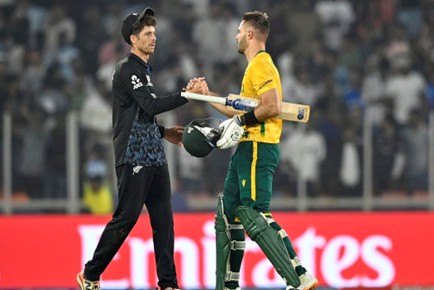

South Africa is on the verge of achieving victory in the Twenty20 World Cup’s Super 8 stage after Captain Aiden Markram’s storming half-century led them to a dominant seven-wicket win over New Zealand in Ahmedabad, India. This was New Zealand’s first loss of the campaign after they posted 175–7, as South Africa’s Marco Jansen took four wickets.

In response, opener Markram hit four sixes and eight boundaries in his unbeaten knock of 86 off 44 balls, the highest by a South African captain in the tournament’s history, helping his team reach 178-3 with 17 balls to spare. After losing the toss, the Blackcaps found themselves batting first, and they found the going tough, as player of the match Jansen (4-40) dismissed most of the top order by the seventh over. Finn Allen (31 off 17 balls) tried to mitigate the damage after Tim Seifert and Rachin Ravindra fell to Jansen. But Jansen got Allen caught at mid-off in the sixth over, leaving New Zealand struggling at 58-3. Mark Chapman (48) and Daryl Mitchell (32) turned things around with a 74-run partnership for the fifth wicket, until Jansen got Chapman caught by Ryan Rickelton at backward point in the 14th.
New Zealand scored only 17 runs in the next four overs, until James Neesham’s unbeaten 23 off 15 balls got them to a fighting total.

If rugby is considered the toughest sport, cricket can be seen as the most ruthless. To score four sixes (over the boundary) and eight boundaries (within the boundary) requires exceptional skill and training. The achievement was even more impressive given that both the Proteas and the Blackcaps (New Zealanders) are among the most talented teams in cricket. Both sides gave their best efforts in the match; however, luck was not on New Zealand’s side. Their loss came as they were caught off guard. Seifert and Ravindra would have had a tough time bowling past Jansen, who stood as the vanguard of batting. There was no room for an easy win for the New Zealanders. In a professional sense, the Proteas proved to be the ruthless team. New Zealand bowler Allen also struggled heavily in the match. There was no chance of a tie—South Africa was taking home the glory, though the New Zealanders were gracious in defeat.
This was a match that kept spectators glued to their seats, watching with intensity. Both teams braced for a performance that sent a wave of ecstasy across the stadium, with the crowd in uproar.

A crowd in excess of 50,000 – the highest for this World Cup – watched South Africa power its way to a win against the Black Caps with relative ease. Put into bat, Jansen struck against the in-form top order. He had Tim Seifert caught behind for 13, while also accounting for Rachin Ravindra (13) and Finn Allen (31) in the space of four deliveries. When Keshav Maharaj bowled Glenn Phillips for 1, New Zealand was down to 64-4 in 6.4 overs. It recovered thanks to 74 off 44 balls between Daryl Mitchell and Mark Chapman, who top-scored with 48 off 26 balls. Mitchell scored 32 off 24 balls. Jansen again provided the breakthrough as Chapman was out caught in the 14th over. New Zealand struggled to cross 180 thereafter, losing three wickets in 17 balls. New Zealand scored only 17 runs in the next four overs, until James Neesham’s unbeaten 23 off 15 balls got them to a fighting total.
But Markram set a hectic pace, smashing 50 off only 19 balls – the quickest for South Africa in tournament history.
The Twenty20 World Cup is one of the most gruelling and intense tournaments in the world of cricket. To bowl, bat, or score a run or wicket requires the right talent to perform professionally on the pitch. Professional cricket is a game where both teams must be trained to the maximum, depending on who will ultimately prevail. The match between the Proteas and the Blackcaps is an example of the pressure faced by both sides and how one must outmanoeuvre the other. The players on both teams were highly talented and kept spectators’ eyes fixed on the pitch. Mitchell, Chapman, Allen, and Seifert are all skilled bowlers, but the South Africans proved to be the cream of the crop. In the end, fortune was not on the side of the Blackcaps, and the Proteas showed they could stand their ground.
The Proteas remain in the tournament, though whether they can continue the winning streak they are known for remains to be seen. In the end, there can only be room for one winner.
Article written by:
Yacoob Cassim
Journalist at Radio Al Ansaar