
Al Ansaar News – Article Roundup
Date: 13 June 2025
Location: Pietermaritzburg, South Africa
Vodacom Invests R100 Million in Rural KZN
Vodacom has pledged R100 million to expand mobile network coverage in some of KwaZulu-Natal’s most underserved areas. The initiative, part of the company’s Rural Coverage Acceleration Programme, aims to build 106 new mobile base stations across districts such as uMkhanyakude, Zululand, Harry Gwala, and parts of uThukela.
The rollout will dramatically improve 4G and 3G connectivity in communities that have previously struggled with limited or no signal. Vodacom says the expansion is not only about connectivity, but about enabling digital inclusion, boosting local economies, and providing essential access to digital education, mobile healthcare, and financial services.
The project is expected to create temporary jobs during construction, and long-term socio-economic benefits once operational. Civil society leaders and rural development advocates have praised the move as a step toward bridging the country’s digital divide.
SADTU Declares KZN Education Department in Collapse
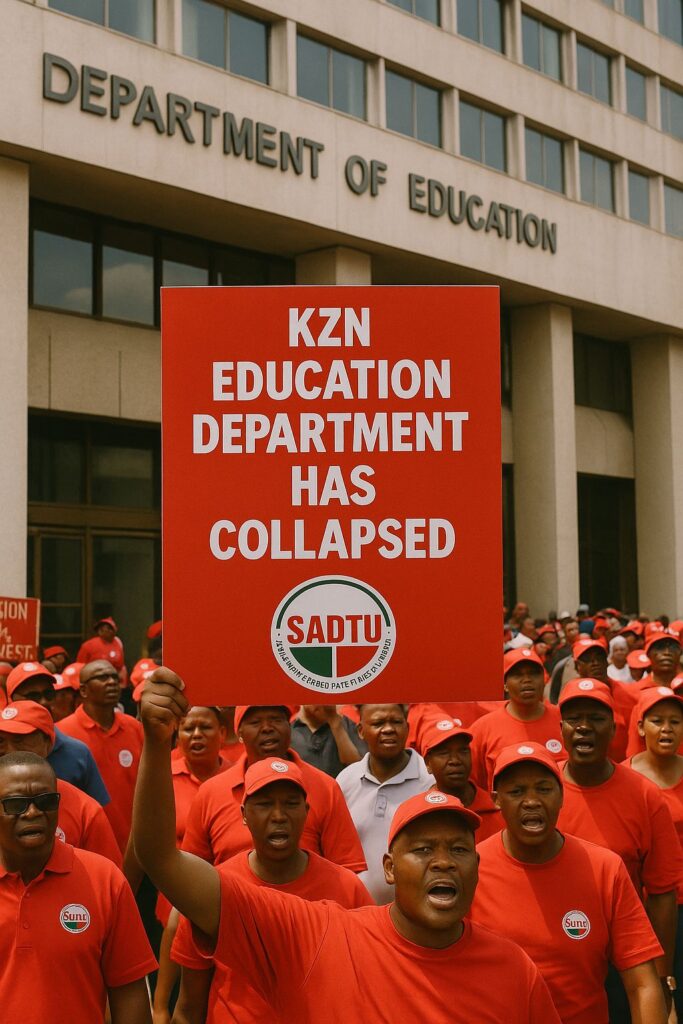
The South African Democratic Teachers’ Union (SADTU) has publicly declared that the KwaZulu-Natal Department of Education is in a state of collapse. The union pointed to multiple crises including the non-payment of service providers, delayed salary adjustments, and a lack of critical learning materials in many public schools.
SADTU has accused the department of failing to meet its obligations under both provincial and national education mandates. In response, it has instructed members to limit their duties strictly to classroom teaching—halting their involvement in administrative support, after-school programs, and exam preparations.
Parents and school governing bodies across the province have echoed frustrations, particularly in rural areas where schools are already under-resourced. SADTU has called for urgent intervention from both the provincial government and the national Department of Basic Education to prevent a total shutdown of the system.
Israel Strikes Iran’s Nuclear and Military Sites
Tensions in the Middle East escalated sharply on 13 June after Israel launched “Operation Rising Lion,” a large-scale aerial assault on Iran. More than 200 Israeli fighter jets reportedly struck over 100 targets, including the Natanz nuclear enrichment site, ballistic missile factories, and command centres belonging to Iran’s Revolutionary Guard.
Iran confirmed casualties among military personnel and scientists, while international media have reported widespread damage across multiple provinces. In retaliation, Iran launched over 100 drones toward Israeli territory, some of which were intercepted by missile defense systems.
This marks one of the most direct and expansive military confrontations between the two countries to date. World powers, including the United States and European Union, have called for immediate de-escalation. Oil prices surged and global markets responded with alarm amid fears of broader conflict in the region.
Global Markets Hit Amid Middle East Tensions
Stock markets across the world experienced sharp declines following Israel’s strikes on Iran. The conflict, which threatens to disrupt major oil supply routes and regional stability, caused widespread investor uncertainty.
Asian markets fell between 1.5% and 2%, while European bourses opened sharply lower. In the U.S., futures on major indices like the S&P 500 and Nasdaq also dropped significantly. Brent crude oil jumped more than 9%, briefly breaching the USD 75 per barrel mark, as investors feared supply chain disruptions through the Strait of Hormuz.
Gold surged to a six-month high as investors sought safer assets, and U.S. Treasury yields dipped. Analysts warn that continued escalation could undermine global economic recovery efforts, especially in energy-dependent and import-driven economies. Central banks may face renewed pressure to reassess interest rate policies amid geopolitical volatility.
U.S. Pushes for Peace Deal Between Rwanda and the DRC
In a renewed diplomatic push, the United States has committed to brokering a peace agreement between Rwanda and the Democratic Republic of Congo (DRC) by mid-2025. The initiative comes amid intensifying conflict in eastern DRC, where the M23 rebel group has been accused of attacks on civilians and government positions.
U.S. special envoys have been shuttling between Kigali, Kinshasa, and Doha to mediate the process. The proposed framework includes demobilization of rebel groups, regional security guarantees, and economic cooperation between the two nations.
While both governments have expressed a willingness to engage, past ceasefire violations and mutual distrust remain major obstacles. The U.S. says the success of the deal will rely on sustained international pressure and the establishment of robust monitoring mechanisms. Humanitarian agencies have also urged negotiators to include protections for civilians, especially displaced populations in North Kivu.
Today’s Exchange Rates – 13 June 2025
1 US Dollar = R17.96
1 Euro = R20.83
1 British Pound = R24.31
Article written by:
Hudaa Ahmed
Journalist at Radio Al Ansaar