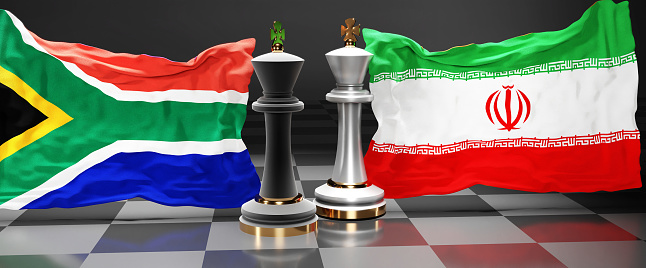

The conflict between the United States and Israel versus Iran escalated after U.S. attacks on Saturday, 28 February, which resulted in the death of the Iranian Supreme Leader and his family. This has created heightened uncertainty in South Africa on multiple fronts. The country is now grappling with higher fuel prices due to shocks in global oil markets, leading to inflation and raising concerns about future interest rate risks.

Politically, South Africa’s ties to Iran may also place the country under scrutiny, with trade tensions elevated, and second-round blowback possibly hitting corporate SA. International relations experts warn that South Africans may soon feel the impact of the US-Iran conflict through surging fuel and food prices as US and Israeli air strikes on Iran continue. In addition, University of Johannesburg (UJ) economist Dr Ntokozo Nzimande said the Israel-Iran conflict could adversely affect South Africa’s economy, potentially leading the government to halt interest rate reductions and causing transport and food costs to rise. Historically, inflation in the country has been significantly affected by changes in exchange rates and international commodity prices, particularly oil prices.
The South African Reserve Bank (SARB) last changed interest rates in November 2025, with the current prime lending rate at 10.25% and the repo rate at 6.75%. This followed a sequence of rate reductions in 2024 and 2025.

South Africa may have to turn to alternative markets for oil. In the context of integrating an African common market, the country may need to consider importing oil from petroleum-producing African nations such as Nigeria, Equatorial Guinea, Gabon, and Algeria. This transition is underway but could take time. Another option would be for Pretoria—specifically the Department of International Relations and Cooperation (DIRC)—to engage in mediation efforts between Tehran and Washington. However, relations between South Africa and the United States are strained, and President Donald Trump appears more interested in economically weakening South Africa than in listening to President Cyril Ramaphosa’s advice. If South Africa continues to maintain diplomatic relations with Iran, Trump could impose tariffs on the country.
Food prices are also expected to rise, as farming produce and canned goods must be transported to markets in surrounding rural and urban areas. Since transport depends on fuel, higher fuel costs will directly drive-up food prices.
Nzimande says, “You will know that the Central Bank has been on the campaign to reduce the interest rate and if prices do go up as we expect then what will happen is that this process of cutting the interest rates will be halted or the central bank may increase the interest rate in response, which will in turn affect the South African economy, the cost of borrowing will be high and it will prolong the financial pressure on the households and small businesses.” He says the South African tourism sector will be greatly impacted by the closure of the airspace in some Middle Eastern countries due to this conflict. Nzimande says, “This will affect the tourism sector, we know that the tourism sector contributes roughly 7% of the country’s GDP and it supports employment, particularly among the youth and the small businesses and more especially the unskilled workers.”
“So what we have heard is that the airspace in some countries in the Middle East has been closed and if this expands to the rest of the Middle East, flight routes will become longer and more expensive, and the airline cost will increase, and it will increase what we call the travel uncertainty so that will affect the GDP through the tourism sector,” he adds. Aviation expert Guy Leitch says it is not possible to estimate how long the current air travel disruptions could last.
South Africa has been placed in a precarious position by the war that President Trump and Israeli Prime Minister Benjamin Netanyahu are waging in Iran. The country may struggle to borrow money if tax duties are imposed on goods exported to the United States. The aviation and tourism industries will be deeply affected by the conflict. Flights from South Africa to Dubai and back, may become a thing of the past, while tourism from Europe, Asia, and the Americas could disappear for a time. The result will be widespread destitution and loss of income for the self‑employed. Alongside its African allies, South Africa will need to accelerate the implementation of the African Continental Free Trade Area (AfCFTA) in the long term. Pretoria must firmly anchor its position within the southern African region and across the continent. There is no simple solution or clear path forward—President Ramaphosa and the Government of National Unity must tread carefully.
This war is likely to last for years unless Trump, and to a lesser extent Netanyahu, are persuaded to change course. The aviation industry may have to give way to railway development across Africa. Not everyone is pleased about the long‑term effects the U.S.–Israeli–Iranian war will have on South Africa’s trade and industry. Both the state and the private sector will need to cooperate in finding solutions to cushion self‑employed traders and small businesses from complete collapse. This will be a slow and complex journey, marked by many twists and turns.
Article written by:
Yacoob Cassim
Journalist at Radio Al Ansaar