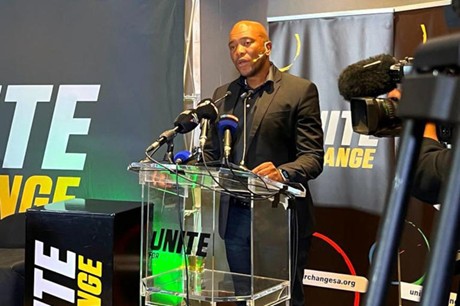

Three minority parties – one in opposition and the other two in the Government of National Unity (GNU) – Build One South Africa (BOSA), the Good Party and Rise Mzansi have agreed to formally merge. The name of the new political formation is Unite for Change. They will run in the 2026 Municipal elections under this new brand when they make their official entry. Bosa leader Mmusi Maimane in particular who is the face of the merger has stated before concerning his ambitions that he is ready to be president. Reaffirming his ambitions for national leadership.
Unite for Change has outlined five core priorities as the backbone of its political programme:
- Capable and ethical leadership
- Local economic recovery
- Dignity through basic services
- Safety and justice
- Digitisation to drive smart governance and combat corruption
The new movement is set to launch a nationwide tour of town hall meetings and community dialogues this month. According to party spokespeople, this consultative process aims to shape policy through grassroots engagement, prioritising community voices over top-down party directives. The formation of Unite for Change marks a critical moment as disillusionment with traditional parties continues to grow. With local government elections less than a year away, the new party could recalibrate the political landscape, especially in urban centres where voter turnout has declined and service delivery frustrations have mounted.
Analysts suggest that while the alliance faces significant challenges – including building organisational capacity and gaining national traction – its unified front and shared leadership could resonate with voters seeking a fresh political alternative.

The new political party has put forward an impressive platform of their key priorities. More details will be revealed when they unveil their election manifesto after they have registered at the South African Independent Electoral Commission (IEC). It is also good that Maimane and his partners in the merger Songezo Zibi (Rise Mzansi) and Patricia De Lille (Good Party) will be going to the community to explain their merger and put forward their goals. This is in terms of the nation-wide municipal town hall meetings and dialogues with various communities. However, if this merger trio is to pull through and prove themselves a formidable political force then they need to offer a tangible different alternative to the African National Congress (ANC), Democratic Alliance (DA), Economic Freedom fighters (EFF), and the Umkhonto We Sizwe (MK) party.
Unite for Change could offer help to end the status quo of the major parties in parliament. However, they need to create a grassroots movement among South African communities and civil society. They have presented their ideology as “centrism” like that of French President Emmanuel Macron.
Meanwhile President Cyril Ramaphosa has heralded a return to profitability for national power utility company Eskom.

President Cyril Ramaphosa says Eskom’s return to profitability for the first time in eight years is a clear sign that South Africa’s efforts to stabilise the power utility and end the electricity crisis are beginning to yield results. In his weekly letter to the nation, Ramaphosa said the improved financial position at Eskom was the result of “staying the course” on reforms and investing in long-term solutions, even when under pressure. “When we announced the National Energy Action Plan in 2022, the national power utility’s losses stood at R12.3 billion and its debt had ballooned to over R300 billion,” Ramaphosa said. “At the time, Eskom’s auditors noted that there was ‘material uncertainty relating to Eskom’s ability to continue.’”
Ramaphosa said the turnaround was largely due to increased collaboration between government departments, the work of the National Electricity Crisis Committee (NECOM), and “the hard work by the leadership and staff of Eskom”.
President Ramaphosa still has a lot of work to do in terms of repairing both the damage corruption had let wrought in the state-owned enterprises (SOEs) and the trust ordinary South Africans have in said SOEs. Ramaphosa must continue with his plan to decentralize the State’s (Pretoria’s) monopoly on resources for public services remains crucial. There is always more that needs to be done in terms of having transparency, accountability and impartial oversight. The President also needs to clarify what long term solutions he has in mind for Eskom and the Energy Crisis that has not been fully resolved. Engaging civil society, the electorate and the private sector in this regard should be paramount. As should be a transition to clean, sustainable energy such as solar and wind.
As regards to Unite for Change Party, they need to build their brand and create a relevant platform that will resonate with the South African people. That is if they truly want to expand their electoral base and attract voters, they have to determine what goals and what future they want. The local elections next year will be their first real challenge to determine Unite for Change’s relevance.
Article written by:
Yacoob Cassim
Journalist at Radio Al Ansaar