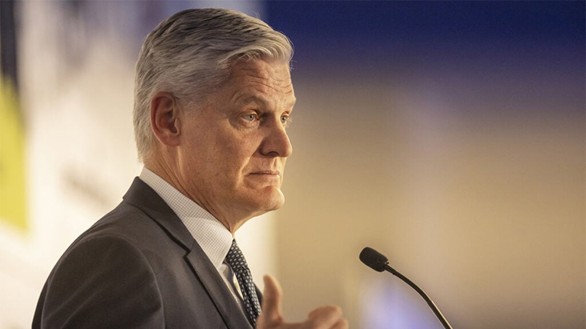

Former Eskom CEO Andre De Ruyter has warned that South Africa is on the verge of collapse if President Cyril Ramaphosa and the government of National Unity (GNU) doesn’t make decisions to restore confidence and take action against the nation’s decline. His grim portrayal shows the nation to be balancing on a very high tight rope. De Ruyter was speaking at the second BizNews Investment Conference held in Hermanus, where he conveyed his message. He said it was up to President Ramaphosa to show bold leadership and choice growth.

De Ruyter outlined what he called his “fantasy SONA”, which included the kind of reforms Ramaphosa could announce to restore confidence. He called for a new, means-tested empowerment system targeted at the poorest South Africans, rather than politically connected elites. “Instead of the largesse doled out in BEE deals, let’s address inequality through economic empowerment of those who need it most. The vast majority of beneficiaries will be black anyway, but without racialising the policy,” he said. He urged the creation of a new anti-corruption body to replace the Scorpions, a moratorium on equity deal requirements for new investments, and firm commitments to fiscal prudence, zero-based budgeting, and an independent Reserve Bank. “Cut the size of the cabinet, and deregulate and stop state-owned enterprises from crowding out the private sector with government-guaranteed funds. State entrepreneurship has reached the end of the road,” he added.
On foreign policy, he said South Africa needed to distance itself from America’s adversaries and recommit to property rights and due process in land reform.

The reforms De Ruyter is proposing can only be achieved if Ramaphosa, his advisors and the GNU cabinet fully embrace transparency and accountability as enshrined in the constitution. This would require a significantly huge and strategic overhaul of the political landscape. The so called Black Economic Empowerment (BEE) policy needs to be severely limited or abolished altogether. This should be done given its limited scope. The African National Congress (ANC) should examine basic reality and enable the economic empowerment of those most destitute through the right form of education. De Ruyter is right to point out that bulk of the beneficiaries of such policies will be the indigenous populace. The establishment and formation of a new anti-corruption body will require the participation of civil society members and judges and lawyers whose legal expertise would be invaluable. The nation’s best legal minds.
The scorpions and the Hawks have had their day. Decentralization of significant domestic power from Pretoria to the provinces and the reduction of cabinet posts could lead to government interaction with the people at all three levels on an equal footing. Government is already paving the way for privatisation of SOEs.
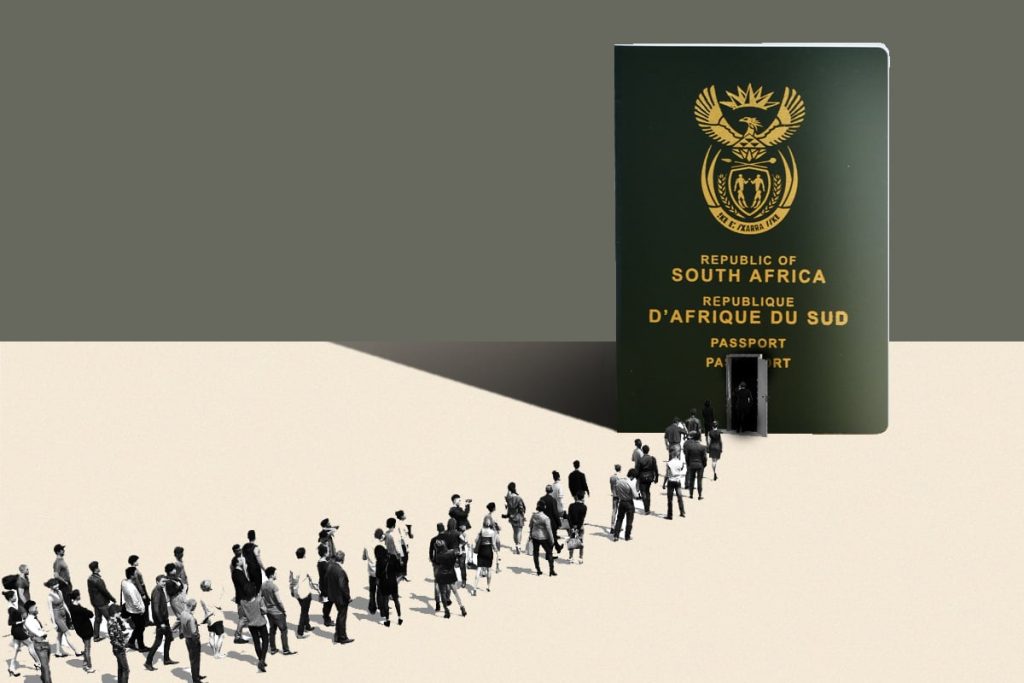
Meanwhile the Home Affairs Department has created a new visa system that you can apply for online.

Minister of Home Affairs Dr Leon Schreiber today unveiled South Africa’s new Electronic Travel Authorisation (ETA) at the Tourism Business Council of South Africa’s Leadership Conference. The ETA marks a major step in the Department of Home Affairs’ mission to deliver Home Affairs @ Home through digital transformation. Powered by advanced machine learning, the system essentially replaces outdated, paper-based visa processes with a fast, secure, and fully digital platform.
With the ETA, visa applicants can:
- Apply online.
- Capture and submit biometrics.
- Receive approvals in real time.
The platform is integrated with Electronic Movement Control System 2.0 (EMCS 2.0), which uses facial recognition technology at ports of entry. Starting at OR Tambo and Cape Town International Airports, the system will speed up arrivals through automated biometric checks, reducing queues while strengthening border security.
The new Visa application can be applied through on your mobile devices such as cell phones or laptops. Schreiber has made the new Electronic Travel Authorisation (ETA) official and its purpose needs to be brought into focus. This is Fourth Industrial Revolution (4IR) and Artificial Intelligence (AI) at its finest. Machine learning and facial recognition technology will now be used in full swing at all South African airports including King Shaka International Airport. The question remains, how safe is this new technology going to be? When we are talking about automated biometric checks, we are referring to registering your facial recognition. This begs another question; how far can the government go with this technology? Can it be used to keep tabs on citizens? This ETA may be a way to streamline government bureaucracy and make security more efficient but at what cost? What extent will government take this new technology?
Who knows how Ramaphosa and his ministers will solve the country’s problems? But the progress of new technology should always be watched.
Article written by:
Yacoob Cassim
Journalist at Radio Al Ansaar