
In a special military operation on January 3 2026 Washington codenamed “Absolute Resolve”, the US launched air strikes across northern Venezuela, including the capital Caracas. This was followed by the capture of Venezuelan President Nicholas Maduro and his wife Cilia Flores by American Commandos. The capture of the Venezuelan President and his spouse by American forces has sparked widespread condemnation and shock from the rest of the world. South African Minister of International Relations and Cooperation Ronald Lamola speaking at the United Nations Head Quarters in New York ahead of a UN Security Council meeting on Maduro and his wife’s capture stated that the world cannot afford to slide back to a post- World War One order with no rules.
The Venezuelan First couple are being held at the Metropolitan Detention Centre in New York and appeared in court yesterday on the Fifth of January Monday.

Leftist strongman Maduro, 63, faces narcotrafficking charges along with his wife, Cilia Flores, who was forcibly taken out of Caracas in the US assault Saturday, which involved commandos, bombing by jet planes, and a massive naval force. President Donald Trump said the United States will run Venezuela until what he calls a proper transition of power, raising serious questions about international law. South Africa has labelled the military raid a violation of the United Nations Charter. Lamola said South Africa is expecting a progressive Security Council meeting on Monday. “ The fact that this issue will be ventilated at the UN Security Council (means that) the whole world will know what happened, how it happened, and this will enable the people of the world to act in unison and in solidarity because they’ll now know the facts.

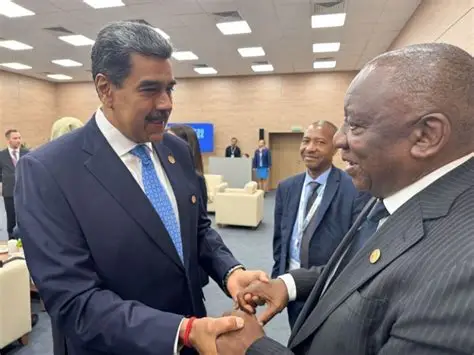
In a world order where transparency and accountability are becoming elusive the Trump Administration’s unilateral actions will face severe diplomatic backlash. Pretoria is a close ally of the Venezuela first under the late Hugo Chavez and now his successor Maduro. Venezuela is a member state of the BRICS Plus group of nations and the reaction from the other member states such as the powers in Brasilia, Moscow, New Delhi, Beijing, Addis Ababa etc will be one of initial shock but then possibly division. A diplomatic taboo has been broken. More details will emerge from the response given by the Security Council following their meeting. This will depend on what “progress” was made. Lamola and the leadership of President Cyril Ramaphosa’s government clearly want transparency on the details of Absolute Resolve and who assumes leadership in Caracas. No ally of Venezuela will accept direct rule from Washington.

If “narco-terrorism” justifies action in Venezuela, what’s to stop it being used against African nations that challenge U.S. interests? South Africa’s position on Gaza at the ICJ or on African debt relief already draw criticism from Washington. BRICS relations could also face strain. China, a major creditor to Venezuela, stands to lose billions and might respond in other regions. Trump’s Venezuela gambit serves as a harsh reminder that sovereignty is not given. It must be defended every day through economic strength, smart alliances, and firm principles. South Africa needs to build greater economic independence by fast-tracking renewables, diversifying trade beyond big powers, and protecting key sectors from outside shocks. We must deepen regional ties via SADC and the African Union, making collective defense and diplomacy our frontline against any overreach. Within BRICS, we should push boldly for true multipolarity. This includes reformed global rules, alternative financial systems, and security pacts that limit any one nation’s dominance.
South Africa is on a diplomatic tight rope made of silk thread. It is easily breakable. Pretoria and other lesser emerging economies have to be weary of whose side they take. In Africa and the Southern African Development Community (SADC) in particular South Africa must forge stronger ties as well as build better institutions based on diplomacy, economics and defence. The African Continental Free Trade Agreement (AfCFTA) is a sprouting shoot that must be fostered into a stronger tree. South Africa alongside Ethiopia and other aspiring African economies must accelerate Agenda 2056 to improve African relations and forge stronger ties to oppose the machinations of the Western World. To do this the South African leadership must take full advantage of its strategic position between East, West and South and stand at the helm of international affairs. If Pretoria is to learn from the special operation of Absolute Resolve it must take seriously the build up of its own defence capabilities.
The South African leadership and people must look to strengthening their own institutions of governance such as parliament and the judiciary and lead by example. Only then can the country push through with supporting multipolarity.
Article written by:
Yacoob Cassim
Journalist at Radio Al Ansaar