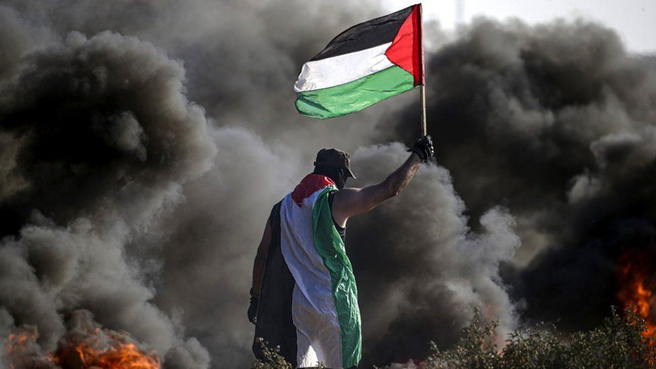

Hamas in Gaza and the Zionist regime of Israeli Prime Minister Benyamin Netanyahu remain tearing at each other’s throats. According to the Chief of Egypt’s State information Service (SIS) Diaa Rashwan stated that the international recognition of Palestinian statehood in one form or another will lead to pressure being exerted on the Israelis, as its global relations are crucial to cementing its future to reality. There is a delicate tightrope to be walked where nations from across the world but especially from Europe have given recognition to a Palestinian state. France and the United Kingdom (UK) notorious for the creation of the state of Israel in 1948 and being allied to it since then have extended formal recognition of a state to the Palestinians. Most of Europe has followed suite.
He stressed that every step toward recognizing a Palestinian state, no matter how small, adds to the long struggle for Palestinian rights on the international stage. He also emphasized that the Palestinian-Israeli conflict cannot be resolved quickly, “like a knockout in a boxing match.” Instead, he said, a resolution will result from cumulative historical and political efforts. At a UN conference on the two-state solution on Monday, France, Portugal, Luxembourg, Malta, and Monaco formally recognized Palestinian statehood. On Sunday, Australia, Canada, and the UK made similar announcements. These recognitions bring the number of UN member states recognizing Palestine to 159. Rashwan said that the countries now recognizing Palestine, including the UK, France, and Spain, were key players in the creation of Israel and central to the Zionist project. He noted that British Prime Minister Keir Starmer’s recognition comes 108 years after the Balfour Declaration, a landmark document in Israel’s establishment.
The SIS head explained that Britain’s role has extended beyond the Balfour Declaration to include arming Zionist groups following its withdrawal from Palestine.

The formal and diplomatic recognition given to the Palestinian State by 159 United Nations member states is a largely symbolic gesture. But it could prove to be binding. One of the ways these nations in question can help is to cut of trade with the Israelis to exert pressure on them to end the settlement construction and to end the war in Gaza. Gesture needs to be translated into action. By this I mean those responsible for perpetrating the genocide in Gaza, that is Israeli Prime Minister Benyamin Netanyahu, his cabinet and the Israeli Defence Force (IDF) senior command should be taken before the International Court of Justice (ICJ) in the Hague and the International Criminal Court (ICC) and face trial. The powers that be in London and Paris as well as the rest of the nations of Europe must choose now. Continue financial support for the Israelis as well as trade needs to come to an end.
But there are those who argue that formal recognition of the Palestinians’ right to exist and have human rights and an independent state will not be enough.

The French-Saudi plan sidesteps the most divisive issues in the conflict: final borders, the fate of the settlements, the return of Palestinian refugees from past wars, security arrangements, the status of Jerusalem and recognition of Israel as a Jewish state. It also relies heavily on the Palestinian Authority, the current leadership of which is despised by many Palestinians who view them as corrupt and autocratic. Israel says they are not fully committed to peace and accuses the Palestinian Authority of incitement despite recent reforms. The plan calls for Palestinian elections to be held within a year, but President Mahmoud Abbas has delayed previous votes when it looked like his party would lose, blaming Israeli restrictions. Hamas, which won the last national elections in 2006, would be excluded unless it gives up its weapons and recognizes Israel.
All of which means the plan is likely to end up on the mound of past Mideast accords, parameters and road maps, leaving Israel in full control of the land from the Jordan River to the Mediterranean Sea, ruling millions of Palestinians who are denied basic rights.

Every diplomat in the UN General Assembly Chamber recognizes that a long-lasting peace between Israel and Palestine can only be brought to fruition when a return to the 1967 borders, the return of Palestinian refugees to their place of origin, the recognition of East Jerusalem as Palestine’s capital and what the faith of Masjid-Al-Aqsa will be. The feasibility of Israel as a “Jewish state” needs to be properly defines. These are the elephants in the Assembly chamber at the UN everyone needs to look at. The Palestinian Authority (PA) for its part needs to face diplomatic pressure to clean up its act. There is no telling how long the eighty-nine-year-old Palestinian President Mahmoud Abbas will last or who will replace him. Hamas must now consent to some form of compromise or the bloodshed will continue unabated.
An all-out war between nuclear armed Israel and the Arab states as sparked by Hamas will not end well. Netanyahu himself is delusional and unethical when allowed the free range and excess of power he has been given. The situation can only escalate without tangible sanctions on Israel as faced by Apartheid South Africa.
Article written by:
Yacoob Cassim
Journalist at Radio Al Ansaar