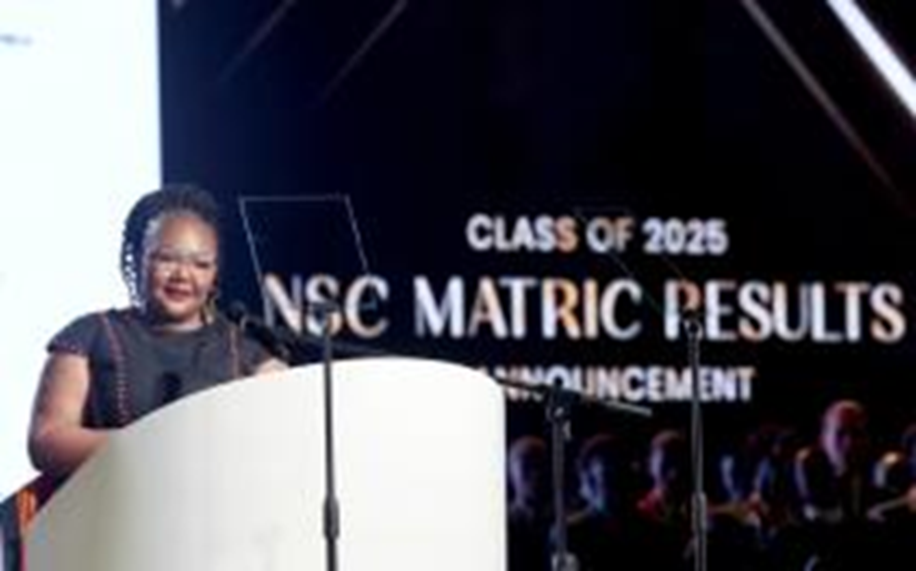

Minister of Basic Education Siviwe Gwarube, announced that KwaZulu-Natal has emerged as the top-performing province in the 2025 matric exams, achieving an impressive 90.6 % pass rate. This accomplishment sets a new benchmark, for educational excellence in the country. Minister Gwarube was addressing a press audience at the Mosaic Church in Randburg, Johannesburg, on Monday evening, where she announced the National Senior Certificate (NSC) examination results. In her passionate speech, she emphasized the significance of this achievement, stating that these results represent not merely numbers but a testament to the collective efforts of educators, learners, and communities nationwide.
“Over 656 000 learners passed the National Senior Certificate. That figure carries the effort of every teacher, every learner, families in every corner of our country,” the Minister said. KwaZulu-Natal’s stellar performance is part of a broader national trend, with the country achieving its highest-ever pass rate of 88% – a 0 .7% increase from 2024. KwaZulu-Natal is followed by the Free State, which achieved a pass rate of 89.33%. Gauteng came next with a pass rate of 89.06%, followed by North West at 88.49%. The Western Cape recorded a pass rate of 88.20%, and the Northern Cape achieved 87.79%, marking a significant improvement. Mpumalanga had a pass rate of 86.55%, while Limpopo increased to 86.15%. Finally, the Eastern Cape achieved a pass rate of 84.17%.

The recent matric results are impressive, but they also show that more still needs to be accomplished. This is especially true in Mpumalanga and the Eastern Cape. Better access to basic services such as education, particularly in rural areas, must be prioritized. Provincial governments, their education departments, and MECs, must lead the charge. Pretoria should act as a guiding force while allowing provinces a greater voice in the allocation of resources. Provincial and local administrations must be transparent and held accountable to their communities.
The curriculum of the national education system must be reformed to meet the demands of the nation. To achieve this, South Africa, should learn from the standards and goals set by other countries for example, Asian nations such as China, Japan, Singapore, and South Korea, as well as European countries like France, Britain, Switzerland, and Germany.
In KwaZulu-Natal, Government of Provincial Unity (GPU) parties are bursting with pride at the province’s accomplishment of achieving first rank in the 2025 matric results.

The IFP (leader of the GPU) commends educators, school administrators, parents, and guardians for their unwavering support and professionalism in sustaining teaching and learning under difficult circumstances. Their dedication remains central to unlocking the potential of South Africa’s youth and shaping future leaders,” read the statement. Another GPU partner, the DA described the province’s top performance as a remarkable achievement and a moment of immense pride. The DA concurred with the IFP that these results reflect the resilience, discipline and determination of learners, as well as the unwavering commitment of teachers, principals and education support staff who worked tirelessly to ensure learner success under challenging conditions including delayed or non-payment of norms and standards funding to schools.
The DA further congratulated uMkhanyakude District for its outstanding performance, having ranked second nationally. “This achievement is particularly significant given the deep rural context of the district. It also demonstrates what is possible when dedication and perseverance are matched with focused effort at school and district level,” read the statement.

The partners in the governing provincial coalition may express satisfaction in the matric results, but much more still needs to be achieved. KwaZulu-Natal and the other eight provinces must cooperate as a cohesive unit to improve service delivery, job creation and economic growth. This should be done while ensuring that students receive quality education and a curriculum that is both relevant and respectable. Political parties in the GPU, such as the Democratic Alliance (DA) and the Inkatha Freedom Party (IFP), have an opportunity to raise living standards and livelihood in KwaZulu-Natal, working alongside the private sector. For similar progress to be accomplished in other provinces, cooperation from all stakeholders is essential. The educational system is evolving in tandem with advancements in the technological field.
The lesson to be learned from the 2025 Matric pass rate, is that South Africa is capable of immense potential. The future generations can accomplish anything if they concentrate their minds on the task. The department of Education still has more work to do in supporting the learning needs of students in terms of school resources. Continued investment in subjects aligned with the Fourth Industrial Revolution (FIR) – such as robotics, Artificial Intelligence (AI), and coding – is essential. Traditional subjects such as math, sciences, and language must also be utilized. South Africa’s future will only be bright if South Africans makes it bright.
Article written by:
Yacoob Cassim
Journalist at Radio Al Ansaar