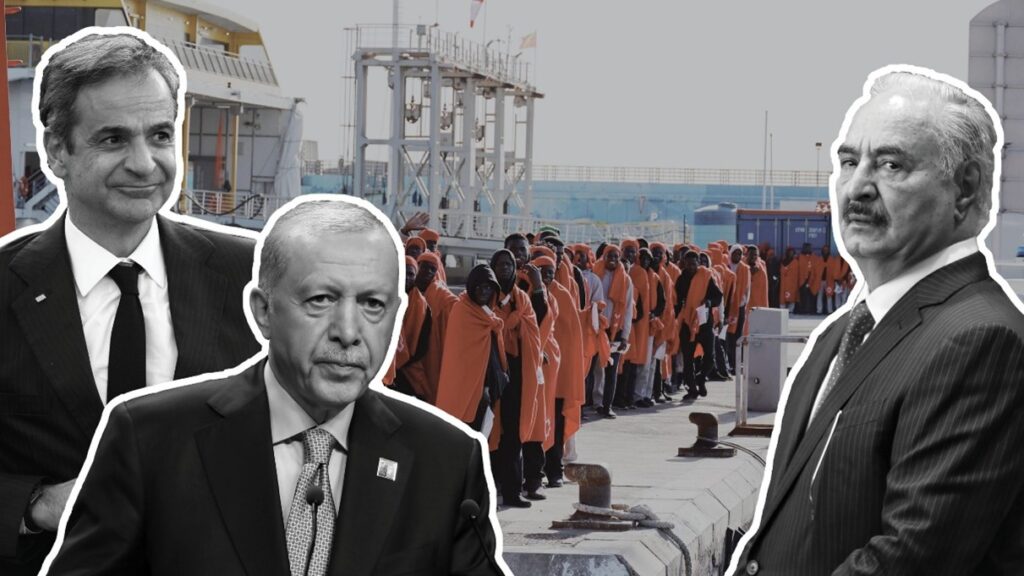

A diplomatic storm is gathering strength over the Mediterranean. Greece is facing a sharp increase in migrant arrivals from Libya, when the North African nation consented with Türkiye to accelerate energy exploration near Crete. The island of Crete is Greek territory. This extraction of resources has fuelled Athens’ fears of geopolitical coercion and escalating tensions in the eastern Mediterranean. Now there is the matter of the arrival of five thousand migrants from Libya have reached the shores of Crete and Gavdos since the beginning of June. European Union Commission Chief Ursula Von der Leyen has dispatched her migration commissioner to the region.

As temperatures soar, the timing of the arrivals coincides with an agreement between Turkey and Libya to launch seismic surveys south of Crete aimed at finding energy riches. The issue could quickly escalate in Athens – with Greece’s ruling New Democracy party reeling from a scandal involving EU funds. Tensions between the three countries date back to 2019, when Ankara and Libya’s internationally recognised government in Tripoli signed a memorandum of understanding establishing their exclusive economic zones (EEZs) in the Mediterranean Sea. The deal, which completely ignores the existence of Crete and has been condemned by the EU as illegal, grants the two countries rights to seabed resources.
The Libya-Turkey rapprochement is not a diplomatic coincidence: Turkey doesn’t recognise that Greek islands have EEZ status, contrary to the International Sea Law, which Ankara has not ratified. With the Libya deal, Turkey wants to set a legal precedent in the region.
In response, Greece signed a competing maritime agreement with neighbouring Egypt. As illustrated in the map below, the maritime zones of the four countries clash, making the situation in the Mediterranean region highly complex.

This agreement between Türkiye and Libya refers to the extraction of energy resources possibly oil and natural gas. The entry of the migrants on the scene in Crete creates a head ache for the Greek government. The seismic surveys being carried out by the Libyans and the Turks is not a coincidence. Libya is looking to stabilize its security after being engulfed in a civil war since 2011. Extraction of this new energy could help regrow Tripoli’s fractured economy. The Greeks for their part see the extraction deal as an encroachment on their sovereignty over the territorial waters around Crete and Gavdos. The EU leadership of which Athens is a member of (more or less) argue that Ankara and Tripoli’s drilling agreement is an abuse of international Sea Law and should be renegotiated with Greece to bring the Hellenic Republic on board.
The Egyptians for their part possibly entered into the agreement with the Greeks to ensure that their own territorial interests in the eastern Mediterranean were not threatened. There is still a longstanding rivalry for influence in the region between Ankara and Cairo. Egyptian President Abdel Fatah El Sisi is interested in securing his country’s own economy.

Libyan Prime Minister Osama Hammad stated that the deal between the two countries is internationally legitimate. He reaffirmed Libya’s firm rejection of any challenges or interference with its sovereign decisions, particularly regarding international agreements made with allies. The Libya-Türkiye cooperation is carried out under international legitimacy and does not violate the sovereignty of any country, Hammad noted. He emphasized that Libya reserves the right to respond firmly to any actions that jeopardize its territorial integrity or political sovereignty, and he warned Greece about the consequences of continuing its policy of provocation and escalation. Hammad also emphasized that Libya’s maritime rights are nonnegotiable and can only be discussed within international legal frameworks, noting that his government has taken decisive steps in response to Greece’s recent attitudes. Greek Prime Minister Kyriakos Mitsotakis’ statements targeting the deal have provoked serious reactions from authorities in eastern and western Libya.
Libya is in an unusual situation as regards its political integrity. On the one hand there is the internationally recognized Government headed by Prime Minister Hammad and on the other the Benghazi based General Khalifa Haftar who fancies himself a new strongman for Libya. The Tripoli based administration is possibly trying to reassert its legitimacy and security through the agreement with President Recep Tayyip Erdogan of Türkiye. Greek PM Mitsotakis believes his country is being excluded from an energy deal that they could have greatly benefitted. There is also a longstanding rivalry between the Greeks and Turks that goes back to the days of the Ottoman Empire. With tensions beginning to shimmer between Greece on the one hand and Turkiyë and Libya on the other all is not well. Von der Leyen for her part should take a diplomatic approach and mediate the dispute.
Another war in one of the most delicate regions of the world is the last controversy anyone in the international community would want. Especially with the migrants fleeing from other parts of Africa due to war or poverty.
Article written by:
Yacoob Cassim
Journalist at Radio Al Ansaar