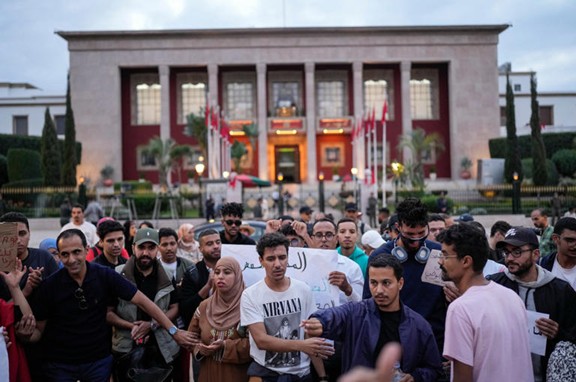

The North African Kingdom of Morocco has born witness to mass youth-led protests demanding the resignation of Prime Minister Aziz Akhannouch and that the government focus on providing basic services such as affordable health care and quality education rather than construction for the 2030 FIFA World Cup. The mass demonstrations were ignited by a mass shortage of professional health workers and insufficient medical equipment. In the city of Agadir the deaths of several women during C-section procedures at the Hassan II Hospital was the final straw that highlighted this chronic failure for the public health system. Morocco remains a constitutional monarchy but the king has the final say on all government policies and decisions as well as key ministerial appointments. The protesters, the vast majority of whom belong to the younger generation are now demanding that King Muhammad VI intervene to possibly dissolve the government.
In his first public remarks on the ongoing protests, Prime Minister Aziz Akhannouch last week said the violence in Lqliaa was “regrettable” and offered to “engage in dialogue” with movement organizers. But while “initially drowned out” in the protests’ early days, “calls for the prime minister’s resignation have risen to the top of demonstrators’ demands,” said Le Monde. For some protesters, however, any negotiations with the government are a nonstarter. Instead, any dialogue must take place with the “real center of power in Morocco,” said Abdelilah Benabdeslam, identified by Bloomberg as a “senior figure” in a coalition of Moroccan NGOs backing the movement: “the Makhzen,” the Moroccan monarch’s nebulous “coterie that comprises advisers and senior security officials who provide counsel on strategic issues,” Bloomberg said.

Morocco had remained the most relatively stable and secured country in north Africa since the beginning of the Arab Spring in 2011. Muhammad VI introduced limited reforms at the behest of his advisors but this changed little to address systematic issues. Now public anger has mounted against the Makhzen (‘store house’) – the entrenched business and political elite clustered around the king vying for influence. Akhannouch the country’s second wealthiest man after Muhammad VI himself is viewed as a puppet of the Makhzen. Morocco is a nation of immeasurable wealth and potential but the majority of its people dwell in poverty. The status quo cannot be maintained even with the brute force of the security establishment. Deeper constitutional reforms and actual limits on the king’s powers are needed. A culture of transparency and accountability should be fostered.
Muhammad VI in an address to parliament on Friday urged elected officials to end their delays and move to prevent social injustices. However, the king framed similar issues to those raised by the masses of demonstrators on the streets as questions of governance, rather than a broader vision for the nation.

The king’s short but charged address mirrored some of the grievances raised by Gen Z 212 protesters about regional inequalities and uneven development but did not address the movement directly. Morocco has been swept by demonstrations for almost two weeks, as young people have taken to the streets to demand better public services and increased spending on health and education. The 62-year-old monarch — walking into parliament without the help of a cane he used for part of last year — implored its members to defend the country and tackle some of the grievances raised at the protests with a spirit of seriousness and responsibility.
The political culture of Morocco desperately needs fundamental changes. The name of the protest movement in terms of Gen Z represents the age groups of the protestors between their teens and twenties and the number 212 is country’s national dialling prefix. It remains to be seen where the Gen Z 212 will lead to in terms of Morocco’s future as well as much needed political and economic reform. Morocco is a strategic gateway to North Africa and the Mediterranean Sea across the straits of Gibraltar. Much of the Middle East and North Africa’s oil transits through this corridor, amongst other produce.
Mean while it should be clear that Muhammad VI is not in his better years. Having had heart surgery in previous years his health at sixty-two warrants closer attention at this moment. Next in line for the Moroccan throne is Muhammad VI ‘s only son 21-year-old Crown Prince Moulay Hassan. Whether Crown Prince Hassan actually takes the throne as King Hassan III remains to be see. For now, the future of both Morocco’s politics and monarchy hangs in the balance. Caught between the demands of a restless generation and the enduring grip of royal despotism.
Article written by:
Yacoob Cassim
Journalist at Radio Al Ansaar