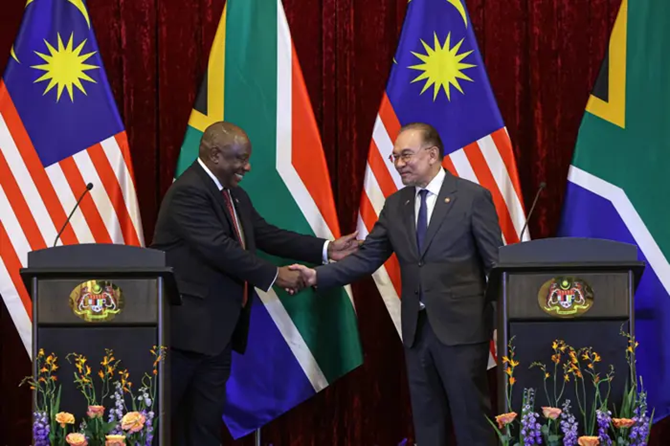

President Matamela Cyril Ramaphosa has departed Kuala Lumpur, Malaysia for home. The President concludes a four-day official visit to the south east Asian country that emphasised the long-standing friendship and shared values between South Africa and Malaysia. President Ramaphosa had attended the 47th ASEAN Summit and related Summits as a Guest of the Chair, Malaysian Prime Minister Datuk Seri Anwar Ibrahim. The president led the Kuala Lumpur International Airport at 9.30 PM on Monday (27 October) following a red-carpet send-off at the Bunga Raya Complex, where a guard of honour was mounted by the First battalion of the Royal Malay regiment. Malaysian Science, Technology and Innovation Minister Chang Lih Kang was present to bid farewell to President Ramaphosa and his delegation.
It was his first official visit to Malaysia since assuming office in February 2018. During his visit, Ramaphosa was conferred an Honorary Doctorate in International Relations by Universiti Malaya, a recognition of his lifelong dedication to democracy, human rights and global diplomacy. In his public lecture, Ramaphosa described the situation in Gaza as “genocide” following decades of dispossession, repression and oppression faced by its people. He also reaffirmed the close Malaysia-South Africa ties, describing it as a “principled solidarity” that continues to guide cooperation in various fields. Malaysia, as Asean Chair for 2025, is currently hosting over 30 world leaders, including those from Asean member states, to deepen engagement and cooperation while addressing regional and global issues of mutual concern. – Bernama

The member states of Asean are strategically placed in the Asia-Pacific region to have economic alliances and partnerships across the world. South Africa stands to gain a lot in terms of economic growth through ASEAN. Ramaphosa is certainly right to argue that “war” in Gaza is a genocide but he should also be advocating for its immediate end. Both at home and abroad. The word for a ceasefire must be spread across international forums and bodies such as ASEAN. Of course, increasing cooperation in the economic sphere such as trade and infrastructure has its advantages. The ASEAN nations in the Asia-Pacific are key to not only a great source of wealth when it comes to natural resources but also a great source of learning in terms of job creation and economic regeneration and growth.
During the ASEAN Summit Ramaphosa admitted South Africa is dealing with corruption after admitting that the issue has had damaging affects on the nation.

Ramaphosa made the admission during a fireside chat at the ASEAN Business and Investment Summit in Malaysia over the weekend. This is part of Ramaphosa’s latest appeal to investors in Asia as South Africa looks to diversify its trade partners amid a global trade shake-up. He said corruption, unemployment, inefficient infrastructure and poor governance are among major challenges being addressed. “Corruption is rife, not only in government, but the private sector. We’re dealing with that and we’re dealing with criminality and enforcing the rule of law. So, all the important indicators are getting into place and are being well aligned and addressed.” He said the country was showing positive improvements, making it a viable destination for Asian investors.
“Our economy is going to start turning around. In fact, it is already turning around. Our state-owned enterprises are also being reformed. So, we are on a good path, going forward, and rebuilding South Africa and delivering a South Africa that many countries can deal with.”

The President is acknowledging that his administration is tackling the matter of corruption. In the interests of the South African people. The strain of corruption has spread across all branches of South African society. Transparency and accountability from public institutions both public and private has become an elusive dream. Although most of the rot goes back to the years of President Jacob Zuma the Ramaphosa administration has to pull up its sleeves and empower the correct legal institutions to unearth the truth and determine who should stand trial. Key to bringing the truth to light are whistle blowers in said organizations. Whistle blowers on fraud, graft and corruption need to be protected whether they are in government, the public and private sector.
As South Africa engages in various international partnerships from ASEAN to the African Union and AfCFTA the country must accelerate the decentralization of economic power. Ramaphosa has made promises of delivering a South Africa that other nations can deal with. To do that he needs to build firm state institutions that have impartial oversight.
Only time will tell whether the President will learn from these lessons.
Article written by:
Yacoob Cassim
Journalist at Radio Al Ansaar