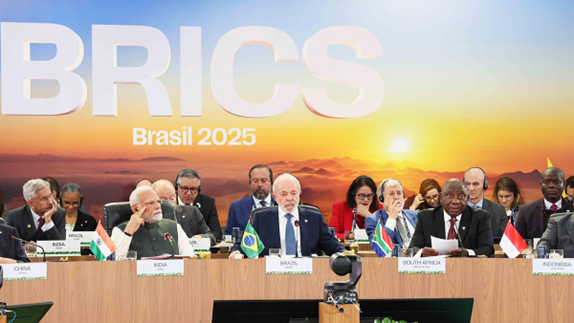

President Cyril Ramaphosa speaking at the BRICS Plus Seventeenth Summit in Rio De Janeiro said that Brazil’s leadership of BRICS and COP30, together with South Africa’s presidency of the G20, has provided an incredible opportunity for developing economy nations to send a strong signal of unity and solidarity in support of their rights and interests.
He called for scaled-up concessional financing for climate action to catalyse investments in early warning systems, resilient infrastructure, community-led adaptation, and people-centred just transition pathways. “At the same time, we need to drive the global health agenda towards inclusive, equitable, innovative, and sustainable health solutions. Global health financing is being severely impacted by the substantial and sudden withdrawals of official development assistance. “Many of the programmes that were supported through this assistance were for disease elimination and targeted towards the most vulnerable populations, like young women and girls, children and adolescents,” the President said. While acknowledging the countries great strides made towards Tuberculosis, Malaria and HIV elimination, through the support of organisations like the Global Fund, President Ramaphosa warned these gains are being threatened by political attention and reduced financing.
As the co-host of the Global Fund’s 8th replenishment campaign together with UK Prime Minister Keir Starmer, President Ramaphosa called on countries, businesses and the wider donor community to contribute to the fund in the interests of global health security.

The reason why financial assistance in terms if funding for medical support across the world came to an abrupt end, was because of US President Donald Trump’s executive orders announcing an end to such aid. This took place alongside the imposition of the tariffs. Ramaphosa who now stands at the helm of G 20 has alongside the British government sort other alternatives to revive the support for medical funding. This form of financial aid is needed for research, equipment, hospital construction, transportation, salaries for medical staff and nurses and the manufacture of medicines and prescription drugs. Pretoria, London and possibly the European Commission in Brussels, Belgium wants the nations of the developing world to have more say in the manufacture and production of medicines and what research is conducted in the field.
The Global Fund is coming forward cap in hand to plead with governments, corporations and individuals to contribute to the medical establishment’s research and manufacturing. Medicine is a complex business and developing countries need to do their part to have their say in what advances are made. Someone needs to take the place of the United States.
Ramaphosa has also called for African nations to be the ones to determine how their resources particularly critical minerals are utilized.

JOHANNESBURG – Africa’s inclusion in the United Nations Security Council, issues of climate change and the condemnation of conflicts in Iran, Gaza and South Sudan were some of the critical takeaways for President Cyril Ramaphosa during the BRICS summit in Brazil. Ramaphosa, who has been attending the summit since Sunday and is expected to arrive back in the country on Tuesday, said it was important for South Africa to lend its voice to some of the issues faced by the continent. He said that Brazil and South Africa were in strong agreement over key minerals within the two countries. “A key issue, such as how our critical minerals that come from largely African countries should be treated, that there should be beneficiation and there should be value addition and this we, as South Africa and Brazil, articulated very strongly during this summit.”

The critical minerals Ramaphosa was referring to are those materials used in mobile devices and AI machines. These are extracted deep from the earth. Brazil and South Africa are the key gate ways to these minerals in their respective continents. Pretoria for its part sees itself as the chief spokesperson for southern Africa. Brasilia has similar views. Brazil being a vast country is home to a significant portion of world’s critical minerals. A partnership between Brazil and South Africa could see both countries take the path to job creation as well as industrial and economic growth. Pretoria must leverage its position in the southern African region to expand its economic and diplomatic growth. Ramaphosa has to do this to utilize its membership of the BRICS bloc. South Africa is at the forefront of major trade blocs of emerging economies.
It needs to use this to its advantage to build its reputation and improve both the position of developing economies in Africa and across the world as well as the livelihood of its own people.
Article written by:
Yacoob Cassim
Journalist at Radio Al Ansaar