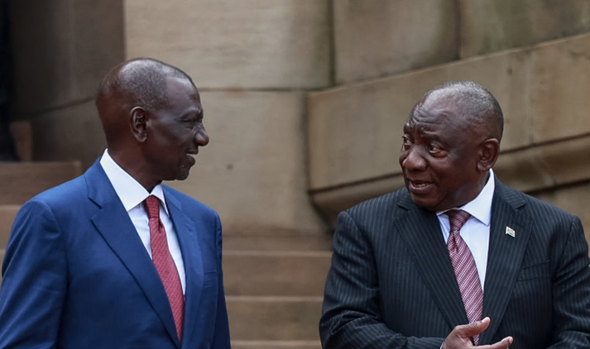

Kenyan President William Ruto stated that Kenya and South Africa built a strong trade partnership in the last 32 years. Ruto delivered the remarks in an address on Thursday at the Union buildings during a State Visit. This 32-year relationship which dates back to the fall of apartheid has not always been mutual and warm. Kenya is South Africa’s largest trade partner outside the Southern African Development Community (SADC) region, with more than R11 million flowing between the two nations every year.
Ruto’s visit is meant to improve if not revive crucial economic, trade and diplomatic ties between the African economic powerhouses that has long been restrained.

Ruto said that Pretoria and Nairobi must continue to strengthen their trade ties in order to boost intra-continental trade. “Over three decades, we have built one of the most important partnerships on the continent, grounded on mutual respect, shared values and a common vision for the prosperity of our people.” Ramaphosa echoed the sentiment. “Our economic partnership is one of the most strategic pillars our bilateral cooperation. Kenya remains South Africa’s largest trading partner in East Africa, and it is also an investment for South African investment on the continent.”

Nairobi is a strategic ally and partner for Pretoria. Both governments need this relationship to grow their economies. The East African region is a lucrative market for South Africa to invest in, and Kenya is the key. if South Africa’s own political and diplomatic elites can look past their egos and strike a more friendly chord with Kenya, Pretoria could then improve trade and industry. Ramaphosa appears on the surface to have made peace with the snub by France to allow Ruto to attend the G Seven in his (Ramaphosa’s) place at the G Seven Summit in Paris as an observer.

Presidents Ruto and Cyril Ramaphosa’s common challenges are likely to dominate the agenda while geopolitical differences will take a backseat, or at least they will be dealt with in private. Both leaders face intense public pressure due to populations squeezed by a worsening economy – Ruto in the form of cost-of-living and fuel protests, while Ramaphosa has had to deal with the violence meted out against immigrants by South Africans in low and lower-income areas where communities are competing for resources. Both presidents have also been accused of improper business dealings despite being elected on anti-corruption tickets. Ramaphosa faces parliamentary scrutiny over concealing the theft of a large sum of dollars hidden in a couch on his Phala Phala game farm, while Ruto faces a series of controversies that involve public procurement irregularities, state-sponsored contracts and historical land disputes.
When it comes to leading a nation – be it South Africa or Kenya – both Ramaphosa and Ruto can agree that leading a nation while practicing private business on the side lines can prove to be difficult manoeuvring in public life. However, there is also the need to maintain and respect transparency and accountability across political and business spheres. Ruto has to sort petroleum and gasoline closer to home soil, possibly from Angola, Nigeria or Gabon. Ramaphosa – if the president can come to his senses on the subject – has to not only acknowledge the extent of xenophobia and condemn it, but also deploy police to troubled areas as well as investigate and prosecute those responsible for perpetrating the riots and damages to respective properties. There is no doubt that Ruto would have raised the matter privately with Ramaphosa.
The conversation would have been as perplexing as walking a tight rope for Ramaphosa, but behind closed doors it would be hard to tell. Business and diplomatic ties might thaw but only in the following days, will the rest of us come to know what bargain was struck.
Article written by:
Yacoob Cassim
Journalist at Radio Al Ansaar