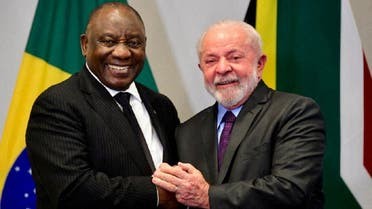

President Cyril Ramaphosa paid a state visit to the Republic of Brazil, where he met with President Luiz Inácio Lula da Silva in the capital city, Brasília. Ramaphosa’s aim was to strengthen bilateral ties between the two countries. During a press briefing, Lula urged the South African president to boost defence cooperation between South Africa and Brazil, warning of the risk of foreign invasion. Both Ramaphosa and Lula expressed criticism of the war against Iran waged by United States President Donald J. Trump and Israeli Prime Minister Benjamin Netanyahu. “I don’t know if Comrade Ramaphosa realizes that if we don’t prepare ourselves in terms of defence, one day someone may invade us,” the Brazilian president said during the briefing.

The two countries’ defence ministers were due to meet Monday to work on a cooperation agreement. “In South America, we present ourselves as a region of peace. No one has a nuclear bomb, no one has an atomic bomb. So we think of defence as deterrence,” said Lula. South Africa and Brazil are members of the BRICS group of emerging nations, which US President Donald Trump has labelled “anti-American.” The bloc also includes China, Russia, and Iran, among others. Lula has been critical of Washington’s actions in Latin America, saying the US attack on Venezuela to oust president Nicolas Maduro crossed “an unacceptable line.” Prior to Maduro’s ouster, the US military carried out several air strikes on alleged drug trafficking boats in the Caribbean Sea and eastern Pacific Ocean.

Military cooperation among member nations of the BRICS Plus bloc is a major priority. However, there is no mutual defence pact requiring members to come to one another’s aid. India, for example, maintains a close relationship with the United States and has a strong rivalry with its neighbouring BRICS member state, China. Brazil, under President Lula, seeks a closer relationship with South Africa due to its strategic position as “Africa’s Gateway” to economic resources. Industrialization, military progress, and development are the central themes of Ramaphosa’s state visit to Brasília. President Ramaphosa has become all too aware of South Africa’s vulnerabilities in defence capabilities and of the risk posed by Trump’s willingness to bend international law when it suits his agenda.
The capture of the Venezuelan president and the assassination of Iranian Supreme Leader Ayatollah Ali Khamenei serve as warnings to Ramaphosa and his successors: Washington cannot be trusted when you let your guard down.

The Presidency said the visit will provide Ramaphosa and Brazilian President Lula da Silva the opportunity to engage on a broad range of issues, including diplomatic and political relations. South Africa’s relationship with Brazil is anchored in the declaration of strategic partnership signed in 2010. The Presidency said as the largest economy in Latin America, Brazil remains a key strategic partner for the country. During the visit, both sides will explore additional ways to broaden economic ties and unlock new opportunities for mutually beneficial trade and economic relations. Accompanied by a business delegation, Ramaphosa will also address a South Africa-Brazil business forum on Monday night, aimed at promoting increased commercial collaboration.
On the sidelines of the visit, Ramaphosa will meet with Brazilian business leaders with the intention of accelerating investments and opportunities in South Africa. Presidency spokesperson Vincent Magwenya said, “South Africa and Brazil share historic and fraternal ties built on friendship, shared African heritage, solidarity, South-South cooperation and multilateralism.”
President Ramaphosa is seeking to increase trade cooperation with all BRICS Plus partners. Brazil is a key regional power that commands influence as an access point to the emerging Latin American market. Ramaphosa is positioning South Africa as a vital pathway to Africa’s industrialization and economic liberalization, inviting Brazilian investors to share in its economic growth and contribute to the expansion of its Gross Domestic Product (GDP). The main goals of this strategic and commercial partnership are to generate investment and create employment opportunities in both the South African and Brazilian business markets. The Southern African region also has a crucial role to play in this broader market. At the heart of the Brazilian–South African partnership is the institutionalization of free trade and cultural exchange within BRICS Plus.
The focus on bilateral and multilateral cooperation is expected to lead to closer and stronger ties in economics, defence, and industrialization. Both Brazil and South Africa, as BRICS Plus partners, oppose the war in Iran and the capture of the Venezuelan president. Iran and Venezuela are themselves BRICS Plus member states. Brazil, for its part, has a large Afro-Brazilian diaspora with strong cultural and historical links to West Africa, particularly Angola. How the Brazil–South Africa partnership develops in the future remains to be seen.
Article written by:
Yacoob Cassim
Journalist at Radio Al Ansaar