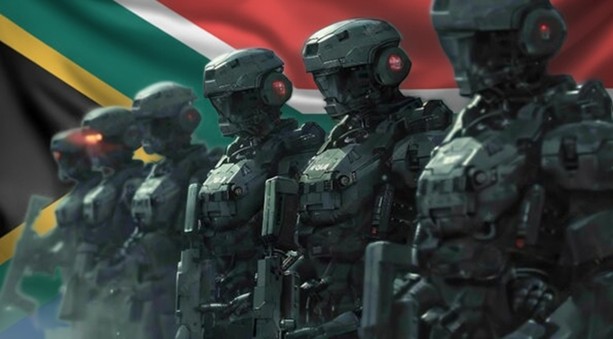

Since the Fourth Industrial Revolution (FIR) arrived on the South African economic scene, new challenges have arisen. These challenges range not only from manufacturing and skills training but also from issues of military capability. The hard strategic truth that has emerged is that military effectiveness cannot be separated from control over technology supply chains. At present, South Africa and the rest of the world are in an era of fragmented global trade, sanctions regimes, export controls, and geopolitical competition; dependence on foreign defence technologies has become a critical vulnerability. For the South African National Defence Force (SANDF), this could be an Achilles’ heel.

These vulnerabilities are most acute in command, control, communications, computers, intelligence, surveillance, and reconnaissance (C4ISR) systems. C4ISR technologies depend heavily on software, data architectures, encryption, and network integration, areas often controlled by foreign vendors. Recent conflicts have shown that when access to updates, encryption keys, or technical support is disrupted, command effectiveness degrades rapidly. Sovereignty in C4ISR is essential because it underpins decision-making authority, operational tempo, and coordination across domains. Without sovereign control, even well-equipped forces risk paralysis under pressure.
Cyber defence and information operations represent another domain where global dependency creates strategic exposure. Cyber tools are deeply embedded in international supply chains, often relying on foreign-developed software libraries, cloud services, and threat intelligence feeds. In current conflicts, cyber capabilities have been constrained by legal, political, and commercial considerations beyond the control of the user state. Sovereign cyber capability, enabled by national R&D, allows South Africa to defend its networks, adapt to emerging threats, and operate independently of external permissions. In this domain, sovereignty is not optional; it is foundational to national security.

Having an efficient military, is only possible when efficient equipment is supplied to it. The military (whether the army, navy or Air Force) requires equipment and technology to be provided by trustworthy manufacturers who uphold integrity. In a world where Artificial Intelligence (AI) and robotics are becoming increasingly prevalent, integrity and trustworthiness should be at the forefront now more than ever. These qualities cannot be allowed to take a back seat. This is why the South African state – meaning Pretoria and the Department of Defence and War Veterans (DDWV), must move forward to exercising some degree of monopoly over the manufacture of the technology, weaponry and equipment being used.
This demand for integrity and trustworthiness in military technology and manufacturing moves beyond the traditional battle field. There is a high risk of military secrets and systems being accessed for malicious purposes by foreign powers and groups. Such breaches can occur through cyberattacks targeting the technology being purchased. If the SANDF and its civilian leadership wish to protect the secrets that safeguard the country, they must exercise sovereignty and maintain a monopoly over the manufacture of the technology they use. The South African state must be the one to write or encode the laws, programming and instructions for all equipment, vehicles and weaponry employed by the country’s military.
Focus should be placed in public-private ownerships to oversee the development of SANDF military technology. The South African private sector should take the lead under government supervision. Private companies may compete to develop the best technologies, but the President as Commander-in-Chief, and the Defence Department will be the ultimate guarantors. Pretoria and the private corporations the government partners with must conduct deeper research concerning the progress of military technologies to stay ahead of competitors.
There is a risk that if the state exercises full sovereignty over the manufacture of military technology, innovation will slow, interoperability with South Africa’s trade partners will be reduced, and the likelihood of domestic capture and corruption will increase. When Pretoria manoeuvres to increase supervision of the technology its military uses, it must be prepared to allow companies some leeway to conceal certain innovation secrets. South Africa will also have to comply with World Trade Organization (WTO) rules, depending on how transparent the government can be with these military secrets. The private sector will have to do the same.
Montgomery Group Africa is staging two new exhibitions in South Africa. The first will be held in Johannesburg, South Africa in 2026, and the second in Cape Town in 2027. Montgomery Group Africa’s commercial director Joshua Low announced that RE+ South Africa will take place from June 2 to 4, next year, in Johannesburg, at the Gallagher Convention Centre. Montgomery Group Africa will host the event in partnership with RE+ Events. The company is best known for its flagship renewable-energy project in North America.

Low describes RE+ South Africa as a three-day clean energy exhibit, coinciding with a two-day conference. He believes the event will be different from other renewable-energy exhibitions in South Africa as it will have a specific focus on the country’s commercial and industrial (C&I) market. “The renewable-energy market was valued at over R100-billion in 2024,” says Low. “The C&I sector specifically is driving new demand, with private renewable developments expected to increase by 6 GW of solar PV and 3.5 GW of wind by 2030, representing R132-billion in total investment.”
The group’s second event is the Cape Town Industrial Technology Exhibition, happening from March 2 to 4, 2027, at the Cape Town International Convention Centre. The aim with this exhibition is to showcase the Western Cape’s high-growth industrial industries which have, to date, not received adequate exposure, says Low.
These include the agriprocessing industry, with the province’s combined primary agriculture and agriprocessing exports having jumped from R63-billion in 2018 to R104-billion in 2023.
When we speak about promoting renewable energy, we talk about solar, wind and hydropower. Montgomery Group Africa aims to foster genuine interest among South African companies and corporations by addressing their concerns. The sale of clean, renewable energy is valued at R100 billion as of 2024. South African corporations must take seriously the capital involved in renewable energy, given the country’s abundance in such resources – particularly solar and wind power. This form of energy if used in south Africa can be cheap but profitable. If harnessed effectively in South Africa, this form of energy can be both affordable and profitable. Solar and wind resources have the potential to power homes, businesses, factories, farms, and natural resources operations, generating millions of kilowatts. The upcoming events in Johannesburg, followed by Cape Town, could lay the groundwork for genuine interest in the proposed expansion of the industry.
Coal, natural gas and oil are on their way out. These resources are diminishing as they become depleted. Montgomery Africa Group’s decision to focus on agriculture is intended to persuade the food industry to come on board. Transport will also be deeply impacted by the transition to renewables. Meanwhile, the SANDF and the DDWV must reconsider the path they will take with the new technologies of the Fourth Industrial Revolution.
Article written by:
Yacoob Cassim
Journalist at Radio Al Ansaar