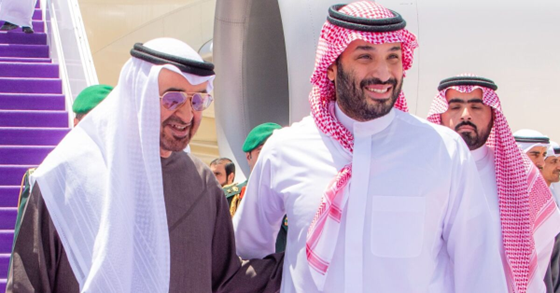

Saudi Arabia and the United Arab Emirates have been at loggerheads over military and diplomatic policies. Riyadh and Abu Dhabi have fallen out over what each Middle Eastern economic power house wants in terms of their wider alliance and long-term relationship. The spark of this recent feud between allies-turned-rivals was the initial seizure of power in southern Yemen by separatists supported by Abu Dhabi. This angered the regime of Saudi Crown Prince Muhammad bin Salman Al-Saud, the Kingdom’s de facto ruler, who backs Yemen’s Presidential Leadership Council (PLC) as the country’s legitimate government. Bin Salman (also known as MBS) had a close relationship with UAE President Sheikh Muhammad bin Zayed Al-Nahyan (MBZ) until now.
A major fear of MBS is that his once-close friend, bin Zayed is seeking to undermine their alliance to further his own agenda. The concern is that Abu Dhabi’s ambitions could disrupt the delicate balance of power in the region. This, in turn, might destabilize the already fragile nations of Yemen, Somalia and Sudan, where the two Gulf monarchies have interests.

But the rupture between the two oil-rich monarchies is already rippling beyond Yemen as Saudi Arabia, alarmed by what it sees as aggressive military and foreign policy moves by its much smaller neighbor, works to counter the deep web of influence Abu Dhabi has spent years building in the Horn of Africa and around the Red Sea. The expansion of the UAE’s influence in this area “runs counter to Saudi Arabia’s view of these regions as part of its strategic security belt,” said one Saudi diplomat, speaking on the condition of anonymity to discuss the sensitive topic, adding that Riyadh is determined to signal its “red lines.”
Riyadh’s sudden, more assertive stance has countries in the region trying to navigate the rift. For years, Saudi Arabia and the UAE worked largely in tandem, backstopping other autocrats amid the Arab Spring uprisings and joining forces to counter the Iranian-backed Houthis in Yemen.

The Emiratis are playing a different game to the Saudis. Abu Dhabi is seeking to undermine the sovereignty of fragmented countries in the surrounding region, further destabilizing them. Riyadh, on the other hand, aims to support legitimate national governments in the countries concerned, whether in Mogadishu or Khartoum. Yemen is on the verge of splintering, leaving the legitimately recognized transitional government without a stable seat from which to govern. In Libya, MBS backs the would-be strongman General Khalifah Haftar. Egypt and its President Abdel Fatah el-Sisi align with the Saudi Crown Prince in that regard. Cairo remains a close ally of both Riyadh and Abu Dhabi but will side with the Saudis, if the Emiratis’ actions in neighbouring Sudan and Libya threaten Egypt’s territorial integrity.
MBS will not threaten the territorial integrity of the Saudi state by waging war against the Emiratis. Such a conflict would further destabilize the Arabian Peninsula, causing oil prices to rise drastically. Europe would be hit the hardest, while the United States would seek alternative sources. Meanwhile, South Africa imports its oil from African nations such as Nigeria.
Egypt, under el-Sisi, for its part, seeking a stable Arabian Peninsula, as well as a secure Nile basin and North African regions. Conflict between two close allies, such as the Saudi Kingdom and the U.A.E. would exacerbate tensions over trade. This is why Egyptian intelligence shares covert information on Abu Dhabi’s military and other foreign activities with their Saudi counterparts.

Egypt passed intelligence on recent Emirati operations in Yemen to Saudi authorities as part of efforts to rebuild strained relations with Riyadh, a senior Egyptian presidential source told Middle East Eye. The move came amid rising tensions between Saudi Arabia and the United Arab Emirates (UAE), with Egyptian officials viewing Emirati backing of armed and separatist groups in Yemen, Sudan and Somaliland as a growing threat to Egypt’s national security. “Egypt offered the UAE as a sacrifice to restore Saudi support and preserve national security,” the source said, describing the step as a “carefully planned manoeuvre”. Saudi Arabia’s partnership in Yemen with the UAE has dramatically unravelled in recent weeks.
Early in January, Saudi Arabia launched strikes on the UAE’s ally in Yemen, the separatist Southern Transitional Council (STC), in response to its unilateral takeover of key eastern governorates. Saudi-backed forces subsequently advanced, STC control collapsed, and government troops retook Aden and surrounding areas. Top of FormBottom of FormSaudi Arabia then accused Abu Dhabi of facilitating the escape of STC leader Aidarous al-Zubaidi from Yemen to the UAE via Somaliland.
Egypt is moving slowly and steadily through a terrain of shards where one misstep could cause injury to itself. By leaking intelligence to the Saudis, the Egyptians hoped to keep the unpredictable Emiratis in check. El-Sisi and his regime crave stability among their immediate neighbours to avert a threefold refugee crisis from Egypt’s west and south. Maintaining open trade thoroughfares like the Red Sea and the Suez Canal open is another priority. Cairo may hope that their allies in Abu Dhabi will be brought back to their senses by MBS. Neither El-Sisi nor MBS wants conflict, as the stakes are too high for a protracted war anywhere of the region.
Both the Saudis and Egyptians want a stable Yemen, as a return to the pre-1990 situation of two separate Yemeni states would be undesirable. Riyadh’s efforts to dislodge the southern separatist movement from control of Yemen’s main port, Aden, have resulted in the city and its surrounding territory being returned to legitimist control. Together with Saudi Arabia, Egypt is sending a clear message to the U.A.E. that it cannot freelance across the region and upset its precarious balance.
Article written by:
Yacoob Cassim
Journalist at Radio Al Ansaar