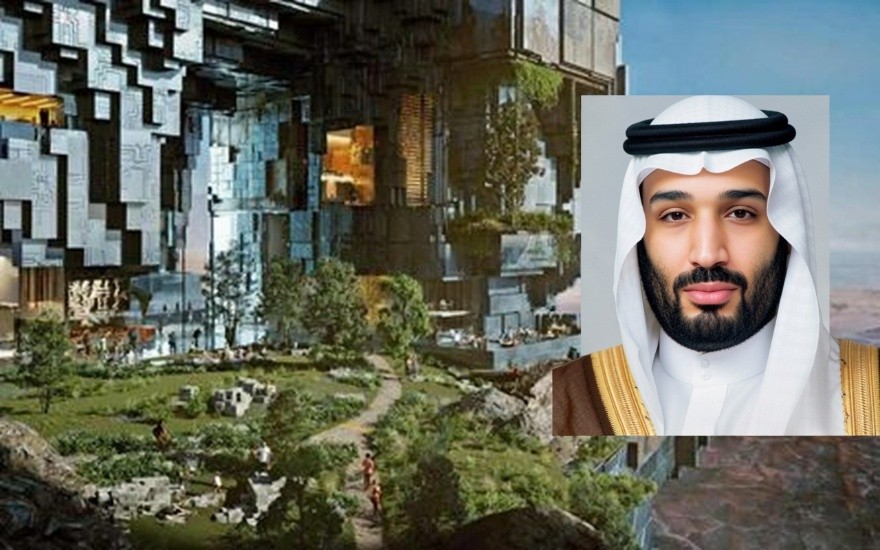

The Kingdom of Saudi Arabia is downscaling on the Neom project, a futuristic US $1.5 trillion Construction of ambitious proportions in the north east of the country. Neom, the largest, most spectacular construction vision, has become known in expert circles as a “Black Swan Event”. While the vision for the desert monarchy’s future has not changed, the nation’s leaders are significantly downscaling Neom’s construction due to rising costs and repeated delays.

The birth of Neom is linked to HRH Crown Prince Mohammed bin Salman’s Vision 2030, a strategic framework designed to end the Saudi Arabian economy’s dependence on oil.
Funded primarily by the Public Investment Fund (PIF), Neom is the “crown jewel” of the Kingdom’s Giga-projects. It is meant to be a global branding vehicle for a “New Saudi Arabia” – one that is technologically advanced, socially progressive and open to international capital.
However, with oil prices fluctuating and the Kingdom seeking to manage a widening budget deficit, the “100-mile linear city” dream of The Line has been re-evaluated. Instead, there will be more focus on high-value segments that offer immediate economic returns, such as luxury tourism and digital infrastructure.
The regime in Riyadh and Crown Prince Muhammad bin Salman (also known as MBS) are facing their most significant crisis to date. MBS and his inner circle have overreached with the ambitions they have pursued. This is not surprising, given that they were attempting to reach for the skies with their grand dreams. Yet even an absolute monarchy must confront the realities and limitations of logistics. MBS, who rules the Kingdom in his father King Salman bin Abdul Aziz’s stead as the de facto ruler due to the aging monarch’s struggle with dementia, has reached a solid brick wall in terms of the capital he can spend. Investors are not keen to support a regime that seeks to appear ‘modern’ while showing little regard for human rights.

The scale of Neom has demanded the involvement of a who’s-who of global engineering and construction companies. The project is the world’s largest customer for civil engineering services, while key international and domestic businesses have secured multi-billion dollar contracts to deliver the foundational infrastructure.
They include:
- WeBuild (Italy)
The Italian contractor is spearheading the US$5bn dam project at Trojena. This includes the construction of three dams to create an artificial lake to support the mountainside ski resort
- Vinci SA and ACS (Europe)
These firms, alongside regional heavyweights Nesma & Partners and Al Bawani, are heavily involved in the backbone infrastructure of Neom – the high-speed rail links and underground utility tunnels that were designed to sit beneath The Line.
- China State Construction Engineering Corp (CSCEC)
CSCEC is instrumental in the rapid vertical construction of residential and administrative clusters, using modular construction techniques to meet aggressive deadlines.

Neom has become a laughingstock in the fields of engineering and large-scale construction. The individuals responsible for organizing Saudi Vision 2030 are inexperienced and often disregard the advice of experts who work daily on the logistics of the megaproject. Building dams to block a lake in the mountains of the north eastern Saudi province of Tabuk, at a cost of about $5 billion, without considering the environmental impact, raises serious concerns. Similarly, constructing tunnels and railway lines below ground level while attempting to keep the encroaching desert sand at bay raises further valid questions about how far costs will escalate.
It is time for wiser, more experienced heads to take the reins and lead the charge. The Crown Prince has overestimated his own degree of power, which has led to severe complications in reforming and diversifying the Saudi economy, as well as in introducing the new infrastructure.
The linear city was cut from 106 miles to just 1.5, and is set to house a measly 300,000, instead of the planned 1.5million. Now the project could be scrapped altogether, as Saudi leaders have launched a review into the Crown Prince’s pipe-dream project. Neom, planned to be as big as Belgium, might now turn into a “much smaller” AI hub, using seawater to cool data centres. The city’s ski resort Trojena has also been partly scrapped. Leadership announced at the weekend that it will no longer be able to host the Asian Winter Games in 2029. It comes as Prince Mohammed makes an aggressive push for the kingdom to become a tech player, and the country scrambles to get ready to host the 2034 men’s football World Cup.
The wildly ambitious Neom was set to become a Saudi region that will be characterised by numerous cities, lavish resorts, and other tourism-based real estate developments.
The decrease in scale of the proposed desert metropolises demonstrates an important lesson: in decision-making and construction, logistics outweigh power. Bin Salman could have built a successful major technology and tourism hub had he adopted a different approach to the design. The ski and winter sports stadium remains one of the most questionable aspects of the project. What the organizers of the Asian Winter Games 2029 will think of the cancellation of the event and the scaling back of construction at the venues remains to be seen.
MBS envisioned Neom as a centre of the Fourth Industrial Revolution (FIR) and a tourism destination when he first conceived it. It was meant to serve as a showcase of his accomplishments and a revelation of what he could bring to the Kingdom upon ascending the throne.
Now, these metropolises—intended to span the Saudi northeast coast, interior desert, and mountainous areas—risk becoming a symbol of regret. The Saudis will have to be wary of Muhammad bin Salman and what he can deliver. He has proven himself ruthless in the murder of journalist Jamal Khashoggi, yet undiplomatic in the spheres of national decision-making.
In the long term Saudi Arabia may need to pivot toward smaller, more achievable projects that still align with Vision 2030 but avoid grandiose overreach.
Article written by:
Yacoob Cassim
Journalist at Radio Al Ansaar