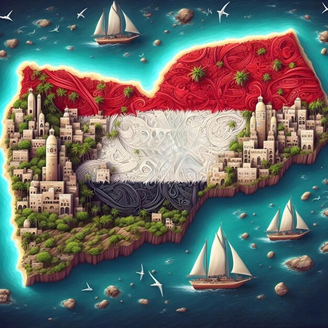

Yemen is at the end of its tether. The Separatist group known as the Southern Transitional Council (STC) that want the south of the country to be an independent state again, have taken control of the oil producing provinces of Hadramout and Mahra. The move by the STC has proven to be a game changer in the country’s civil war. The capture of the oil field provinces along the key international trade route of the Gulf of Aden and the Red Sea that also threatens to bring new risks to the Arabian Peninsula and Persian Gulf region. The secessionist STC, which has the support of the United Arab Emirates (UAE), this month seized most of the provinces of Hadramout and Mahra, including the petroleum facilities.

Yemen has been mired for more than a decade in a civil war that involves a complex interplay of sectarian grievances and the involvement of regional powers. The Iran-aligned Houthis control the most populous regions of the country, including the capital Sanaa. Meanwhile, a loose regional coalition of powers — including Saudi Arabia and the UAE — has backed the internationally recognized government in the south. The war has created a humanitarian crisis and shattered the economy. Still, since 2022, violence has gradually declined as the sides reached something of a stalemate in the war. The move by the UAE-backed separatists upends the political arrangement among the anti-Houthi partners.
The war in Yemen began in 2014, when the Houthis marched from their northern stronghold of Saada. They took the capital, Sanaa, and forced the internationally recognized government into exile. Saudi Arabia and the UAE entered the war the following year in an attempt to restore the government.

Yemeni culture and society are known to be deeply tribal and fractious. The fabric of the whole social structure is more delicate than the thread of a spider’s web. Yemeni society is a complex network that has been broken asunder due to the civil war that erupted in 2014 following a failed coup attempt to reinstate President Ali Abdullah Saleh that saw him kill by his former allies the Houthis who took power in the north. The Houthis took control of the capital Sanaa forcing the transitional government that had been in charge since the 2011 Arab Spring uprisings to flee to the south.
The game changer in this conflict is that the UAE and Saudi Arabia may support the secessionist movement of the STC to weaken the hold of the Houthis who have been targeting and capturing ships on route to Israel to cripple the siege on Gaza. It looks like the Houthis will ask for a cease fire after having lost the vital petroleum producing provinces of Hadramout and Mara.

The STC’s latest escalation was a “major shift,” which will have regional repercussions, with the UAE appearing to be “the main winner,” through expanding its influence in Yemen, said Ahmed Nagi, a senior Yemen analyst at the International Crisis Group, a Brussels-based think tank. “This changes the balance of power in Yemen,” he said. “The key question now is how Saudi Arabia will respond, given the direct implications for its national security.” The UAE-backed forces now control almost all Yemen’s southern half, including key coastal areas, including the strategic Mayun Island in the Bab el-Mandeb Strait, and the volcanic island of Socotra in the Indian Ocean. The UAE’s support for the secessionists has threatened the Saudi-led coalition fighting against the Houthis for more than a decade. The UAE is part of the coalition.
The UAE released a statement on Monday, saying that its “unwavering position on the Yemen crisis is in line with Saudi Arabia,” and that it supports international efforts to resume a political process in the country.
Abu Dhabi is playing a game of high risk. Riyadh and Crown Prince Muhammad bin Salman (also known as MBS) may not be pleased. MBS may however be persuaded to support the insurgency and break up of Yemen if it weakens the Houthis. The Houthis for their part have wanted control over Yemen in its entirety. They have yet to react to the STC’s territorial gains. The Emiratis’ main goal is to isolate the Houthis from becoming the dominant power in the South East of the Arabian Peninsula. The Yemeni national government has been reduced to a relatively minor pawn in the wider chess game of strategic geopolitics. The main goal of this game for Yemen is divide and rule. Also, with the violent conflict raging across the south and the militant Houthis in control of the north It would not be unsafe to travel in the country.
While the Saudi and Emirati ruling clans seek to reshape Yemen the country’s other significant neighbour Oman has long had a neutral position in the conflict. It would appear the separation of the north and south of tribal and sectarian Yemen again is on the table. This will be divisive depending on the popular outlook of Yemenis in both parts of the country.
Article written by:
Yacoob Cassim
Journalist at Radio Al Ansaar