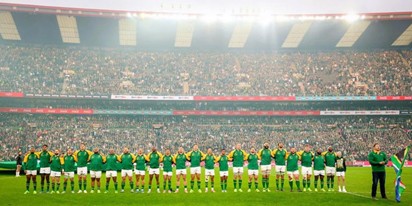

South African rugby is set to undergo a strategic shift as the Springboks prepare for their next tournament. This year, they will compete in the newly established Nations Championship, while the All Blacks—the New Zealand national rugby team—are scheduled for an extensive tour of South Africa in 2026. The Nations Championship will feature the four SANZAR countries (South Africa, New Zealand, Australia, and Argentina), along with invited teams Fiji and Japan, facing off against Europe’s Six Nations (France, Ireland, Italy, Scotland, Wales, and England). These cross-hemisphere clashes will take place in July and November, with the biennial Nations Championship crown at stake.

In total, there will be 42 matches in the 12-nation series, which culminates with a showdown between the best of the south against the best of the north at the Allianz Stadium in London in November.
Mark Alexander, president of SA Rugby, has now come out to suggest that the official launch of the Nations Championship was the “biggest step forward” for the sport since the advent of professionalism 30 years ago. “The Nations Championship is more than a tournament, it is a statement of unity and ambition,” said Alexander. “It reflects our collective belief that rugby’s future must be shaped through partnership, not fragmentation. This is the biggest step forward for the international game since the advent of professionalism.” This ‘collaboration’ comes at a time when there is increasing talk that the Rugby Championship could be permanently shifted to align with the Six Nations in a global calendar. The proposed changes, backed strongly by Springbok coach Rassie Erasmus, would aim for Test action to be more closely aligned between the southern and northern hemisphere seasons.

This tournament will shape the fate of more than twelve national rugby teams. In professional rugby, competing sides must be prepared to tackle each other for possession of the ball in order to score. They are well-trained and disciplined, ready for the intensity of their matches.
The future of professional rugby must be guided by bilateral ties and partnerships, as noted above. International sports tournaments should serve not only as contests of skill but also as opportunities to build trust and friendships across all participating nations. The Rugby Nations Championship ought to be a gathering of unity as well as ambition. While the teams compete for glory, they must also embrace the spirit of camaraderie. Rugby may be brutal, but it can act as a bridge, connecting players and supporters alike.
Spectators attend to enjoy themselves, to cheer, and to encourage their national teams. In the end, there may be only one winner, but the cultural exchange can be profound. Aligning the Nations Championship with other tournaments is essential to ensure a smooth rugby calendar, avoiding scheduling controversies and allowing for efficient transitions between competitions.
Meanwhile, the provincial rugby team, the Cheetahs, are courting Faf de Klerk to join their ranks.

The Cheetahs have emerged as shock suitors in the race to land Springbok scrum-half Faf de Klerk when his contract with Yokohama Canon Eagles runs out at the end of the season. De Klerk, who turns 35 later this year, could have played his last game for the Japan Rugby League One club after being de-registered following an ankle injury suffered while tackling Shizuoka Blue Revs wing Valynce Te Whare in December. He has been linked with several clubs, including his former employers, Gallagher PREM side Sale Sharks, where he made over 100 appearances in a five-year stint before moving to Japan back in 2022. Top 14 strugglers Perpignan also had talks, but they feared they would be unable to afford the veteran, while Pau, who are high-flying in the French top flight this year, are also keen on him.
Recruitment in rugby is a ruthless game of thrones, centred largely on who is desired by whom. Faf de Klerk is regarded as a highly valuable asset—a strategic player capable of enhancing a team’s prospects. The recruitment of professional players often hinges on who can secure a place for their team in the major leagues of South African rugby. De Klerk, or one of his teammates, could even earn a spot in the Springboks if circumstances allow.
Talent in professional sport is a rare commodity: it cannot simply be traded, but must also be valued. The skills possessed by De Klerk and others require continuous refinement through rigorous training and development. Ultimately, however, the decision rests with the player himself. Guided by his manager’s advice, he must determine which team he wishes to represent.
At present, De Klerk holds the cards, deciding where he will choose to apply his talent.
Article written by:
Yacoob Cassim
Journalist at Radio Al Ansaar