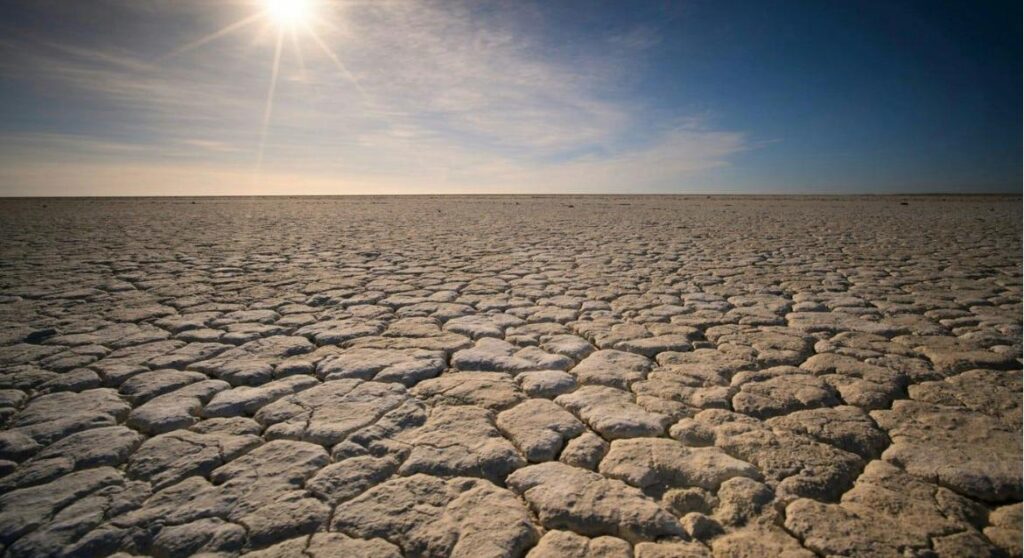

Iran isn’t just running out of water – it’s entering a phase where the explanation itself is starting to feel insufficient.
For decades, the country has been locked in a slow, grinding drought. Rainfall has declined. Reservoirs have thinned. Entire regions are struggling to sustain agriculture, while pressure on major cities continues to build. At one point, officials even considered relocating parts of Tehran due to water stress.
This isn’t a bad cycle.
It’s a system under strain – and it’s not recovering.
But something else is beginning to shift alongside it.
The scientific explanation is not complicated.
Rising temperatures have reduced rainfall. Years of poor water management have drained reserves. Groundwater has been over-extracted at unsustainable levels. Agriculture continues to consume more than the system can replenish.
The data is consistent.
The research is aligned.
But when a crisis reaches this scale, facts alone don’t always hold the narrative together.
Because a different question is starting to surface – not in official reports, but in the background.
Quietly. Persistently.
What if this isn’t entirely natural?
Claims of weather manipulation.
Accusations that rain systems are being interfered with.
Suggestions that drought itself could be influenced.
There is no evidence to support this.
But the belief is spreading anyway.
And that matters.
The idea sounds far-fetched – until you realise parts of it already exist.
Cloud seeding is real. It has been used in multiple countries to encourage rainfall by dispersing particles into clouds. Its impact is limited, inconsistent, and nowhere near capable of controlling climate patterns across an entire country.
But it doesn’t need to be.
Because the existence of even limited influence changes how people interpret possibility.
The science is clear.
The perception is not.
And perception, in a crisis like this, is not harmless.
Because when essential systems begin to fail – water, food, infrastructure – people don’t just look for explanations.
They start looking for intent.
They look for pressure points.
For actors.
For control.
Even if the explanation doesn’t fully hold.
This is where the situation shifts from environmental to unstable.
Because drought, on its own, is a crisis.
But drought combined with suspicion?
That’s something else entirely.
Analysts at the Atlantic Council warn that weakening a country’s water and energy systems doesn’t just create shortages – it creates instability.
It increases pressure on governments.
It reshapes public behaviour.
It amplifies tension across borders.
And critically, it alters how people interpret what’s happening around them.
When basic systems fail, trust doesn’t just decline.
It fractures.
And once that fracture appears, the nature of the crisis changes.
If people begin to believe that environmental systems can be influenced, then drought is no longer just a natural event. It becomes something that can be questioned. Possibly challenged. Even blamed on external forces.
There’s no proof.
But that doesn’t stop the idea from taking hold.
History makes that easier.
Weather has long been studied, tested, and, in limited ways, modified. Governments have explored ways to influence environmental conditions – not at the scale people fear today, but enough to make the concept feel less impossible.
And once something feels possible, it becomes harder to dismiss.
Even when the evidence isn’t there.
Iran’s drought is real. Its causes are well documented. Climate pressure and internal mismanagement have already pushed the system to its limits.
That part is not in question.
But something else is evolving alongside the crisis – something less measurable, but potentially just as significant.
Not in the reservoirs.
Not in the rainfall.
In perception.
Because when reality becomes too severe…
and too complex to fix…
The explanation, no matter how accurate, starts to feel incomplete.
And when that happens, people don’t just question the crisis.
They start questioning the system around it.
And once that line is crossed…
It’s no longer just about water.
Article written by:
Hudaa Ahmed
Journalist at Radio Al Ansaar