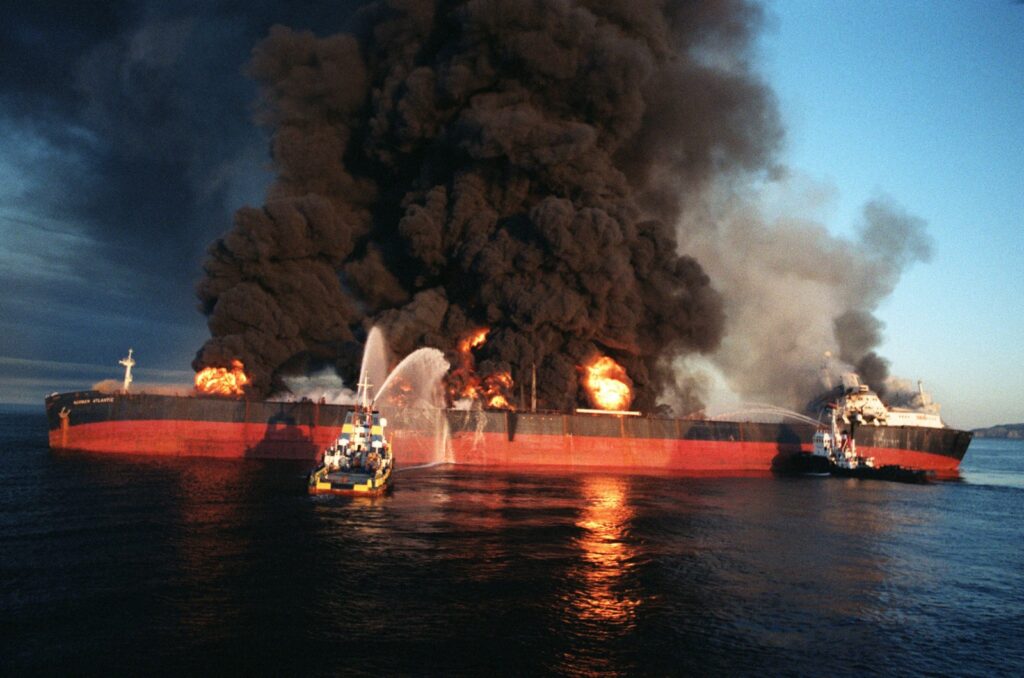

Most people won’t notice when a cargo vessel is struck at sea. But global trade doesn’t have that luxury.
When incidents begin to surface in one of the world’s busiest maritime corridors, they don’t stay contained for long – they evolve.
Reports from multiple international outlets, including Reuters, BBC News, Al Jazeera and Associated Press, confirm that cargo vessels have recently come under attack in a key strategic strait in the Middle East. Details remain limited, but maritime monitors indicate that ships navigating the corridor were struck under unclear circumstances, drawing attention from security and shipping analysts.
On the surface, this may appear to be another regional incident. However, the significance lies not in the vessels themselves, but in where the incident has taken place.
The targeted waterway is one of the most critical chokepoints in global trade. It is narrow, heavily congested, and highly exposed to geopolitical pressure. A significant portion of the world’s oil and commercial cargo passes through this corridor daily, leaving little room for disruption.
The vulnerability is not theoretical – it is structural.
Energy analysts have long identified such corridors as among the most sensitive pressure points in the global economy, where even limited instability can trigger outsized reactions in oil prices and shipping risk assessments.
Markets do not wait for confirmation. They respond to uncertainty. Insurance costs begin to shift, shipping routes are reconsidered, and exposure is quietly recalculated. Governments, too, begin monitoring developments more closely.
Incidents of this nature rarely remain isolated. Over time, similar disruptions in strategic waterways have followed a recognisable pattern: initial ambiguity, limited attribution, and a gradual shift towards sustained tension. While not always escalating into open conflict, they often result in prolonged uncertainty.
The Middle East remains a region shaped by overlapping political, economic, and military pressures. In this context, even minor incidents take on added weight, not only for what they are, but for what they may indicate.
Not all signals are immediately understood. Some are observed first, and only interpreted later.
While this incident may prove to be isolated, global systems do not operate on assumption. They respond to patterns, and even early indicators can begin to influence behaviour.
If such disruptions continue, the implications extend beyond the immediate damage. Shipping companies may adjust routes, increasing both time and cost. Insurers may raise premiums for vessels operating in high-risk areas. Energy markets may respond with volatility.
The impact does not remain at sea. It is reflected in fuel prices, grocery costs, and supply chains that are already under strain.
What starts in a narrow stretch of water rarely stays there.
Events like these are often easy to overlook in their early stages. They are characterised by limited information, measured responses, and cautious observation rather than immediate escalation.
At present, responsibility remains unclear, and official responses have been restrained. However, ambiguity does not reduce the significance of such incidents. It increases the range of possible outcomes that must be considered.
The real story lies beyond the strike itself. It reflects the fragility of global systems, the sensitivity of key trade routes, and the growing pressure on critical points within the global economy.
Disruptions of this nature do not begin with major announcements. They begin quietly.
And by the time they are widely recognised as significant, the consequences are already in motion.
Article written by:
Hudaa Ahmed
Journalist at Radio Al Ansaar