
The Xenophobic attacks last week exposed a significant barrier to Africa’s economic integration. Many could argue that although the continent’s industrialization is inextricably linked to open borders and the free movement of peoples, as well as goods and services. The riots against foreigners in Johannesburg, Durban, and Pretoria is a direct assault on the continent’s integration agenda and can’t be seen as being South Africa’s issue only. The African Union (AU), the Africa Continental Free Trade Agreement (AfCFTA) Secretariate, and every leader of an African national government who has ever signed a protocol on the free movement of persons must now answer a simple and devastating question: What are the continent’s nation states integrating if not African peoples?

Here is the central contradiction that must be stated plainly: African heads of state have, under the architecture of the African Union and the AfCFTA, committed themselves to creating a single continental market one that includes the free movement of persons, not just goods. The AU’s Protocol on Free Movement of Persons, adopted in 2018, envisions an Africa where citizens can live and work anywhere on the continent. The AfCFTA, described as a $3.4 trillion economic integration project, cannot function if the people who are supposed to trade across borders are afraid to cross them. And yet, according to the latest GovDem Survey of the Inclusive Society Institute, 73 percent of South Africans report not trusting African immigrants “at all” or “not very much.” South Africa the country that accounts for over 40 percent of all intra-African trade, the continental powerhouse without whose participation AfCFTA loses much of its gravitational force is also the country where intra-African trade is least safe in human terms.

To be clear on this issue, xenophobia is not a positive response to expanding a local person’s commercial prosperity, it is detrimental. Total isolation from your neighbours is not a positive practice in the business arena. Every country in the world is going to have foreign expatriates living in it to a certain degree. The free movement of peoples, goods and services is a part and parcel of trading between neighbouring nations. In the case of ‘peoples” this involves having them live as permanent residents with in the host country. A business relationship depends on mutual trust and respect and if your trade partners on the other end are not feeling either trust or respect towards you then your business relationship is in jeopardy.
South Africa will not be a power house for long if it continues in this manner of violence and distrust towards its neighbours. Disapproval between neighbours and business partners can go both ways. In South Africa’s case the disapproval caused by xenophobia is painting a negative image of the nation for not only southern Africa and other parts of the continent but the rest of the world.
The African Chamber of Content Producers put it with blunt precision: intra-African trade stands at just 14 percent of total African trade, compared to roughly 60 percent in Asia and Europe. Xenophobia is not merely a moral outrage in this context. It is a structural barrier to integration as consequential as any tariff wall or non-tariff barrier. You cannot have free trade without free movement. You cannot have free movement without safety. And you cannot have safety while your government denies that the attacks are even happening.
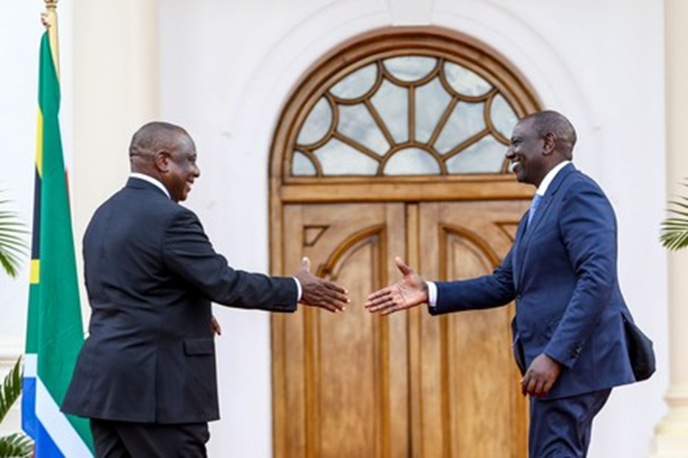
President Cyril Ramaphosa’s indecisiveness over the xenophobic attacks could cost South Africa both diplomatically, commercially and financially. The challenge of mass prejudice is detrimental to economic growth and job creation. Education on the consequences of believing prejudices based on anger and ignorance must be implemented. Ramaphosa, the Government of National Unity (GNU) and the political establishment surrounding them risks isolating the country from the AU and the country’s regional economic community; the Southern African Development Community (SADC). Yesterday Ramaphosa had met with his Kenyan counterpart President William Samoei Ruto to discuss trade.
The leaders are also expected to explore opportunities presented by the African Continental Free Trade Area (AfCFTA), infrastructure development projects such as the LAPSSET Corridor, as well as investments in renewable energy and logistics. Following the official talks, President Ramaphosa and President Ruto will participate in a signing ceremony and media briefing before attending a South Africa-Kenya Business Forum at Gallagher Estate in Midrand.
The meeting between Ramaphosa and Ruto is strategic and crucial to an economic relationship between Pretoria and Nairobi. Ruto like many of his colleagues across Africa might have grown weary of Ramaphosa’s external charm. They (the leaders) are not blind to the mistreatment their countrymen suffer at the hands of South Africans when they come to do business or work here to send income home. If South African society as a whole does not clean up its act it will lose more than it had bargained for.
Article written by:
Yacoob Cassim
Journalist at Radio Al Ansaar