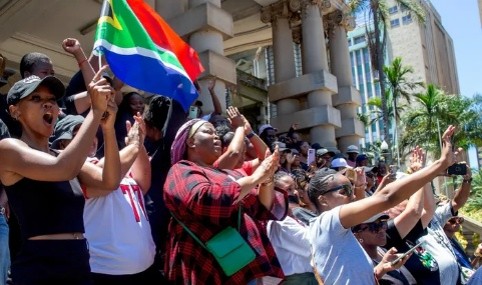

Thirtieth of June, the infamous deadline given by the anti-immigrant vigilante movement March on March has arrived. This is when the ultimatum that all foreigners (those present in South Africa illegally) must leave. Both the police and even some military units are out in full force in Durban. Many across the city are petrified with fear. However, the March and March movement and its leader DJ Jacintha Ngobese-Zuma claims their main target is illegal migrants and those who employ them. The demonstrations are fuelled by fear that migrants are taking South Africans’ jobs, although there is no basis for that.

While initial confusion reigned when Ngobese-Zuma accused the eThekwini Municipality of declining their request to march, it seems that they will be allowed to do so, but through an alternative route to the one they had sought. Similarly, in Johannesburg, the City has confirmed that the anti-foreigner grouping has applied to march through Hillbrow, among other places. There is a reason why they are targeting Hillbrow in Johannesburg and the Point precinct in Durban. These are areas most inhabited by foreign nationals. To march through these areas would only serve one purpose, to provoke the residents and foment violence. South Africa is a country with the rule of law and a strong constitution with human rights at the centre.

The March and March demonstrators are being provocative. They feel their jobs are being taken away from them, by the illegal migrants. However, the fault needs to be examined and the blame placed at the setup of South African society. Politically, it is the government and political structures (parties) that are responsible for growing the economy and offering alternatives for employment creation respectively. It is good the municipalities of Johannesburg and Durban prevented March and March from infiltrating those neighbourhoods where many expatriates are in residence. It should be noted that regardless of what the vigilante movement says, even those expatriates with legal documentation are being attacked. The rule of law must prevail, and the truth about who is pulling the strings of March and March must come to light.

Citizen-led groups have backed the unofficial deadline after weeks of unrest, including attacks on migrant-owned businesses. South Africa, one of Africa’s largest economies and a nation of some 65.5 million people, has long attracted migrants seeking work. Estimates put foreign-born residents at between 2.4 to 3.1 million. But unemployment in South Africa remains among the highest in the world, with about a third of people out of work and deep inequality fueling public anger. Some activists blame migrants for crime and pressure on public services, though rights groups warn such claims risk inflaming tensions.
A key issue South Africans need to keep in mind is that African nations, particularly those of the southern African region are interdependent. If we isolate ourselves from the main body, then we risk cutting ourselves off from vital resources and trade. To call for the forced removal of all foreigners from the country will create friction with our neighbours, especially those that have business relations with South Africa. When it comes to improving and growing the South African economy, it cannot be done without the cooperation of the Southern Africa region and the Southern African Development Community (SADC) in particular.
Exclusion of citizens from those countries and other African nations will see us excluded from business and trade relations with those countries concerned. Inclusion rather than exclusion is the key to economic success.
Article written by:
Yacoob Cassim
Journalist at Radio Al Ansaar