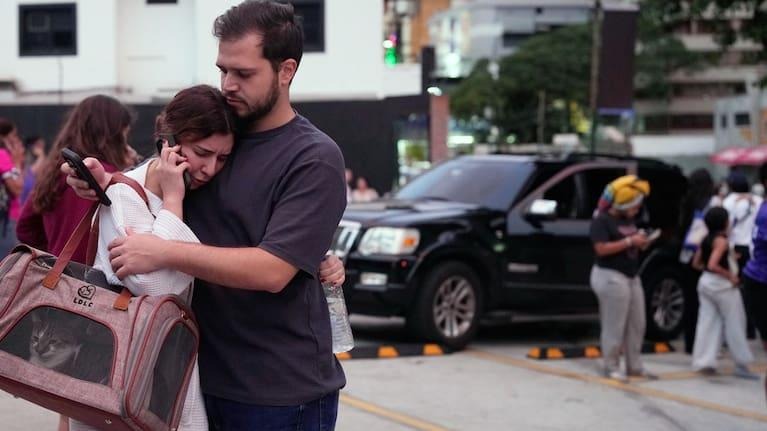

For months, they had lived with uncertainty.
Detention. Immigration hearings. Deportation.
When more than 100 Venezuelans boarded a flight from the United States back to their homeland, many believed the hardest part of their journey was finally over. Families waited for the phone call that would confirm their loved ones had landed safely. Some were already planning reunions after months, and in some cases years, apart.
Those calls never came.
Instead, within hours of arriving in Venezuela, many of the deportees were taken to temporary accommodation at the Hotel Santuario La Llanada in the coastal state of La Guaira. Before they had the chance to unpack a suitcase or embrace their families, two powerful earthquakes measuring 7.2 and 7.5 struck northern Venezuela, reducing homes, hotels and apartment buildings to rubble.
In a matter of seconds, a journey home became a desperate fight for survival.
Among the collapsed buildings was the hotel housing dozens of recently deported Venezuelans. What was intended to be a temporary place of safety became one of the disaster’s most heartbreaking symbols—a reminder that for some people, surviving one crisis does not always mean escaping the next.
For families, the nightmare unfolded from hundreds or even thousands of kilometres away.
Instead of celebrating a safe return, they began calling hospitals, emergency shelters and government officials, desperately trying to find out whether their loved ones had survived. According to Reuters, some relatives said they struggled to determine whether family members had even been inside the collapsed hotel. Others reported that deportees no longer had access to mobile phones or identification documents after arriving in Venezuela, making an already agonising search even more difficult.
Every unanswered phone call deepened the uncertainty.
The Associated Press reported that survivors described crawling through shattered concrete, helping strangers escape and searching frantically for fellow deportees who had been sleeping only metres away when the building gave way. While some were pulled alive from the rubble, many others remain unaccounted for, leaving families clinging to hope with every passing hour.
Across La Guaira, rescue operations have continued around the clock despite repeated aftershocks. Firefighters, soldiers, volunteers and international rescue teams have worked tirelessly, often risking their own safety to search unstable buildings where every sound beneath the concrete could signal another survivor.
But as rescuers searched for signs of life, engineers began asking a different question.
Why did so many buildings fail?
According to Reuters, structural engineers are now calling for urgent inspections of ageing apartment blocks, hotels and state housing developments across Venezuela. They argue that while earthquakes cannot be prevented, disasters on this scale are often made worse by ageing infrastructure, inadequate maintenance and buildings that were never prepared to withstand such powerful seismic activity.
The concern now stretches far beyond the buildings that have already collapsed.
If one hotel intended to shelter returning migrants could fail so catastrophically, how many other ageing structures remain standing with the same hidden weaknesses?
For humanitarian organisations, the tragedy has also highlighted the vulnerability of people returning to countries already facing significant economic and social challenges. Rights groups told Al Jazeera that many deportees arrived home hoping to rebuild their lives. Instead, they found themselves caught in one of the country’s worst natural disasters in decades before they had even reached their own communities.
Perhaps that is what makes this story so difficult to forget.
It is not only about an earthquake.
It is about the cruel collision of two crises.
One created by borders.
The other by nature.
Neither gave its victims a chance to recover before the next one arrived.
Eventually, the rubble will be cleared.
Buildings will be rebuilt.
Roads will reopen.
Life, as it always does, will slowly move forward.
But for the families still refreshing missing-person lists, answering every unknown phone call and hoping for news that their loved one has been found alive, the aftershocks are no longer measured by seismographs.
They are measured by uncertainty.
And when the rescue operation finally ends, Venezuela may be left with a question that reaches far beyond this disaster:
Did the earthquakes simply destroy buildings… or did they expose vulnerabilities that had been waiting years to be uncovered?
Article written by:
Hudaa Ahmed
Journalist at Radio Al Ansaar