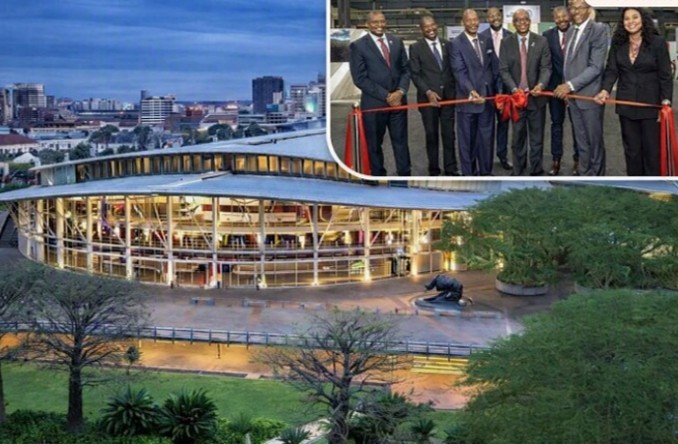

Last week Durban had the honour of hosting the ninth Southern African Development Community (SADC) Industrialization Week, and on paper it reads like a fairly standard regional-summit exhibition, where leaders and representatives of government, business and investors gather at the Durban International Convention Centre (ICC) for five days of panels and stands dedicated to the goal and agenda of industrialization.
The programme for industrialization according to the fare’s organizers; will be built around the continent’s infrastructure, agriculture and critical minerals, settles squarely in the centre of one of the most consequential economic questions happening in Africa: Who will have the monopoly to determine how the continent’s mineral wealth is processed, and where?

SADC’s position is interesting because it sits at the geographic center of the answer. The Democratic Republic of Congo and Zambia have cobalt and copper. Zimbabwe has some of the continent’s most significant lithium deposits. South Africa has the one thing most of its neighbours don’t: established chemical processing infrastructure, research institutions and a partially developed battery-materials industry. No single SADC country has the full package of the mines, energy, transport, processing capacity and finance needed to turn raw minerals into finished battery-grade products alone. That’s precisely the gap regional value chains are meant to close, and it’s why “regional integration” keeps showing up as the answer in almost every recent African minerals strategy paper, not just this week’s Durban agenda.

South Africa has the capacity to guide SADC nations to utilize the southern African region’s rare and precious minerals to benefit the peoples of southern Africa as whole. It will largely depend on the leadership of South Africa and SADC member states. It is the position of being the continent’s industrial hub that makes South Africa stand out as the Gateway to the African Common Market, especially in the south of Africa. South Africa has the means such as the infrastructure as stated in the above extract to export to its fellow SADC members. When it comes to innovation, infrastructure is the corner stone on which all industrial marvels are built from. Economic integration of the SADC market through infrastructure can make the entire southern region of Africa an industrial giant to rival other emerging economies such as India and Brazil, although it would have a long path to follow to rival China.
Challenges and obstacles on this path for South Africa and southern African nations are deficits in infrastructure deficits, energy shortages; load shedding especially in South Africa which Pretoria/Tshwane is now addressing, logistics bottlenecks, policy uncertainty, skills gaps, governance and corruption risks in several mineral-rich members, and competition from global processors; especially the Chinese. However it must be noted that doing anything worth wile is not easy.
This Conference for industrial integration took place in Durban, a key port for exports from the African continent. The venue for the exhibition spent R 11.3 million on upgrading the building’s infrastructure.
- R6 million to replace the ICC’s defective Building Management System (BMS)
- R2 million to upgrade the front-of-house emergency door mechanism
- 3 million to refurbish the venue’s operable wall systems
The report presented by the eThekwini Executive Committee also stated in the report from which the above information came that the funding included upgrades to air conditioning systems and other infrastructure required to ensure the venue is fully prepared for the summit.
The municipality said the investment would not only ensure the successful hosting of the summit but also strengthen the Durban ICC’s long-term value as one of the city’s key strategic assets. Hosting the event is expected to provide Durban with an opportunity to showcase itself as a leading destination for international conferences and business events while boosting its profile as a hub for regional cooperation, trade and investment. The city added that the summit would attract heads of state and government, senior policymakers, business leaders and development partners from across the 16-member SADC bloc.
The ICC is a venue that showcases Durban Metro as a world class city. This is appropriate given Durban’s status as an international port. The ICC is a necessity for hosting major commercial, political and international gatherings. It is an asset that provides the hospitality, tourism and holiday resort industries with customers. The ICC stands out from the rest of eThekwini region as the conference venue that brings the rest of the country and the world to Durban. SADC as a regional bloc is now currently hosted by South Africa and the next Summit for its heads of State and Government will be at the ICC in Durban.
A five-day conference can only lay part of the ground work for the labour ahead, more discussion and deliberation will follow. It will be up to President Cyril Ramaphosa as host to persuade his fellow SADC leaders to push forward the industrialization agenda at the Summit so that all sixteen participating nations can benefit, by growing their economies, creating jobs and generating income.
Article written by:
Yacoob Cassim
Journalist at Radio Al Ansaar