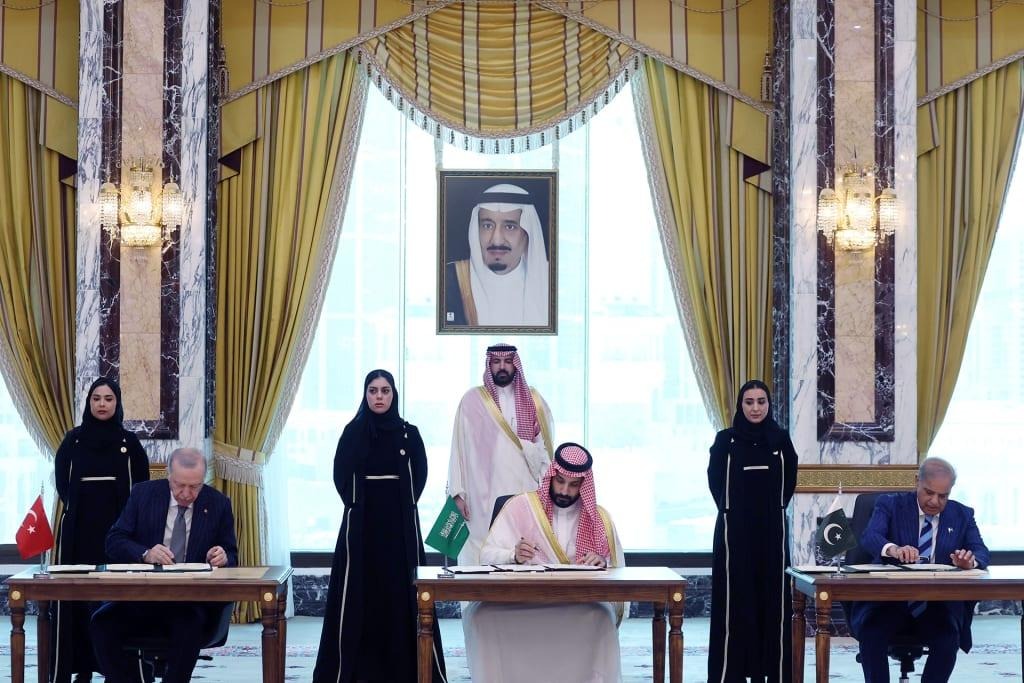
Leaders of Saudi Arabia, Türkiye and Pakistan sign the historic Makkah Joint Defence Agreement in a formal ceremony marked by religious and political symbolism. Image: Supplied
Makkah is the city towards which Muslims around the world turn in prayer. Now, its name has been placed on the Makkah Joint Defence Agreement, a collective security pact signed by Saudi Arabia, Türkiye and Pakistan that has already been compared with NATO.
The pact states that an armed attack against one member will be regarded as an attack against all three. However, it is not yet a fully developed military alliance, and the precise form of assistance would be decided through consultation.
What is the Makkah Joint Defence Agreement?
The Makkah Joint Defence Agreement was signed on 7 August 2026 by Saudi Crown Prince Mohammed bin Salman, Turkish President Recep Tayyip Erdoğan and Pakistani Prime Minister Shehbaz Sharif.
Turkish Foreign Minister Hakan Fidan said the agreement’s central principle was technically similar to NATO’s Article 5, which treats an attack on one member as an attack on the entire alliance.
However, the Makkah Pact does not automatically require all three countries to enter a war. The type and scale of assistance provided would still be determined through consultation between the members.
Why was the Makkah Pact signed in Islam’s holiest city?
The agreement is not connected to Hajj or Umrah. It is called the Makkah Pact because it was signed in the holy city, although its location gives the alliance considerable religious and political symbolism.
The Saudi Arabia, Türkiye and Pakistan defence pact was created as regional governments reconsider their dependence on the United States and other outside powers for security. Its central question is whether Muslim nations can build their own system of collective protection.
On 31 August, foreign ministers, defence ministers and senior military commanders held the first meeting of the pact’s Strategic Political Defence Committee in Istanbul.
The countries agreed to strengthen military coordination, encourage cooperation between their defence industries and establish a permanent secretariat in Saudi Arabia. They also committed themselves to de-escalation, restraint and the peaceful resolution of regional crises.
What do Saudi Arabia, Türkiye and Pakistan bring to the alliance?
Each member contributes a different form of power.
Saudi Arabia brings substantial financial resources, global energy influence and religious standing. Türkiye has NATO’s second-largest military and a rapidly developing defence industry. Pakistan contributes extensive military experience and remains the only Muslim-majority country known to possess nuclear weapons.
Together, the three countries appear formidable. At least on paper, where alliances are always united and nobody receives an inconvenient phone call.
The true test will come during a crisis. Would Türkiye and Pakistan enter a confrontation to defend Saudi Arabia? Would Riyadh provide meaningful support if Pakistan were attacked?
The agreement promises collective defence, but its full operational rules, command structure and military obligations have not been made public.
Could Iran join the Makkah Pact?
Iran could become the decisive factor in the pact’s future.
If Tehran remains outside, the agreement could be interpreted as a Sunni-led Middle East security alliance created partly to contain Iranian influence. That could deepen regional divisions instead of promoting Muslim unity.
If Iran eventually joins, however, the Makkah Pact could become something far more ambitious: a Muslim defence alliance crossing the Sunni-Shia divide.
Iranian involvement could create opportunities for dialogue over the Strait of Hormuz, regional armed groups and military tensions across the Middle East. It would also require an extraordinary level of trust between governments with competing interests.
The members would need clear rules covering intelligence sharing, emergency communications, freedom of navigation and the actions of armed groups supported by participating states. Speeches about Islamic unity are simple. Remaining united when national interests collide is the actual examination.
What could the Makkah Pact mean for Palestine?
Saudi Arabia, Türkiye and Pakistan have expressed support for Palestinian statehood. However, it remains unclear whether Palestine will become part of the pact’s practical security strategy or remain within its diplomatic messaging.
This distinction matters. The agreement will be judged not only by what its members say about Muslim solidarity, but also by whether they coordinate diplomatic, economic or security responses when Muslim populations face conflict.
Is the Makkah Pact really a Muslim NATO?
Not yet.
The Makkah Pact has a collective defence commitment, a strategic committee and plans for a permanent secretariat. However, it does not yet have a publicly defined joint command, automatic military response, common deployment system or clear funding arrangement.
The Makkah Pact will ultimately be judged not by the symbolism of the city in which it was signed, but by what happens when unity becomes difficult and expensive.
For now, it is neither a fully developed Muslim NATO nor an empty political gesture. It is a promise. Whether that promise becomes a genuine collective shield may depend on Iran, the decisions of its founding members and their willingness to place shared security above regional rivalry.