The Impact of Language and Socio-Economic Conditions
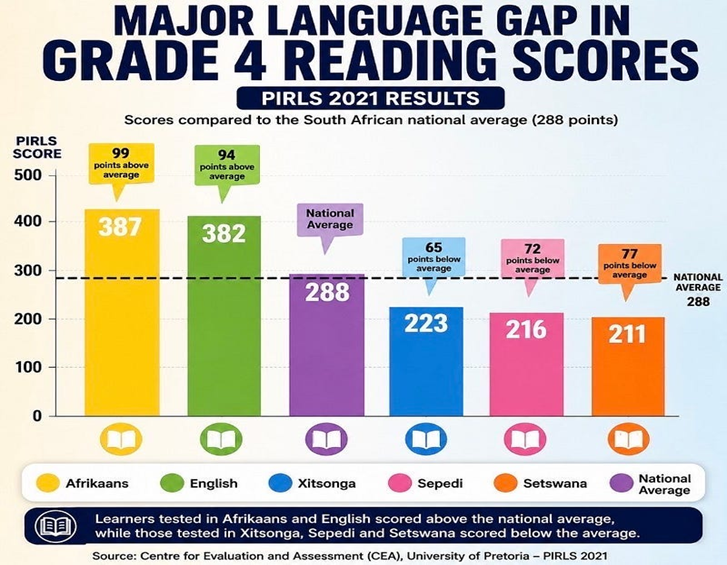
The PIRLS 2021 report also found noticeable differences in reading performance across official languages. However, the study suggests these gaps go beyond mere language differences. Instead, they link closely to the conditions in which many children grow up and learn.
Factors like limited access to books and poorly resourced schools heavily impact students. Additionally, the level of reading encouragement children receive at home plays a critical role in shaping their abilities.
Research from the Centre for Evaluation and Assessment (CEA) reveals a clear gap across language groups. Learners assessed in English and Afrikaans achieved the highest reading scores. Meanwhile, students assessed in Xitsonga, Sepedi, and Setswana recorded lower levels of reading comprehension.
These differences require a broader view alongside socio-economic conditions and educational resources. South Africa has 11 official languages and highly unequal learning environments. Therefore, the findings highlight a desperate need to give all learners equal opportunities to develop strong comprehension skills.
Lack of Books Fuels the South Africa Reading Crisis
Solving this literacy challenge will require a massive collective effort. Communities must improve learning environments, expand access to reading materials, and foster a strong reading culture.
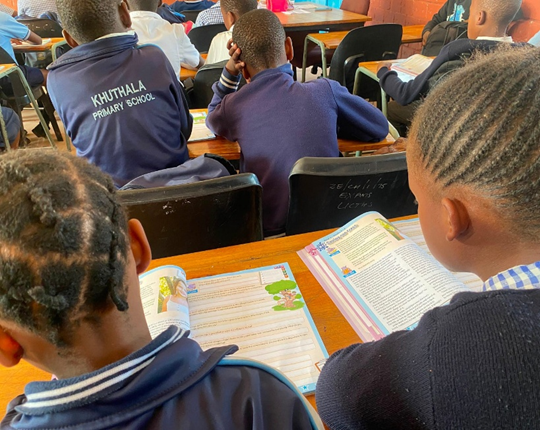
Lungile Hadebe teaches at Khuthala Primary School. She stated that limited access to books remains a major hurdle for her students.
“One of the biggest challenges we face is that our learners do not have access to books. Our school does not have a library. Ultimately, this limits their opportunities to develop a culture of reading,” Hadebe explained.
The Struggle Begins in the Foundation Phase
This problem does not suddenly start in Grade 4. It begins much earlier in Grades 1, 2, and 3. During these years, teachers expect learners to develop basic reading skills. By Grade 4, these early struggles become a much bigger problem because teachers expect learners to read to learn across other subjects.
The Funda Uphumelele National Survey (FUNS) highlights just how deep this problem runs. The survey assessed 27,838 learners across 710 schools. It measured whether children were reaching nationally developed reading benchmarks in the Foundation Phase.
In Grade 1, only 31% of learners reached the expected Home Language Reading Benchmark. In Grades 2 and 3, just 30% reached their respective grade benchmarks. Even more concerning, 15% of Grade 3 learners could not read a single word by the end of the year.
According to FUNS, the problem affects learners differently. The survey found significant differences based on language, province, gender, and socio-economic background.
Learners assessed in English were more likely to reach the benchmarks. Similarly, learners in the Western Cape and Gauteng performed better than those in other provinces.
This educational inequality becomes even clearer when comparing schools. Children in quintile 5 schools were roughly twice as likely to reach the reading benchmarks compared to children attending no-fee schools in quintiles 1 to 3.
Mugwagwa Madonsela serves as the principal at Njanji Primary School. He firmly links this struggle for meaning directly to limited reading resources.
“One of the leading causes of this crisis is that many no-fee schools do not have libraries. Learners often only have textbooks. However, textbooks focus on specific subjects and do not necessarily develop a child’s fundamental reading ability,” Madonsela said.
The Growing Gender Gap in Literacy
A child’s learning environment undoubtedly shapes their reading ability. However, the differences in performance do not end there. Gender also emerges as a massive division in the South Africa reading crisis.
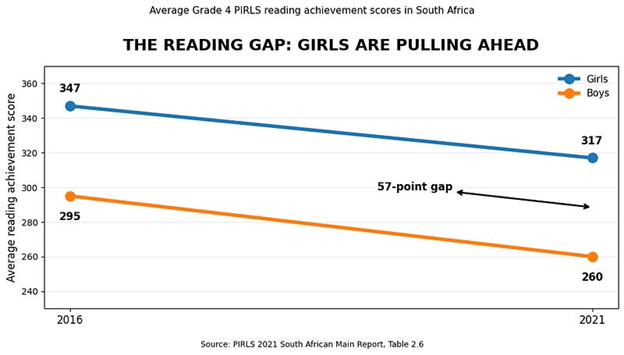
The PIRLS 2021 data shows that girls perform considerably better than boys. Grade 4 girls recorded an average reading score of 317 points in 2021. Conversely, boys scored only 260 points, creating a massive difference of 57 points.
This gap already existed in 2016 when girls scored 347 points and boys scored 295. Unfortunately, the gap widened by five points by 2021. Both groups experienced a decline in performance recently. However, boys recorded a larger drop of 35 points compared to a 30-point decline among girls.
These figures introduce another difficult question. Why are boys falling further behind girls when it comes to understanding what they read?
Zanele Shezi is a school governing body (SGB) member. She revealed a clear pattern she observed during extra reading classes.
“From what I have observed, boys tend to lose focus more easily than girls. They struggle to stay attentive during the reading lessons. I believe this may be one of the reasons why they are falling behind,” Shezi said.
Technology and the University Struggle
This lack of comprehension eventually follows students to higher education. Professor Theodora Dame Adjin-Tettey lectures at the Durban University of Technology. She noted that some students have become entirely accustomed to consuming information through videos and audio.
“Other reasons contributing to students at the university level not reading with comprehension stem purely from laziness and technology habits. Students would rather look for a video than read a prescribed text,” she explained.
Families Fighting the Reading Crisis
Behind all these numbers are real children experiencing this struggle every day. For many parents, seeing a child struggle to understand a simple story feels incredibly frustrating and worrying.
Neliswa Phewa has a Grade 4 daughter who struggles to read for meaning. She has enrolled her child in extra classes and actively encourages her to read daily.
“I noticed my child was struggling to read for meaning, so I enrolled her in extra classes. I also started buying her books and encouraging her to read every day to build a culture of reading at home,” Phewa shared.
The South Africa reading crisis is far more than a collection of statistics. It represents a harsh reality for children, teachers, and families every single day. From socio-economic challenges and gender gaps to struggles that follow learners into university, this massive problem reaches far beyond the primary classroom.