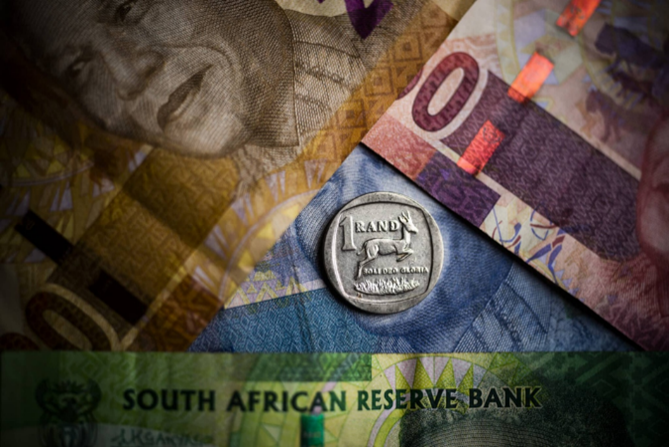

The value of South Africa’s Rand currency decreased on Tuesday as the United States (US) resumed strikes on Iran on Tuesday. This has brought any hopes of a permanent peace to ruin. The delicate truce in place between the US and Iran was jeopardized after the US military conducted what it described as defensive strikes, which Tehran condemned as a “gross violation” of the seven -week ceasefire.

Despite this, both sides indicated that progress was being made toward an agreement that would end the conflict and allow shipping to resume through the blockaded Strait of Hormuz. On the domestic front, South Africa’s composite leading business cycle indicator, which measures economic momentum, rose by 2.4% in March. “The continued increase in the leading indicator suggests that, before recent developments, the domestic economy was on track for another year of improved economic growth,” said ETM Analytics. Market attention is currently focused on the South African Reserve Bank’s Monetary Policy Committee meeting scheduled for Thursday, where economists polled by Reuters anticipate a 25-basis-point rate hike.
On the Johannesburg Stock Exchange, the Top-40 index closed down 0.2%. Additionally, South Africa’s benchmark 2035 government bond weakened, with the yield rising by 2.5 basis points to 8.54%.

It would appear that South Africa like so many other developing world nations will have to look for alternative sources of energy elsewhere. Oil Prices are unlikely to be reduced if South Africa continues to export from the same source (the Middle East). Alternatives can either be renewables such solar, wind or hydraulics or even hydrogen. If South Africa has to continue to use fossil fuels for a time, Nigeria and Angola could prove to be alternative markets. The good news though is that, the country’s composite leading business cycle indicator has increased due to good business decisions. South Africa must look to creating security and stability within Africa to accelerate economic integration to access the continent’s energy potential.
Although Pretoria’s government bond weakened, it shows that investment should be directed to alternative markets that are neutral in the US-Israel led war on Iran. Until negotiations lead to a more sustainable peace, Pretoria must reconsider alternative energy trade partners.
Cape Town has become the first South African city to successfully implement the country’s first pooled wheeling model for renewable energy across multiple properties within a municipal electricity network. This was done in cooperation with Etana Energy and Growthpoint Point Properties.

The initiative marks the next phase of renewable electricity wheeling in Cape Town following the launch of the city’s first wheeling pilot project with Growthpoint and Etana Energy in 2023. The first pooled renewable electricity allocation was completed in April 2026. The project enables renewable electricity generated at remote sites to be allocated across multiple buildings connected to Cape Town’s municipal grid, rather than linking supply to individual properties.
This decision for infrastructure progress, will supply electricity to other provinces such as the Free State. It is a good part for renewable energy in South Africa. The country is progressing to a new age in energy. It can transition to sustainable energy as is shown in the Western Cape by this pilot project. What is needed is to attract investment from the private sector, to grow this sector. It will also depend how the government, President Cyril Ramaphosa and Electricity Minister Kgosientsho Ramokgopa responds.
Article written by:
Yacoob Cassim
Journalist at Radio Al Ansaar