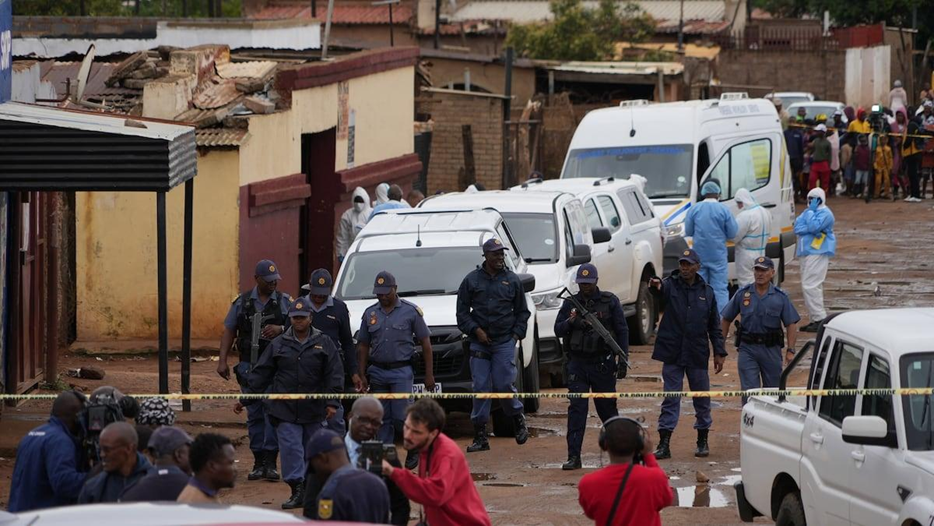
South Africa is once again confronting questions about violent crime after 40 people were killed in three separate mass shootings within days.
The attacks took place in KwaMakhutha in KwaZulu-Natal, Wedela in Gauteng and Lwandle in the Western Cape. While investigators have found no evidence linking all three incidents, the scale of the bloodshed has renewed concern about illegal firearms and the country’s ability to prevent mass casualty crimes.
The shootings have also raised broader questions about crime intelligence, border security and the growing availability of high-powered weapons in criminal networks.
Three Mass Shootings Leave 40 Dead
The first attack occurred in KwaMakhutha, south of Durban, where armed men opened fire on a gathering at a homestead in the Ziko area.
Initially, several victims were rushed to hospital. However, the death toll later rose to 12 people. Police have not ruled out gang rivalry as a possible motive.
Days later, two more mass shootings unfolded within hours of one another.
In Wedela, near Carletonville on Gauteng’s West Rand, gunmen armed with AK-47 rifles and pistols opened fire on patrons inside and outside a tavern.
The death toll later increased from 17 to 18 people. Police have launched a manhunt for eight suspects believed to be involved.
Investigators are examining whether the attack may be linked to an earlier shooting at the same tavern. Authorities are also exploring the possibility of retaliation between rival groups.
Just hours after the Wedela massacre, another deadly attack occurred in Lwandle, near Cape Town.
Gunmen opened fire at a shisanyama, killing 10 people and injuring 11 others. Police have since launched an investigation to determine the motive and identify those responsible.
Together, the three shootings claimed 40 lives, making them among the deadliest incidents reported in South Africa in recent months.
Illegal Guns Under Renewed Scrutiny
The latest mass shootings have shifted attention beyond the crime scenes themselves and toward a critical question: where are criminals getting these weapons?
Crime and justice expert Professor Jacob Mofokeng from the Tshwane University of Technology has argued that illegal firearms remain one of South Africa’s biggest crime challenges.
According to Mofokeng, weaknesses in border control and crime intelligence have enabled the movement of illicit firearms into the country. He believes criminal networks continue to exploit these vulnerabilities, supplying weapons to violent groups.
He also noted that the true number of illegal firearms circulating in South Africa remains unknown.
The use of military-style rifles in attacks such as the Wedela shooting highlights the ease with which some criminal groups appear able to access deadly weapons.
As a result, investigators are facing questions not only about those who carried out the attacks, but also about the networks supplying the firearms.
Crime Intelligence Faces Tough Questions
The shootings have also renewed debate around the effectiveness of crime intelligence operations.
Experts argue that monitoring criminal groups and identifying illegal firearm trafficking routes could help prevent future tragedies.
This issue is particularly relevant in the Wedela case, where police are investigating possible links to previous violence at the same tavern.
In KwaMakhutha, investigators are also examining whether gang rivalry played a role.
Although the cases are separate and involve different circumstances, they collectively highlight the challenge of disrupting armed criminal networks before attacks occur.
Mass Shootings and Their Impact on Communities
South Africa already faces high levels of violent crime.
Against that backdrop, repeated reports of mass shootings can leave lasting effects on communities, families and young people.
The concern extends beyond individual perpetrators. Community leaders and crime experts warn that repeated exposure to extreme violence risks creating an environment where such incidents begin to feel normal.
For many South Africans, that possibility is deeply troubling.
Mass shootings should remain rare and shocking events. However, the recent attacks have sparked fears that communities are becoming increasingly accustomed to seeing large-scale violence in the headlines.
The Bigger Question for South Africa
Police investigations into the KwaMakhutha, Wedela and Lwandle shootings remain ongoing.
Authorities are working to identify suspects, establish motives and determine whether any criminal networks were involved.
Yet even if investigators solve each case, broader questions remain.
Can illegal firearms be intercepted before they reach criminal groups? Can intelligence services better identify emerging threats? And how can communities be protected from future mass casualty attacks?
For the families who lost loved ones, those answers will come too late.
For the next generation of South Africans, however, finding those answers may prove critical.