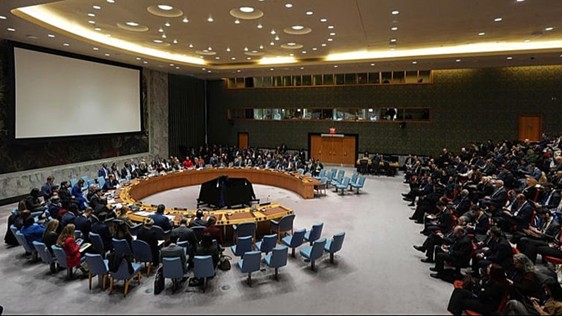

The United Nations Security Council (UNSC) was engaged in a heated debate on Monday over the United States Operation “Absolute Resolve” in which Venezuelan President Nicolás Maduro and his wife Cilia Flores were captured and extracted by a team of American commandos as the US Air Force and Navy launched strikes in northern Venezuela and the capital, Caracas. The representatives of the fifteen member UNSC panel is inclusive of both allies and opponents of the US Venezuela operation. Maduro and his spouse are on trial in New York on drug trafficking conspiracy charges. The events of operation Absolute Resolve were unprecedented in world history and could have serious consequences for international diplomacy.
Notable critics at the emergency session included traditional US allies, Mexico and Denmark, both of whom (US President Donald) Trump has separately threatened with military action over the past year. Mexico’s ambassador, Hector Vasconcelos, said that the council had an “obligation to act decisively and without double standards” towards the US, and it was for “sovereign peoples to decide their destinies,” according to a UN readout. His remarks come just days after Trump told reporters that “something will have to be done about Mexico” and its drug cartels, following Maduro’s abduction. Denmark, a longstanding US security ally, said that “no state should seek to influence political outcomes in Venezuela through the use of threat of force or through other means inconsistent with international law.”
“The inviolability of borders is not up for negotiation,” Denmark’s ambassador, Christina Markus Lassen, told the council in an oblique reference to Trump’s threat that the US would annex Greenland, a self-governed Danish territory.

The threats by Trump to target drug cartels in Mexico and annex Greenland serve as a warning that the US president is capable of extreme measures. Trump’s words carry the weight of his actions no matter how consequential those actions are. If Trump is serious about tackling Mexican drug cartels, he should take into account their own resources and capabilities. The cartels of Mexico like most forms of organized crime, act according to their own bases of codes and laws. They will not take threats coming from the White House lying down. No one truly knows the extent of their strengths or whom they would target. In Latin America alone the cartels and gangs are notorious for their ruthlessness. It may take a more cautious approach to deal with these criminals. Trump may have also underestimated the influence of Latin America state allies, with the possible exception of Argentina.
Denmark and its European allies may not accept any unilateral action by Trump to invade Danish territory. The nation of Denmark may be small but they have a close-knit alliance of European nations in support of it. Trump may even risk causing the breakup of the North Atlantic Treaty Organization (NATO) including Canada should he attempt to invade Greenland.
Meanwhile as Maduro’s Vice President Delcy Rodriguez serves as Venezuela’s interim-leader, the opposition are preparing for a democratic transition, set in motion by Maduro’s capture. A figure who has emerged as a likely candidate for change is María Corino Machado who had previously been living in hiding due to security threats.

After the capture of Maduro, there were hopes that the (alleged) 58-year-old Nobel Peace Prize laureate would fill in the political vacuum in Venezuela and restore democracy in the country. Even though Machado came out in support of Maduro stepping down, no one knows where the exiled opposition figure is, fueling speculation on social media, as, since Maduro’s capture, Machado has limited her public appearances. While on the contrary, U.S. President Trump also showed concerns by ruling out Maria Machado as a future leader of Venezuela, claiming she lacked the necessary “respect” and “support” in the country.

Trump it should be apparent is not an expert on Venezuelan politics. There are others such as US Secretary of State Marco Rubio, Secretary of War Pete Hegseth and Trump’s ambassador to the United Nations Mike Waltz who advise him. It is also a possibility he is unlikely to have the Venezuelan people’s interests at heart. Whereas Machado may enjoy a certain degree of popular support, real political power in Venezuela – as in most authoritarian regimes – is wielded by the armed forces. It is the paramount priority of the Venezuelan military to maintain the status quo regardless of who is in office. Venezuela is a major oil-producing country; while Washington and American and other western corporations have a wary eye on the country’s petroleum industry. It should be clear that Trump and his inner circle of advisors and allies as well as the Venezuelan military may desire some person other than Machado to lead Venezuela. time will be the determining factor in the outcome.
Article written by:
Yacoob Cassim
Journalist at Radio Al Ansaar