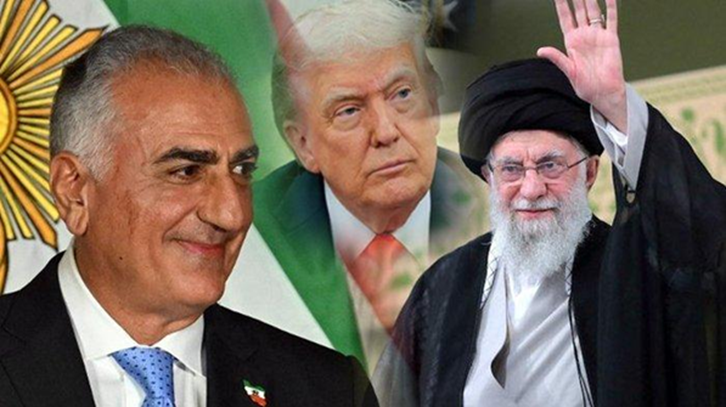

Mass demonstrations in Iran, calling for the ousting of Supreme Leader Grand Ayatollah Ali Khamenei, have escalated. The mass movement across the streets of Iran’s major cities, has resulted in 538 people dead (according to BBC estimates), in violent clashes with police and the arrest of over 2,200 civilian demonstrators. The unrest was sparked by the collapse of the Iranian Rial, amid soaring inflation, as well as an address by the exiled Crown Prince Reza Muhammad Pahlavi, son of the late deposed Shah (King) Muhammad I Reza Pahlavi of Iran. In his speech, the Crown Prince urged Iranians to assemble in mass street demonstrations. The last Shah was deposed in the 1979 Islamic Revolution, that brought Khamenei’s predecessor Ayatollah Ruhollah Khomeini to power. US President Donald Trump has indicated that he believes, that Ayatollah Khamenei is planning to flee the nation. It is still early for that and Trump’s statement is speculation.
Trump delivered this warning to the Iranian leadership: “I’ve warned them that if they do anything bad to these people, we’re going to hit them very hard. I’ve said it very loud and very clear, that’s what we’re going to do.”

Iran’s theocratic government is facing intensified pressure as nationwide protests erupt, fuelled by the Islamic Republic’s struggling economy. This unrest follows a tumultuous period for Tehran, which is still recovering from a 12-day conflict in June, initiated by Israel, that saw US forces bomb Iranian nuclear facilities. Economic hardship has deepened significantly since September, when the United Nations reimposed sanctions on the country due to its atomic programme. This has plunged Iran’s rial currency into freefall, now exchanging at more than 1.4 million to $1. Concurrently, Tehran’s self-described “Axis of Resistance” – a coalition of countries and militant groups backed by the capital – has been significantly weakened since the onset of the Israel-Hamas conflict in 2023.

Washington and its allies have long maintained a stranglehold over Iran through the sanctions imposed upon it. The Iranian economy has been crippled, leading to wide spread public discontent. This strategy has been pursued by four successive United States administrations beginning with former US president George W Bush a Republican and continuing first under Presidents Barack Obama, a Democrat, and then under Trump, another Republican. Democrat President Joe Biden reopened the 2008 peace negotiations with Tehran begun by Obama discussed in paragraph below. The United Nations Security Council (UNSC) has long been the foreground for the imposition of sanctions. At the Security Council the United States, alongside Israel, has long argued that Tehran is seeking to manufacture a nuclear war head or atomic bomb. The Iranian regime under Khamenei has consistently maintained that the country’s nuclear research programme is peaceful and conducted within the boundaries of international law. Iran is a signatory of the Treaty on the Non-Proliferation of nuclear weapons that was established in 1968. It is worth noting that Israel has not signed the Non-proliferation treaty.
The Joint Comprehensive Plan of Action (JCPOA) commonly known as the Iran nuclear deal, was an agreement reached in 2015 between Tehran and the US, its allies and Iran’s partners, aiming to limit the nuclear programme the Iranians were pursuing, in exchange for relief from the economic sanctions imposed. The JCPOA is significant as it seeks to prevent Iran, from acquiring a nuclear weapons arsenal, while permitting peaceful nuclear energy development.
Amid the divisions over Iran’s pursuit of nuclear technology for civilian use, the prevailing public sentiment among Iranians, centres on who should assume the mantle of leadership in the transition they desire. Afterall, the demonstrators on the streets are singing the praises of the Pahlavi shahs and the Crown Prince Reza – but who is this man?

Born on October 31, 1960, in Tehran, Reza Pahlavi is the eldest son of Mohammad Reza Pahlavi, the last Shah of Iran, and Farah Pahlavi (Farah Diba). He was officially named crown prince in 1967 during his father’s coronation. He spent his early years studying at a private school within the royal palace and trained as a pilot. He had his first solo flight at the age of 11. In 1978, he relocated to the United States for military flight training with the Imperial Iranian Air Force. A year later, the monarchy was abolished, forcing the royal family into exile. Following his father’s death in 1980, Pahlavi declared himself the rightful heir to the throne, adopting the title Reza Shah II. He studied at Williams College and the American University in Cairo before earning a degree in political science from the University of Southern California in 1985. He has largely lived in the United States since the Islamic Revolution.
Pahlavi is a prominent opposition figure to Iran’s Islamic Republic, despite holding no formal political role in the country. In 2013, he co-founded the Iranian National Council to bring together opposition groups.
Reza II Pahlavi has led an active life, but he remains nothing more than the pretender to the Iranian throne. Whether the Iranian people desire the return of the Pahlavi dynasty is ultimately up to them. Reza enjoys widespread support amongst the Iranian diaspora, especially in the United States, though within Iran it is unknown how much support he truly has. Across the many imperfect republics of the Middle east and Arab World there have been calls for the restoration of deposed monarchies. These calls have come either from members of the former royal families themselves or those who feel certain nostalgia for that era. In Iraq there is even a minority pro-monarchy party represented in the country’s parliament. In Iran’s case Reza hopes to lead a transition toward democracy. However, the Iranian people may be weary of trusting the royal pretender. During his father Muhammad Reza’s reign in 1953, the Shah was forced to flee due to popular social unrest.
He (Muhammad Reza) returned in a matter of months in a coup supported by the US Central Intelligence Agency (CIA), which led to the deposition of the democratically elected government of Prime Minister Mohammad Mosaddegh. Mosaddegh had nationalised the management of Iran’s oil industry. Iran may have to think twice about the return of the Pahlavi monarchs, even in a constitutional role. Only time will tell how the current mass demonstrations and unrest will unfold.
Article written by:
Yacoob Cassim
Journalist at Radio Al Ansaar