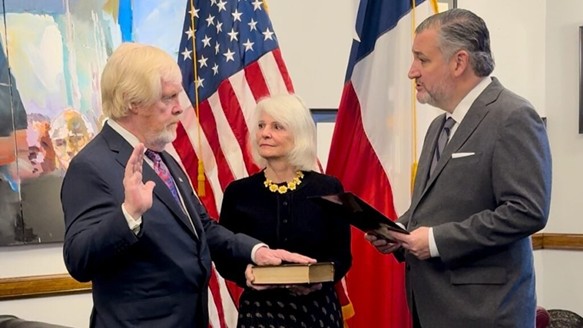

United States President Donald Trump’s ambassador-designate to South Africa, Leo Brent Bozell III, has been officially sworn in as Washington’s chief diplomat to Pretoria. Legally, his appointment still requires confirmation, when Bozell presents his credentials, to President Cyril Ramaphosa. His appointment by the White House, comes at a time of heightened tensions between Washington and South Africa. Bozell is a conservative writer, activist, and media owner. Born in 1955, he runs the largest media watchdog in the United States, the Media Research Center (MRC), according to U.S. State Department records. Bozell will assume the ambassadorial position amid an unsettled period in relations between South Africa and the United States, following Trump’s return to the presidency in early 2025.

Notably, while the US has finally appointed an ambassador to South Africa, the inverse is yet to take place. Former ambassador Ebrahim Rasool was deemed persona non grata in May 2025 after calling Trump a white supremacist. Since then, diplomats sent to the US have been met with a cold shoulder. In lieu of an ambassador, Ramaphosa appointed former deputy finance minister Mcebisi Jonas as his ‘special envoy’ to the US, but reports indicated that he, too, was not welcome. Ramaphosa has not yet appointed another official to serve as ambassador. Meanwhile, tensions have only risen with the Trump administration.
A bone of contention has arisen between Pretoria and Washington over South Africa’s leadership of the Gaza genocide case at the International Criminal Court (ICC). This has led the United States— a staunch ally of Israel, especially under Trump— to distance itself from a close relationship with the Ramaphosa administration. While former South African Ambassador Rasool’s comments were provocative, Washington’s treatment of other South African diplomats was harsh. Trump’s presidency is marked by personality-driven and unilateral actions; he is not inclined to reconcile with his critics. It will be a complex case to resolve when Trump is unwilling even to listen to what Ramaphosa’s special envoy has to say. In the end, any South African diplomat sent to Washington to reason with members of the Trump administration, or with President Trump himself, risks appearing ineffective.
Meanwhile, as Pretoria sponsors and leads the Gaza genocide case in The Hague, Trump and his inner circle, including Ambassador-designate Bozell, are falsely accusing the South African state of committing genocide against white Afrikaners.

The White House has pushed claims of a white genocide and land grabs in South Africa, and has opened its refugee program to Afrikaners who it says face heightened violence in South Africa. Trump and his cabinet also refused to attend the G20 conference in Johannesburg in November 2025, despite it being the norm for global leaders to send at least one high-ranking government official. Economically, the picture is not much better, with the USA imposing a 30% “reciprocal” tariff on South African goods as part of the “America First Strategy.” US lawmakers have also pushed legislation to ‘punish’ South Africa for its geopolitical ties and relationships, accusing the country of aligning with its enemies.
As such, two bills—in the House and the Senate—have been tabled to review the US’s relationship with South Africa and to possibly bring sanctions against government officials.

In terms of the “genocide” allegedly perpetrated against Afrikaners in rural areas, the killings are in fact indiscriminate, affecting both white and black residents. Trump and his right-wing allies have a tendency to exaggerate and selectively interpret certain events and state policies of foreign governments when it suits their interests. South Africa faces a critical risk should President Ramaphosa refuse to accept Bozell’s credentials. If Pretoria antagonizes Washington further, trade relations could come under severe strain. There is also the possibility that Trump’s appointment of Bozell was intentionally provocative. According to established diplomatic protocol, Ramaphosa may refuse to accept the credentials of an ambassador on the basis of their personal or public behaviour toward South Africa, rather than on the positions taken by the government they represent.
The risk of South Africa facing sanctions from the Trump administration is real. The United States, however, has no right to dictate who Pretoria can or cannot ally itself with. It is worth noting that several African nations— with whom South Africa maintains trade and diplomatic relations— and the African Union, of which South Africa is a member state, have close ties with other BRICS member states. Should the United States impose sanctions on African countries as a whole, Washington would risk isolating itself from key strategic allies. South Africa is the gateway to the Southern African region, and it can strengthen alliances with other African states to resist Bozell’s, Trump’s, and the wider Trump administration’s demands if it pursues deeper integration with the rest of Africa.
Article written by:
Yacoob Cassim
Journalist at Radio Al Ansaar