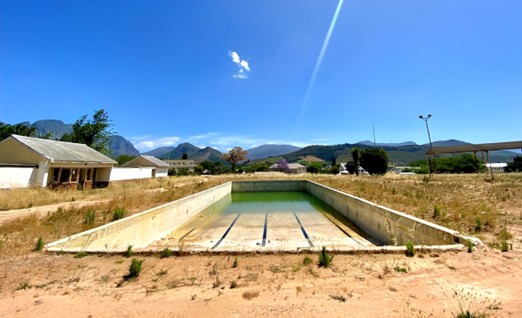

The Franschhoek High School was intended to house a High-Performance Centre for training future athletes in Swimming. Co-sponsored by Swimming South Africa, (SSA), the World Aquatics Development Centre, and Camp Train, the project came to a halt, leaving the centre in a derelict state. Today, the site currently consists of corroding half-built structures that hint at the original plans. SSA, the senior partner, is under investigation, by the Special Investigating Unit (SIU) to account for the R50 million allocated to the project.
The abandoned facility now features vandalizes walls, broken gates, shattered windows, filthy bathrooms, and swimming pools that hold shallow puddles of sewage water. Patchy knee-high grass surrounds what was meant to be a world class centre.
The remains of the complex, stand on the property of Franschhoek High School, one of South Africa’s oldest government schools.

SSA received funding from World Aquatics (around R8.5-million), the National Lotteries Commission (about R35-million) and The Sports Trust (about R6-million) to finance the project. The total cost of the project was set to be R111-million, with further private investment also supporting the project. Once the Franschhoek High Performance Centre was up and running – which a section of it was, for a short period in 2023 – it aimed to be self-sustaining. The income was to have come from star international junior athletes who would have received scholarships from World Aquatics. They would have occupied refurbished hostels at Franschhoek High School and been educated at the school, in a language of their choosing and in a curriculum they preferred.
The Franschhoek High Performance Centre would have been a hotbed for talented swimmers, at the time one of only four High Performance Centres worldwide accredited by World Aquatics. Other centres have since been approved. The project, as initially laid out by sports development programme Train Camp, was perhaps too ambitious. The High Performance Centre was to be SSA’s national training base, while also housing SSA’s high school development programme, which aims to accelerate transformation in swimming.

Greed appears to have overcome leading figures at SSA, resulting in the embezzlement of the R50 million allocated to the project and the neglect of a promising initiative. This has severely damaged the organization’s reputation. Its relationship with World Aquatics and Camp Train has soured, and with the SIU investigation underway, accountability is inevitable. Corrupt representatives and managers of the organization are expected to be brought to trial. The matter of transparency and accountability within SSA will now come under close scrutiny.
The key to understanding this tragic misuse of a professional sports programme lies in the daily conduct and practices of the organization’s leadership. The case is likely to provoke public anger—not only within the school community but also from the wider public.
The disappointment over the failure of this project is immense, and its mismanagement has become a source of national embarrassment. What is meant to be a high-performance centre for training young professional swimmers has turned into a money laundering scheme that has broken the country’s trust in a key sporting association. The ethics of South Africa’s sporting and athletic community have been brought into disrepute.
The ambition of raising a team of professional swimmers from their teenage years may have been too bold, but the World Aquatics and the Sports Trust should have conducted thorough back ground checks on all managers and employees involved in the project.
The SIU will now have to trace the trail of what happened to the R50 million in High-Performance Centre Funds meant to make the Franschhoek High School into a destination for promising young athletic swimmers.
Article written by:
Yacoob Cassim
Journalist at Radio Al Ansaar