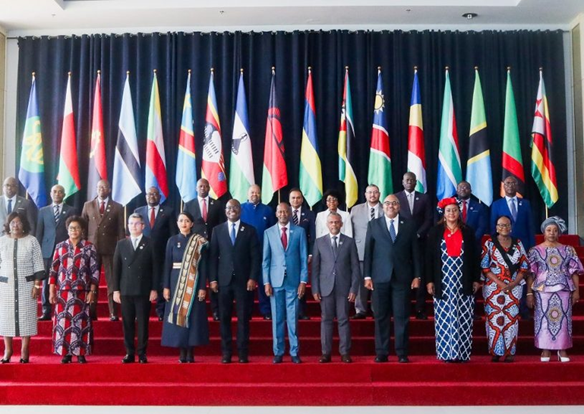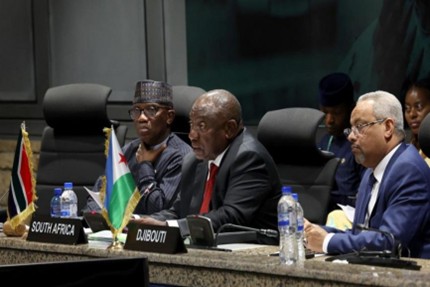

President Cyril Ramaphosa was in Addis Ababa, Ethiopia, to attend the 39th Ordinary Summit of the African Union (AU) Assembly of Heads of State and Government. He joined other African leaders for meetings and discussions. Speaking at a press conference with SABC News on the side lines of the summit, the president warned that the continent must remain united at a time when the global geopolitical system is changing. Ramaphosa was responding to a recent statement made by United States Secretary of State Mark Rubio at a security conference in Munich, Germany, where Washington’s top diplomat endorsed a return to imperialism.
At the press conference, President Ramaphosa stated: “What we should be avoiding is a new form of colonialism, where those economies begin to target the minerals that we have. It is now time for Africa to do business on its own terms. It should no longer be a case where rock, soil, and dust are exported out of Africa.”

He said the AU reforms must be implemented to strengthen the effectiveness of the continental body. Ramaphosa also called for practical steps to build a better Africa “Institutional reforms are not an event, they are a process. Every reform process does take its time. Sometimes there are detours. Sometimes there are stops and starts but the important things is that the reform process in the AU is going ahead. Various heads of state are quite committed to ensuring that the reforms do proceed so as to make the AU much more effective.” Ramaphosa has called on the AU to work with determination to address the conflicts in Sudan, DRC and the political crisis in South Sudan.
He is the Chair of the AU committee that is helping South Sudan to resolve the current political challenges and to hold democratic elections later this year.

President Ramaphosa was right to argue that the institutional reforms the AU, its leadership, and African leaders are undertaking are a step-by-step process. After all, Rome was not built in a day. The AU is working towards greater integration in economic and governance matters. To achieve this, the body should focus on creating a culture of transparency and accountability through the proposed institutional reforms. South Africa has a role to play alongside other African nations, such as Nigeria and Ethiopia, through the implementation of Agenda 2063 and the African Continental Free Trade Area agreement. The entire continent, from the Regional Economic Communities (RECs) to the fifty-five nation states, is playing its part.
Investments in infrastructure and manufacturing are being poured into the continent. Conflict still reigns in some regions of Africa. The DRC, Sudan, and South Sudan are no strangers to civil war, but that can change through implementing truces and holding negotiations. Democratic and institutional reforms are needed in all three countries to create more desirable conditions.

Beyond governance reforms, Ramaphosa urged African countries to unite in response to shifting global power dynamics, warning of fundamental changes in the international system. “Africa needs to respond with one voice. The global architecture has changed and some would even say the rules-based architecture of the world has in a way collapsed.”
He cautioned that Africa must guard against external exploitation of its natural resources, particularly critical minerals essential to global industries. “What we should be avoiding is a new form of colonialism. It should no longer be a case where rock, soil and dust is exported out of Africa without being beneficiated.”
The president said Africa must use its growing strategic leverage responsibly and collectively. “Now we have leverage and as Africa we must use that leverage, this is the time when as Africans we must act together.”
President Ramaphosa’s warnings have merit. The major global economies in North America and Europe are now focused on exploiting developing nations that are economically less powerful. This exploitation has arisen from the rise of right-wing nationalism and the centralization of power in the west that has supplanted bilateralism. African peoples and their leaders need to coordinate their state policies and economies through the AU to avoid having their sovereignty undermined by Western leaders and their representatives. This refers to leaders and representatives with Rubio’s mindset. African nations, including South Africa, must prepare for economic and political integration by boosting private-sector output through trade and industrial manufacturing.
The collective power of African nations must be strengthened through collaboration with one another rather than through investment in infrastructure. Ramaphosa’s warnings about the return of colonialism must be taken seriously. Only by standing united and steadfast can Africa oppose the machinations of US President Donald Trump and his entourage.
It is time to look beyond a raw, mineral-based economy and build relations with other actors and powers across the world that do not threaten Africa or the territorial integrity of its nations.
Article written by:
Yacoob Cassim
Journalist at Radio Al Ansaar