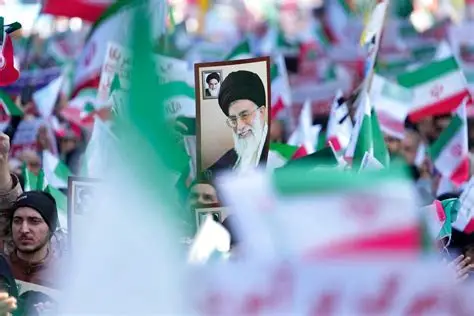

Grand Ayatollah Ali Khamenei, Supreme Leader of the Islamic Republic of Iran, has been killed in airstrikes led by the United States and Israel. Iranian state television and the state-run IRNA announced the death of the eighty-six-year-old Khamenei early Sunday. U.S. President Donald J. Trump announced the cleric’s death hours earlier, calling it Iranians’ “greatest chance” to “take back” their country. The announcement followed a joint U.S.-Israeli aerial bombardment targeting Iranian military and government sites. Trump stated that the “heavy and pinpoint bombing” would continue throughout the week, or as long as necessary.
Khamenei’s assassination has thrown the future of the Iranian state into doubt and raises the risk of destabilizing the Middle East more broadly.

The head of Iran’s Revolutionary Guard and a top security adviser to the late Supreme Leader Ayatollah Ali Khamenei were killed in American-Israel airstrikes on the country, state media reported Sunday. The state-run IRNA news agency announced the death of Maj. Gen. Mohammad Pakpour, who took over as the Guard’s top commander after Israel killed its past commander in the 12-day June war. Also killed was Ali Shamkhani, long a figurehead within Iran’s security establishment, IRNA said. Shamkhani was wounded in the June war. A council has formed to govern Iran after the killing of Iran’s Supreme Leader Ayatollah Ali Khamenei.
That council is enshrined in law in the Islamic Republic. It is made up of Iran’s sitting president, the head of the country’s judiciary and a member of the Guardian Council chosen by Iran’s Expediency Council, which advises the supreme leader and settles disputes with parliament. Iran’s reformist President Masoud Pezeshkian and hard-line judiciary chief Gholamhossein Mohseni Ejei are on it. Iranian law says the Assembly of Experts “must, as soon as possible,” pick a new supreme leader.

In Iran, the Supreme Leader holds extensive executive and legislative powers that are almost absolute. As the highest-ranking representative of the country’s Shiite Muslim religious establishment, the person occupying this position has the final say on all political, security, and economic decision-making. The death of Khamenei has created a political vacuum that could be filled by a hard-line successor, possibly someone he (Khamenei) himself would have preferred. The Islamic Republic, however, remains deeply unpopular among ordinary Iranians, who have borne the brunt of Western economic sanctions and desire a more open society. Another pressing issue is who will influence the election of the next Supreme Leader and what tone will be set for Iran’s political future overall.
The Islamic Revolutionary Guard Corps (IRGC) functions as a state within a state, wielding nearly as much power as the Supreme Leader himself, while remaining deeply loyal to the regime. The administration of Iranian President Pezeshkian and other members of Iran’s governing council can rely on the IRGC and the formal military to restore security among the general population, though much will depend on how the current conflict is managed. The deaths of Khamenei and Maj. Gen. Pakpour have dealt a devastating moral blow to both the government and its loyalists.

Hardliners will race to fill the void, simply to survive. They may be reluctant to be next in the US-Israeli crosshairs, but that fear has not led to a shortage of candidates in the past. Is it possible a consensus emerges that, to endure, the autocracy must make peace with the US and the region, and feign moderation for a while? Perhaps. But that risks projecting the weakness Tehran is so allergic to. There is no easy replacement government-in-opposition-on-a-box that Trump can promote. Reza Pahlavi, heir of the long-deposed shah, cannot swan into Tehran and pick up the reins without risking an angry IRGC trying to kill him. There is no opposition really left inside Iran. As in Caracas, any solution will likely have to come from inside the remnants of the regime.
In many ways, missteps by Khamanei have made the US and Israel’s job easier. His repression and economic mismanagement mean Iran is in desperate and self-evident need of change, his people yearning to be freer and richer.
Iran is a complex nation and state. Although Persian (Farsi)-speaking Iranians form the majority, there is a presence of ethnic minorities, with the Kurds being the second largest group. Whatever new power emerges after the death of Khamenei—most likely a new Supreme Leader—will have to adjust its rule to the current situation. The military operation led by U.S. President Trump and Israeli Prime Minister Benjamin Netanyahu has created an unprecedented reality that Tehran must confront in order to restore order. For now, the regime of the Islamic Republic may step back from sponsoring militant groups in the region such as the Houthis and Hezbollah. Reza II, the Pahlavi pretender to the Iranian throne, may never be able to return to the country to lead a transitional government of any kind. Iran’s civilian nuclear energy program will likely continue in a low-key manner.
Khamenei may be gone, but the struggle to determine the future of the Middle East and the Islamic world has begun. An abyss has opened, and where it will lead remains uncertain. The Iranian secular opposition remains divided and many of its members languish in prisons across the country. How the airstrikes – intended to cripple Iran; are utilized will be closely watched by the world.
Article written by:
Yacoob Cassim
Journalist at Radio Al Ansaar