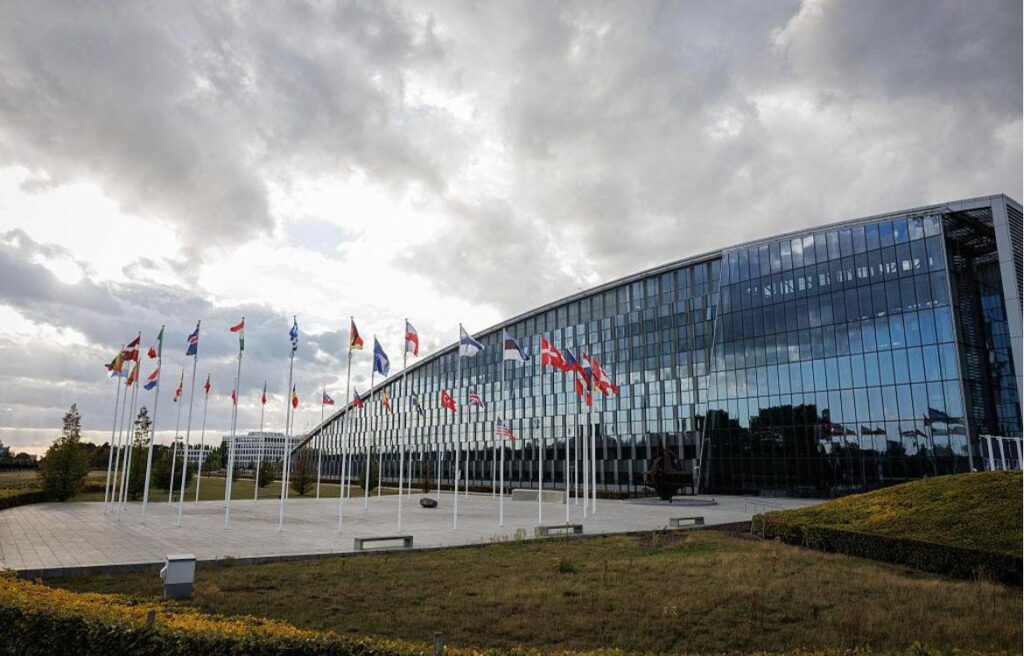

Missiles are flying across the Middle East – but the world’s most powerful military alliance is not firing back.
As the war between Iran, Israel and the United States intensifies, the North Atlantic Treaty Organization (NATO) has taken an unusual position: support the campaign politically, but stay out of the fighting.
That silence raises a critical question. Why is the largest military alliance in modern history standing on the sidelines of one of the most dangerous conflicts in the world today?
NATO was created to defend the West from major security threats. With 31 member states and some of the most advanced militaries on earth, the alliance has long been seen as the backbone of Western security.
Yet the current war involving Iran – a country whose missile and nuclear ambitions have worried Western governments for decades – has not triggered a NATO military response.
Instead, the conflict is being led primarily by the United States alongside Israel, with NATO allies offering varying degrees of political support while avoiding direct involvement.
This careful distance reflects a major strategic calculation: preventing the conflict from expanding into a wider global war.
The scale of the conflict has already raised fears of escalation. Iran has launched waves of missiles and drones across the region, targeting U.S. bases and strategic infrastructure while threatening energy routes critical to global markets. At the same time, U.S. and Israeli strikes have targeted Iranian nuclear and missile facilities.
Despite the intensity of the fighting, NATO Secretary-General Mark Rutte confirmed that the alliance itself would not join the military campaign.
Speaking in Brussels, Rutte said the actions taken by the United States and Israel were degrading Iran’s ability to develop nuclear weapons and ballistic missiles, but emphasised that NATO would not become directly involved in the conflict.
Strategic analysts say NATO’s cautious approach reflects the alliance’s legal and political limits. Experts at the Atlantic Council note that Western governments are attempting to contain the conflict while preventing a broader regional war that could destabilise global energy markets and security alliances.
Their analysis suggests that while many NATO members support U.S. objectives in limiting Iran’s military capabilities, there is significant concern in Europe about becoming directly entangled in a Middle Eastern war.
Even without direct NATO involvement, the conflict is already placing pressure on the alliance.
One major moment came when an Iranian ballistic missile entered the airspace of Turkey, a NATO member state, and was intercepted by defence systems. The incident immediately raised questions about whether NATO’s famous Article 5 mutual defence clause could be triggered.
Article 5 states that an attack on one NATO member is considered an attack on all.
Yet Rutte quickly moved to calm fears of escalation, saying that NATO was monitoring the situation closely but had no plans to activate its collective defence mechanism.
The decision highlights a major shift in how Western alliances handle modern conflicts.
During the Cold War, NATO was designed primarily to deter the Soviet Union and protect Europe from large-scale invasion. Over time, the alliance expanded its role, participating in missions in Afghanistan, Libya and the Balkans.
But direct involvement in a Middle Eastern war against Iran would represent a far more dangerous escalation – one that could draw in other global powers and destabilise already fragile regional alliances.
NATO’s cautious stance reflects a broader strategic dilemma.
Western governments want to limit Iran’s military capabilities and prevent the country from developing nuclear weapons. At the same time, a full NATO intervention could dramatically widen the conflict, potentially drawing in neighbouring states and threatening global energy supplies.
For European leaders already managing the war in Ukraine against Russia, opening another military front in the Middle East is a risk many are unwilling to take.
The war is therefore revealing something important about modern geopolitics.
Military alliances are no longer automatically drawn into every conflict involving their members or partners. Instead, leaders are increasingly calculating when intervention could make a crisis worse.
For now, NATO has chosen caution over confrontation.
But as the conflict spreads and regional tensions rise, the alliance may find it increasingly difficult to remain on the sidelines of a war that is already reshaping global security.
Article written by:
Hudaa Ahmed
Journalist at Radio Al Ansaar