
The global order that shaped the modern world is beginning to show visible cracks.
The alliances that dominated international politics after the Cold War are under strain, the United States is openly reconsidering its role as the world’s primary guarantor of stability, and rising powers are testing the limits of Western influence. What once appeared to be a stable international system is increasingly being replaced by something far more fragmented, competitive and unpredictable.
For more than three decades following the collapse of the Soviet Union in 1991, the world operated under a largely unipolar system led by the United States. That period now appears to be entering a period of serious transition.
In January, United States Secretary of State Marco Rubio openly described America’s post-Cold War dominance as an “anomaly,” signalling a major shift in how Washington increasingly views global power. Weeks later, Defence Secretary Pete Hegseth reinforced that message by describing China as a “peer competitor” and warning NATO allies that the United States would need to focus more heavily on deterring Beijing moving forward.
Those remarks were not made in isolation.
Russia’s war in Ukraine, ongoing instability in the Middle East, growing economic confrontation between major powers and Washington’s increasingly aggressive position toward what it claims is expanding Chinese influence abroad have all intensified pressure on the existing international system. President Donald Trump’s sweeping tariffs against global trading partners have further deepened concerns that the world is moving away from global cooperation and toward a far more confrontational era of strategic competition.
At the centre of that uncertainty is NATO.
For decades, the alliance represented one of the strongest symbols of Western unity and American global leadership. But recent tensions have exposed growing divisions within the bloc.
Earlier this month, Rubio criticised some NATO allies for refusing to allow the United States to use military bases in Europe during operations linked to Iran. Although Rubio insisted he remained a strong supporter of NATO, the comments highlighted increasing discomfort among some European countries over Washington’s military priorities and foreign policy direction.
At the same time, Trump has repeatedly threatened to reduce or even withdraw American involvement in NATO altogether – a move that analysts warn could fundamentally reshape European security.
The implications would be enormous.
According to Reuters Breakingviews, European governments may be forced to increase defence spending far more rapidly than originally planned if Washington steps back from the alliance. Countries such as Germany, France and Britain would likely face mounting pressure to strengthen military capacity while already dealing with weak economic growth, inflation concerns and domestic political strain.
That shift could push Europe into politically dangerous territory, where governments are forced to balance rising defence budgets against already stretched public spending demands.
Even the possibility of a ceasefire in Ukraine offers limited reassurance. Analysts warn that any prolonged pause in fighting could allow Russia the opportunity to rebuild military resources and strengthen its position over time, further increasing European fears about long-term security vulnerability.
But the uncertainty extends far beyond NATO itself.
According to the European Council on Foreign Relations, the post-Cold War international order is fading without any clear replacement emerging. While the United States appears increasingly willing to act unilaterally, China and Russia are presenting alternative models of global influence that continue to attract interest across parts of the Global South.
At the same time, middle powers are expanding their own freedom of action.
Rather than fully aligning with either Washington or Beijing, many countries are increasingly attempting to position themselves between competing power centres while protecting their own economic and strategic interests. In this emerging environment, influence is no longer determined only by military strength, but also through trade networks, infrastructure partnerships, sanctions, technology standards and control over supply chains.
The world is no longer moving toward one centre of power, but toward competing spheres of influence operating under different rules.
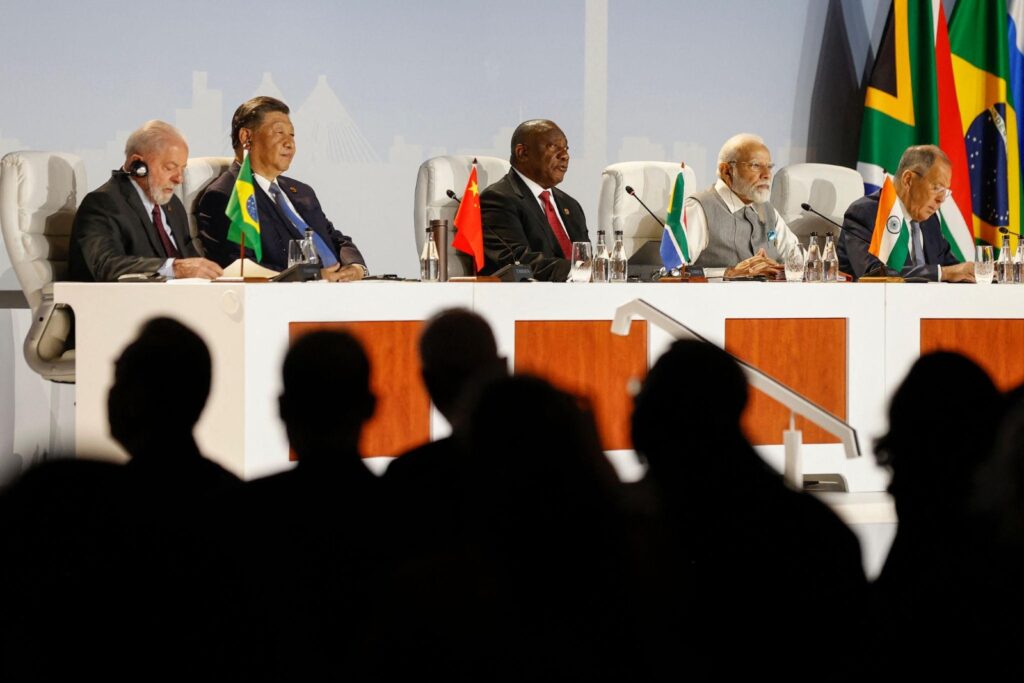
South Africa itself reflects many of the pressures shaping this emerging geopolitical landscape. As the current holder of the G20 presidency and a BRICS member, Pretoria increasingly finds itself balancing relationships between Western economies and rising global powers such as China and Russia.
That balancing act has become increasingly delicate.
According to Reuters, tensions between Washington and Pretoria have intensified since Donald Trump returned to the White House earlier this year. The Trump administration has adopted a far more hostile position toward multilateral institutions, withdrawing from several international bodies while publicly criticising South Africa over unfounded claims relating to land expropriation and a so-called “white genocide.”
At the same time, the importance of the G20 has arguably grown even further. By bringing together the G7 economies, BRICS+ nations, the European Union and the African Union, the grouping represents roughly 85% of the global economy. As geopolitical tensions deepen, South Africa now finds itself chairing one of the few major platforms where rival global powers continue engaging directly with one another.
That reality highlights how middle powers are becoming increasingly significant in a more fragmented international order.
The Brookings Institution describes this period not simply as disorder, but as a process of “reordering.”
For decades, the international system operated around relatively stable assumptions regarding trade, security and cooperation. Today, however, multiple powers are attempting to rewrite those rules simultaneously – through tariffs, sanctions, economic pressure, technological restrictions and strategic competition.
From the outside, the process appears chaotic. But analysts argue that what the world may be witnessing is not the collapse of global order in the traditional sense, but the painful transition toward a new balance of power still being shaped in real time.
What makes this moment particularly significant is not simply the weakening of one system, but the absence of a clear replacement.
Unlike the Cold War, where two dominant superpowers largely defined the global political landscape, today’s emerging order appears far more fragmented. Power is increasingly spread across regional alliances, economic blocs and competing strategic interests, with no single country fully capable of imposing stability on its own.
For smaller and middle-income nations, that uncertainty creates both opportunity and risk. Countries capable of balancing relationships between major powers may gain greater strategic flexibility, but they may also find themselves caught between rising geopolitical tensions, economic pressure and rapidly shifting alliances.
The post-Cold War era was built on the belief that globalisation, open markets and Western-led institutions would provide long-term stability. In 2026, that confidence is being tested from multiple directions at once.
The world may not be entering a new Cold War. It may be entering something far less predictable – a fragmented era where power is divided, alliances are increasingly conditional, and the rules that once governed the international system are no longer universally accepted.
Article written by:
Hudaa Ahmed
Journalist at Radio Al Ansaar