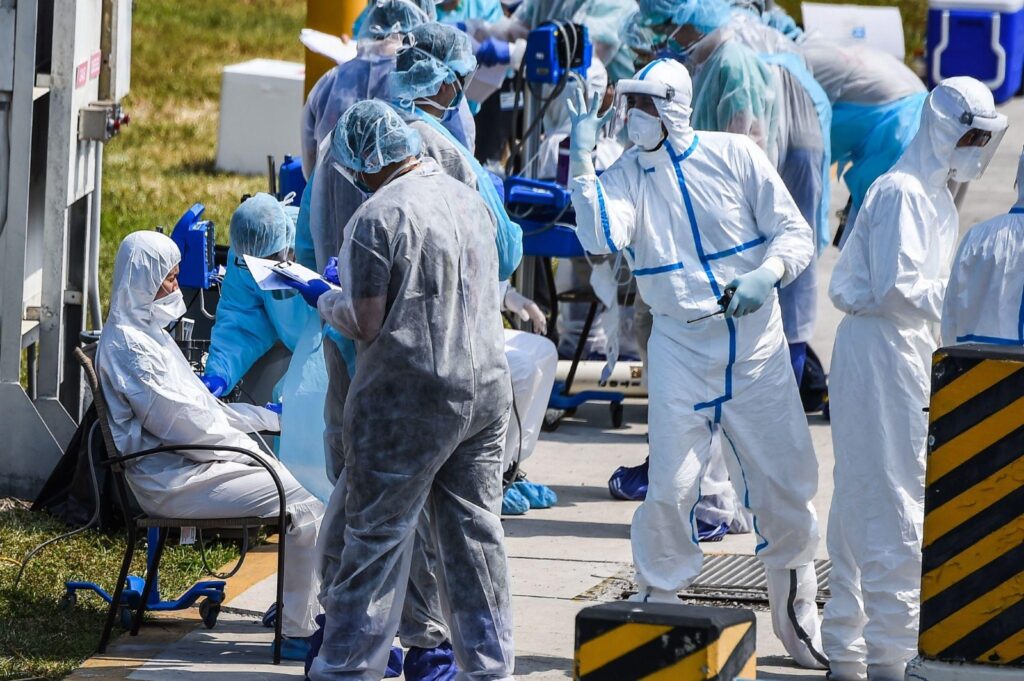

Britain does not normally deploy paratroopers into the middle of the Atlantic Ocean over a suspected infection.
This week, it did.
Military medical personnel were parachuted into Tristan da Cunha – the world’s most remote inhabited island – after fears grew over a suspected hantavirus case linked to the outbreak-hit MV Hondius cruise ship.
The operation felt less like a routine medical response and more like a scene from a post-apocalyptic thriller: military aircraft crossing thousands of kilometres, emergency teams dropping into violent Atlantic conditions, and a tiny volcanic island running dangerously low on oxygen supplies.
But beneath the dramatic imagery lies something far more significant.
The world has changed after Covid-19 – and governments are no longer willing to gamble on waiting too long.
Tristan da Cunha, located roughly 2,800 kilometres west of South Africa, has fewer than 250 residents and no airport. The island can only be reached by sea after days of travel, making emergency evacuations painfully difficult.
That isolation is exactly what transformed one suspected infection into an international concern.
The case is believed to be linked to the growing hantavirus outbreak connected to the MV Hondius expedition cruise ship, which has already triggered tracing operations and suspected cases across multiple countries.
Health officials are particularly cautious because the strain involved is believed to be the Andes variant – the only known hantavirus strain capable of limited human-to-human transmission through close contact.
That single detail changes the psychological weight of the story entirely.
Under normal circumstances, hantavirus remains relatively rare. Most infections are linked to rodents, not widespread community transmission. But in the post-Covid era, even a small outbreak carrying the possibility of human transmission immediately triggers global anxiety.
And the imagery surrounding this crisis only intensifies that fear.
A luxury cruise ship tied to infections.
Passengers monitored across countries.
A remote island with limited medical infrastructure.
Military medics parachuting into isolation.
It taps directly into a global memory many societies are still trying to suppress.
Covid-19 fundamentally changed how governments calculate risk. Containment is now prioritised long before outbreaks become widespread. Even relatively isolated cases can trigger aggressive intervention if authorities believe there is the slightest possibility of escalation later.
That is the real story unfolding around Tristan da Cunha.
Reuters reported that British officials viewed the deployment as a precautionary operation aimed at preventing a remote medical emergency from spiralling into something far more difficult to contain.
The military deployment also reveals how outbreak response is evolving beyond traditional healthcare systems. Infectious disease management is increasingly overlapping with emergency logistics, border control, national preparedness and even military coordination.
Diseases are no longer treated purely as medical events.
They are economic events.
Tourism events.
Political events.
Security events.
And cruise ships have become one of the most powerful symbols of that vulnerability.
Before Covid-19, cruise liners represented luxury travel and escape. Today, they carry a very different psychological association: quarantine, isolation and uncontrolled spread in confined spaces.
That perception matters because fear often moves faster than scientific certainty.
While health authorities continue stressing that the overall public risk remains low, the scale of the international response reveals how deeply pandemic trauma still shapes decision-making worldwide.
For South Africans, the story also feels geographically close.
Tristan da Cunha lies within the broader South Atlantic region historically connected to Southern Africa, while South African authorities have reportedly monitored contacts linked to the wider hantavirus situation. The outbreak highlights how rapidly health scares can move through global travel routes connected to the region.
One suspected infection aboard a cruise ship was enough to trigger tracing operations stretching across continents.
That domino effect is precisely what governments fear most.
Because modern outbreaks rarely stay local for long.
A virus detected in one corner of the world can rapidly become an aviation issue, a tourism crisis, a diplomatic concern and an economic threat within days. Geography no longer guarantees safety in a hyper-connected world.
The hantavirus outbreak linked to the MV Hondius may ultimately remain contained.
But the images surrounding it – military aircraft crossing oceans, oxygen supplies running low, and paratroopers dropping into one of the world’s most isolated islands – reveal something much larger than a single suspected infection.
The outbreak may remain small.
The global reaction to it does not.
Article written by:
Hudaa Ahmed
Journalist at Radio Al Ansaar