
The most powerful weapon in this war isn’t a drone – it’s the illusion that it’s winning the war.
Every day, you’re shown precision. Clean strikes. Targets hit with surgical accuracy. Drones hovering like something out of a video game. Controlled. Efficient. Almost impressive.
But that’s not the war.
Because while you’re watching clips, the battlefield is barely moving. The fighting is slow, messy, and stubborn. Gains are measured in metres. Losses are constant. Nothing about it looks like what you’re being shown.
That gap should bother you.
According to reporting from Reuters and Associated Press, drones have become central to the conflict. They are everywhere – scouting, striking, watching.
But they are not winning anything.
Signals are jammed. Systems fail. Countermeasures adapt faster than the technology itself. What looks like dominance on screen often breaks down in reality.
Analysis from Center for Strategic and International Studies and Institute for the Study of War is blunt: drones are shaping tactics, not deciding outcomes.
In other words – the war hasn’t become more precise.
The way it’s being shown to you has.
And that’s where the real shift begins.
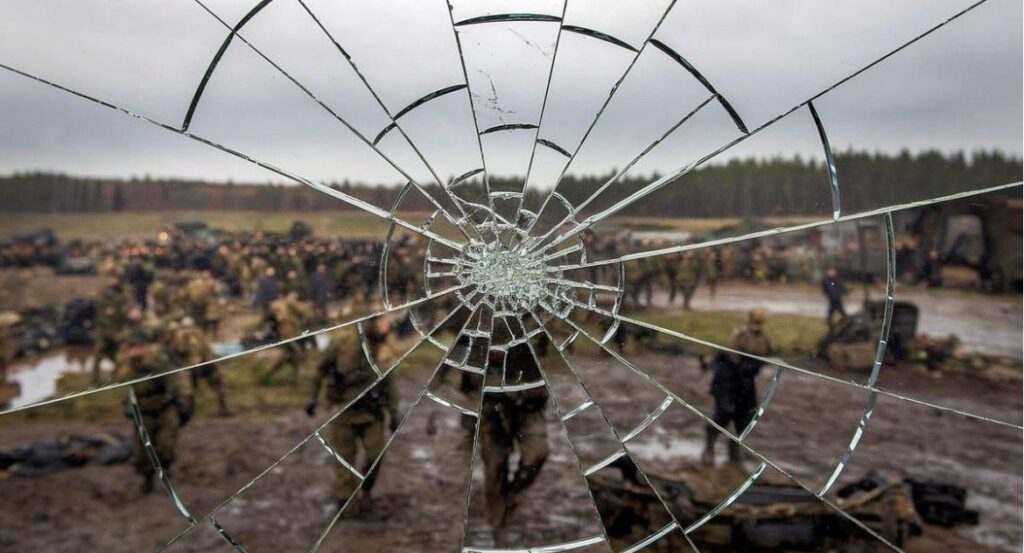
Because what you’re watching is not the war. It’s a version of it. Edited. Selected. Packaged. A highlight reel in a conflict that has no highlights.
You’re not seeing the confusion. The failures. The hours where nothing works. The reality that most of this war is still fought the old way – slow, brutal, and unforgiving.
You’re seeing what survives the filter.
And that filter doesn’t belong to one person.
Governments frame victories. Militaries release footage that looks decisive. Media organisations like BBC News and Reuters select what is clear, visual, and digestible. Platforms amplify what gets attention. Analysts interpret it all, shaping how it’s understood.
No single force controls the narrative.
But at every stage, it is shaped.
Layer by layer, it is filtered, refined, and repeated – until what reaches you feels complete.
And once it feels complete, you stop questioning it.
That’s where it becomes dangerous.
Because if war can be made to look controlled, it feels less urgent. And the more manageable it looks, the longer it lasts.
When urgency fades, pressure disappears. And when pressure disappears, wars don’t end – they settle in.
They stretch. They normalise.
Wars were once judged by territory.
Now they’re judged by clips.
And in that shift, something deeper takes hold.
Because once perception starts to matter more than reality, truth becomes flexible. What people believe is happening begins to carry as much weight as what actually is.
That’s not just influence.
That’s power.
Because if you can shape what people think they’re seeing, you don’t just guide opinion – you control the emotional temperature of the war itself.
And right now, that temperature is dropping.
Not because the war is slowing down.
But because it’s being made to look manageable.
This isn’t about drones.
It’s about control – not of the battlefield, but of perception.
And in a war where perception can be engineered this precisely, one thing becomes very clear:
You’re not watching the war.
You’re watching what you’re allowed to believe about it.
Article written by:
Hudaa Ahmed
Journalist at Radio Al Ansaar