
The world is racing toward clean energy.
But the system holding it together relies on something far more dangerous than most people realise.
Uranium.
It rarely features in everyday conversations about sustainability. There are no sleek campaigns built around it, no rooftop panels or spinning turbines to make it feel accessible. And yet, quietly, it is becoming one of the most critical materials shaping the future of global power.
Because while the world wants clean energy, it also needs something just as important – stability.
And that’s where uranium enters the picture.
Energy demand is rising. Power systems are under pressure. From major economies to countries battling rolling blackouts, the question is no longer just how to generate cleaner energy – but how to generate it reliably.
Renewables like wind and solar are expanding fast, but they come with a limitation most people overlook: they are inconsistent. The sun sets. The wind drops. And when that happens, entire systems need backup.
Nuclear energy doesn’t have that problem.
It runs continuously. It produces massive amounts of power. And most importantly, it does so with very low carbon emissions.
At the centre of that system is uranium – a dense metal that, through a controlled reaction, releases extraordinary amounts of energy. A small quantity can generate far more power than fossil fuels, making it one of the most efficient energy sources available.
This is why, according to the International Energy Agency, nuclear power is becoming increasingly difficult to ignore. Experts warn that without it, global climate targets become significantly harder – if not impossible – to achieve while maintaining stable electricity supply.
Clean energy may be the goal – but uranium is the price.
And like most things that come at a price, it demands trade-offs few people fully see.
But uranium doesn’t begin in a reactor.
It begins in the ground.
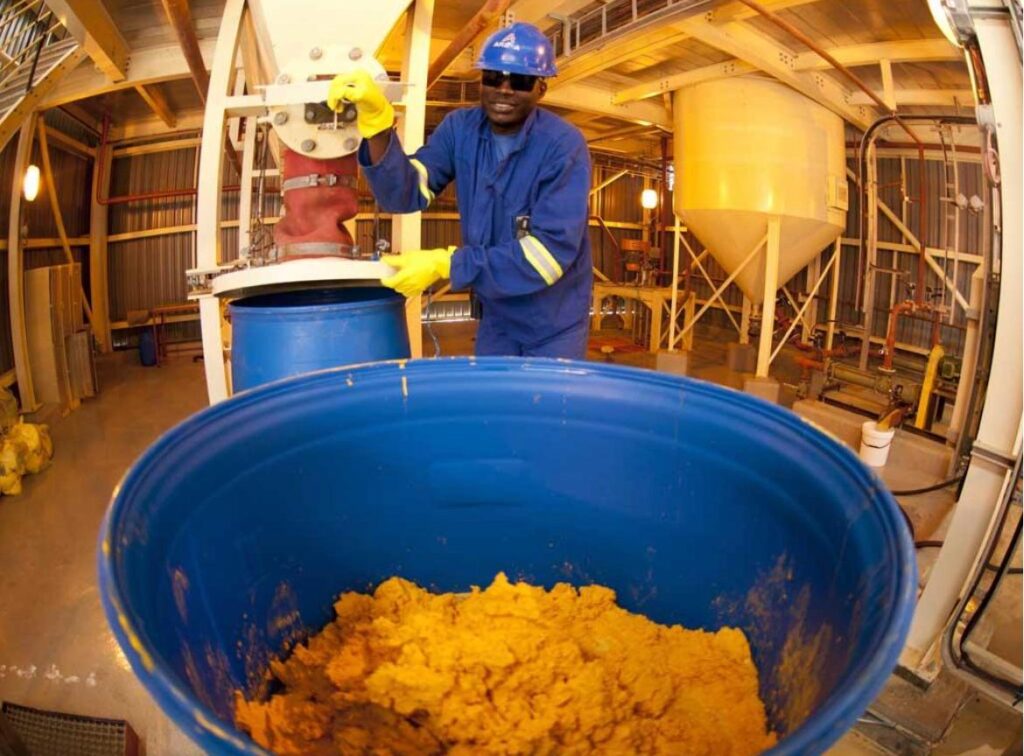
The journey from ore to energy is long, technical, and tightly controlled. Uranium is mined, processed into a concentrated form known as “yellowcake,” converted, enriched, and finally manufactured into fuel capable of powering nuclear reactors.
This entire chain depends on infrastructure, expertise… and control.
And control is where the story shifts.
Uranium is not evenly distributed across the world. A limited number of regions hold the majority of known reserves. That alone turns it into something more than just a resource – it becomes leverage.
Because when a material is both essential and scarce, it stops being about availability… and starts being about influence.
The world may be moving away from oil dependency – only to walk into a quieter, less understood reliance on uranium.
Clean energy may be sold as the future – but its foundation is far less comfortable than most people realise.
And like oil before it, control over uranium may quietly reshape who holds power in the global energy system.
Then there is the part that never fully disappears.
Risk.
While nuclear energy produces minimal carbon emissions, it comes with consequences that extend far beyond the moment electricity is generated. Uranium mining can disrupt ecosystems. The fuel cycle demands strict regulation. And nuclear waste remains one of the most persistent challenges.
It does not disappear.
It stays – requiring careful storage, monitoring, and responsibility that can stretch across generations.
So while nuclear energy appears clean on the surface, the reality underneath is far more complex.
It solves one problem – emissions – while introducing another that cannot be easily undone.
Countries already involved in nuclear energy now find themselves in a strategically important position.
South Africa, for example, operates nuclear power stations and holds uranium resources. As global demand begins to rise again, countries like this sit at a critical intersection – not just as energy users, but as potential players in a supply chain that is becoming increasingly valuable.
And that value is growing.
As climate pressure intensifies and energy systems are pushed to their limits, more governments are quietly reconsidering nuclear power. The conversation is shifting. It is no longer just about safety.
It is about necessity.
Because without a stable energy backbone, the entire clean energy transition begins to look fragile.
And this is where the domino effect begins.
More nuclear power means more demand for uranium.
More demand leads to expanded mining.
More mining increases environmental strain – and heightens geopolitical competition over supply.
What starts as an energy solution quickly evolves into something much larger.
A system of dependence.
Uranium is no longer just a fuel.
It is becoming a pressure point.
There was a time when nuclear energy was defined by fear – disasters, accidents, and public resistance. That fear has not disappeared. It has simply been pushed aside.
Now, it is being replaced by something far more powerful.
Urgency.
The world is running out of easy energy solutions. And when that happens, difficult choices begin to feel inevitable.
The shift toward clean energy is accelerating. That much is clear.
But as the world leans more heavily on nuclear power, one question continues to linger:
Are we solving the energy crisis…
or quietly building a future that depends on something we may never fully control?
Article written by:
Hudaa Ahmed
Journalist at Radio Al Ansaar