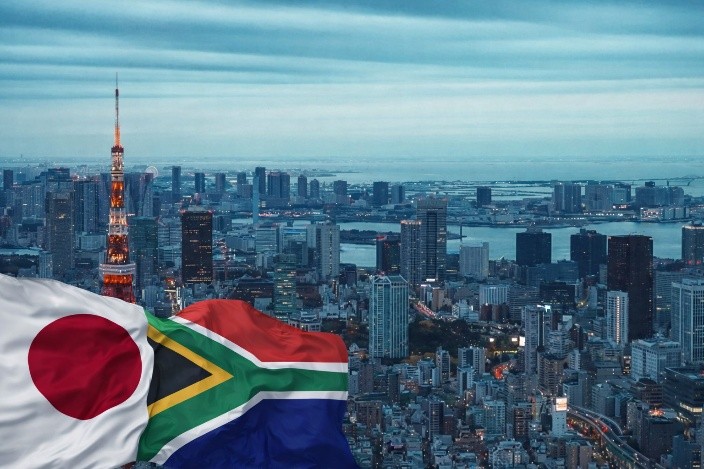

South Africa is seeking to deepen trade ties with Japan. Although Japan is not a member of BRICS plus, Tokyo remains one of Pretoria’s closest allies on a number of fronts. In the spheres of trade and investment, both countries hope to find ways to expand their trade, business and diplomatic relationship. An official high-level meeting in Pretoria, has already been confirmed.

Here, International Relations and Cooperation Minister, Ronald Lamola, held bilateral talks with Japan’s Foreign Minister, Toshimitsu Motegi. “This year marks 116 years of relations between South Africa and Japan. Over this period, our cooperation has expanded significantly across a wide range of sectors,” said Lamola while remarking on the talks. Along with expanding trade and investment cooperation with Japan, the South African government plans to focus significantly on diversifying exports as well as exploring new industries for collaboration, including energy and defence. “South Africa continues to prioritise diversification of trade and investment partnerships, with Asia as a key region. We see strong potential for expanding access for South African agro-processing and agricultural products to the Japanese and broader Asian markets,” noted Lamola.

The opportunity of this friendship and business relationship between the two nations focuses on building ties on shared diplomatic interest. This comes at a time of war in western Asia and divided loyalties. South Africa is a strategic hub that straddles the international thoroughfares of Latin America and Asia, astride the sudden tip of Africa. A century of good relations with Tokyo, through highs and lows could be a progressive path to grow both economies. South Africa has much to learn from the Japanese experience in terms of trade, industrialization and business. President Cyril Ramaphosa needs a trade agreement to create jobs in South Africa’s agricultural sector. Nations of Far East Asia provide that trade. In return South Africa has an alternative to trade with the United States (US) tariffs imposed by President Donald Trump.
Meanwhile the BRICS plus bloc remains divided.

This all appears untenable, but Trump’s project – behind which lies not just a neo-fascist ideology but the danger of a longer-lasting ‘Muskism’ regime of accumulation – could well continue, given how little geopolitical resistance he’s finding in the broader community of nation-states. Widespread hype and – at minimum – hope have turned now to helplessness, after BRICS failed to lead a de-dollarization drive last year, when hosted by Lula da Silva at the Rio de Janeiro summit (or in 2024 by Vladimir Putin at Kazan). The BRICS could not even provide a unified response to Trump’s tariff wars, or respond to attacks on fellow member Iran.
BRICS plus (Brazil, Russia, India, China and South Africa) is performing a balancing act on a tight rope. On the one hand Russia and China are among the major nations in the bloc that wish to move away from de-dollarization. But not all members are on board. The Trump administration for its part proceeds to use the tariffs it has imposed across international markets to bend nations to their will. Trump’s economic agenda is based on not just accumulating, but amassing wealth rather than investing it into circulation. BRICS has largely remained a loose association of emerging economies with no coherent ideology. Even India is more closely aligned with the US.
It remains to be seen how the current founding members of the bloc and additional members respond to the machinations of the west in the future. The war against Iran, shows the bloc still has a long way to achieve its goals.
Article written by:
Yacoob Cassim
Journalist at Radio Al Ansaar