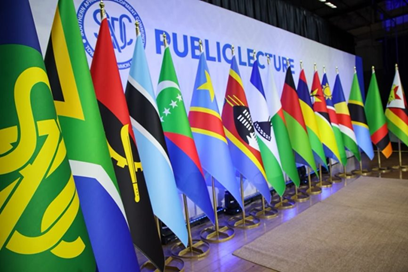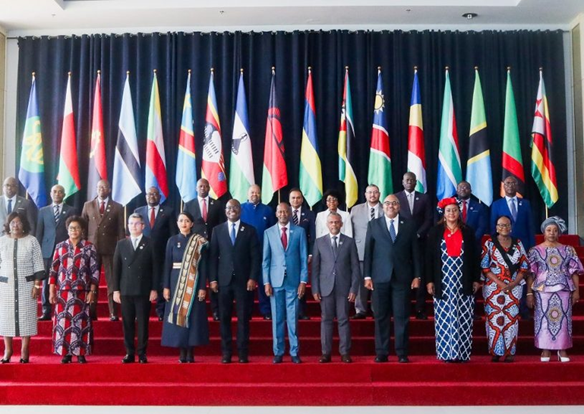

High ranking officials responsible for security matters from across the global south – including Minister in the Presidency of South Africa Khumbudzo Ntshavheni – gathered for their sixteenth summit in Delhi, India: The 16th Brics Meeting of High-Ranking Officials Responsible for Security Matters – Session One: Navigating Non-Traditional Security Challenges: Brics In an Uncertain World, 23 June 2023.
Ntshavheni spoke about the role BRICS (Brazil, Russia, India, China, South Africa and additional member states) will play in South Africa, the African continent and the world.

In this unsettled world, BRICS is an important platform for South Africa. It brings together major producers of food and energy, key markets, and countries that hold significant technological and environmental assets. We see BRICS as an instrument to drive reform of global governance, to amplify the voice of the Global South, and to deliver practical cooperation that improves the lives of our people. We believe that BRICS can add value through the mobilisation of affordable finance for climate related infrastructure and adaptation, building regional value chains in critical minerals and green technologies, enhancing pandemic surveillance and response, and promoting climate smart agriculture and balanced trade in food and inputs. For South Africa it is essential that these initiatives support African priorities, reinforce the African Continental Free Trade Area, and advance Agenda 2063’s vision of an integrated, prosperous and peaceful continent with silenced guns.
For South Africa, the real danger is in a disorderly transition in which power is used selectively, international law is applied inconsistently, and shared threats are met with fragmented responses. In such a context, the countries and regions with the least historical responsibility for global crises often carry the heaviest burden, and that includes many in the African continent.

Pretoria is at the heart of forging this integrated network between Africa, the African Union (AU) and the global south through BRICS. South Africa as the gate way to Africa and the Southern African Development Community (SADC) must be a catalyst for change. In times of war particularly in Ukraine, Iran, and Gaza, food and environmental security is paramount. The key priority now is to focus on the construction and facilitation of climate change; infrastructure and adaptation. It will be the global south and the developing world including South Africa that will pay the price when it comes to rising sea levels. If South Africa is to play a key role in the green energy transition and its process in free trade, then it has to manoeuvre across all parties and organizations involved, particularly the United Nations (UN), AU and Brics. This also means ceasing to allow violence within Africa.
The goal for President Cyril Ramaphosa and South Africa is to build bridges with African nations across the Southern African region and the continent. The purpose of establishing these connections is to create sustainable growth. Pretoria must lead the way while coming to terms with combating xenophobia and ending conflict across Africa. Only then can they (the AU) invest in infrastructure and grow their economies.

“Historically, Africa’s export structure has been dominated by primary commodities with limited value addition, leaving economies vulnerable to commodity price volatility while limiting industrial development and employment creation,” the report argues. Afreximbank maintains that the current global environment reinforces the need for a transition away from exporting raw commodities towards value-added production and processing.
The goal of African economies is to transition to the manufacturing sector to accelerate their industries. To do so African governments have to attract investors and promote competitiveness in the private sector. The matter at hand is to promote privatization and infrastructure construction across borders such as roads, rail ways and canals. It will be up to South Africa and the rest of the continent to determine the path, as well as what role BRICS will play.
Article written by:
Yacoob Cassim
Journalist at Radio Al Ansaar