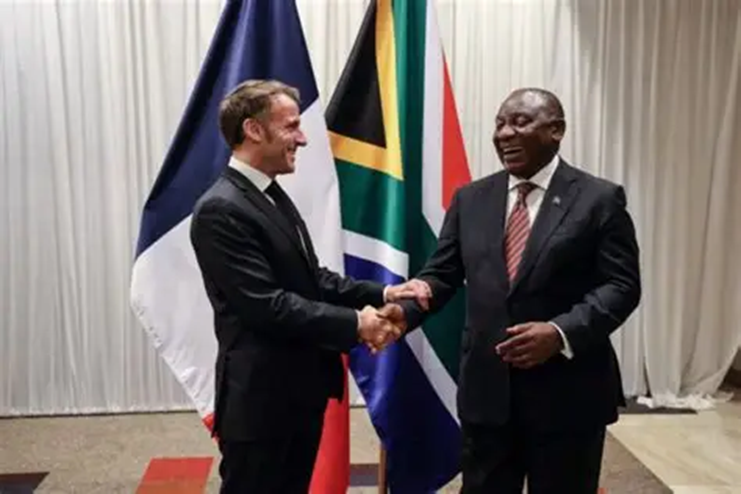

President Cyril Ramaphosa was in Paris, France for a three-day official visit. He met with his French Counterpart Emmanuel Macron. At an address at the South African National Memorial in Longueval in northern France the President commemorated the 110 years since the battle of Delville Wood on Sunday – Delville was one of the war’s most significant battles involving South African soldiers. While laying a wreath at the memorial he called for the recognition of black South Africans’ service on the allied side in World War 1.

“We remember all those whose contribution was diminished, ignored or deliberately excluded from the official history of our country. We gather to affirm that the memory of a nation cannot be divided according to race,” Ramaphosa said according to remarks shared by the presidency. “For too long, South Africa remembered only part of this history. Today, we remember it in full.” He paid tribute to South African soldiers who fought at the Battle of Delville Wood — one of the battles of the Somme — in July 1916, during which hundreds were killed and thousands wounded, captured and reported missing. “Their sacrifice deserves the eternal gratitude of our country,” he said.
He also honoured the more than 600 members of the South African Native Labour Contingent — a unit of workers sent to Europe to support the Allied war effort — who died in the sinking of the SS Mendi in 1917 in the English Channel.

The President is speaking about righting the wrongs of history, ruling out excuses for exclusion such as racism. World War One or the Great War as it was formally called at the time was a crucial moment in the history of the world. Battles such as Delville Wood were crucial in determining the future foundations of the international political landscape. The Somme itself was one of the bloodiest battle grounds in modern history. Ramaphosa in his speech spoke about inclusion of the contribution all those gave to fighting in the war – be they black, white or brown. Hopefully the president took the time to contemplate and warn against the repetition of such wars.
Some argue that we are at a trajectory – cross roads – for a third world war. Especially in regard to US President Donald Trump’s military policies in Venezuela, Iran and elsewhere. The same can be argued concerning President Vladimir Putin’s war in Ukraine. It remains to be seen what role an independent, democratic South Africa will play in such a conflict. President Ramaphosa had best advocated against the promotion of such conflict. The tragedies of the Battle of Delville Wood and SS Mendi should not be repeated.
At an international forum held in Paris for quality education, the President also urged his counterparts and other global representatives to prioritize education as the bedrock and enabler of all Sustainable Development Goals (SDGs), so as to advance global education reform.

He outlined three pillars for action: foundational and lifelong learning, strengthening the teaching profession, and inclusive digital transformation. He maintained that robust literacy, numeracy, and socio-emotional skills provide the essential scaffolding for a student’s educational journey. Furthermore, he noted that learning outcomes improve when teachers are adequately empowered, equipped with the necessary resources, and fully supported in their work. He stressed that digital transformation is “non-negotiable if we are to adequately prepare today’s learners for the workplaces, economies and societies of the future.”
The President was urging his counterparts at the summit such as Macron, and Unesco Director-General Khaled El-Enany to support the importance of developing the education sphere along Fourth Industry Revolution (4IR) lines. In many ways what Ramaphosa was advocating for was on the right track. Improving the track record on universal literacy, numeracy, and socio-emotional skills through establishing the foundational and lifelong learning, strengthening the teaching profession, inclusive digital transformation is essential for all students. Ramaphosa must do his part to sway the private sector to cooperate with the public sector on the matter.
In terms of South African public education (25 – 34 years old) without upper secondary attainment continues to be in the decline across the Output of Education Institutes and the Impact of Learning (OECD), reaching an average of 13 %, This trend also continues in South Africa, where the share fell from 50% from 43 % between 2019 and 2024.
In terms of the crime rate over 1,854,609 crimes across its 1,154 plus police precincts during the 2025/26 fiscal year, representing a crime rate of 3,067 per 100,000 of the population. These crime rates are compiled from data reported by the South African Police Service (SAPS) across all precincts nationwide, covering contact crimes, property crimes, and crimes detected through police action.
There is however much more for the president to concern himself with, besides representations of the wars of the past and improving the standards of education. Special focus has to be given to improving employment, and lowering the crime rate by improving the quality of the police. Ramaphosa must not ignore the domestic front for the international frontier.
Article written by:
Yacoob Cassim
Journalist at Radio Al Ansaar