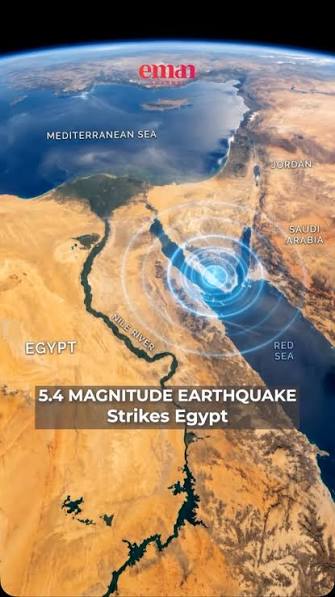
Residents in Cairo and the east of Egypt experienced a strong earthquake before dawn on Monday, causing panic, as the tremor lasted for several seconds. The National Research Institute of Astronomy and Geophysics (NRIAG) said the earthquake’s epicentre, which was registered 5.6 on Richter scale, was 38 km north of Suez. However international agencies reported slightly lower value (GFZ≈5.4, USGS≈5.0). The measurements of the earthquake vary.
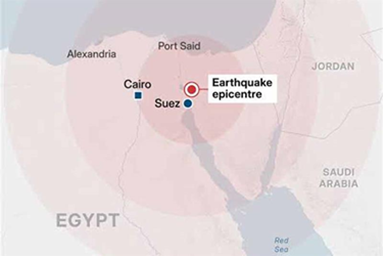
The earthquake was also felt to varying degrees across the region by the residents of Palestine, Jordan, Lebanon and Syria.
Mahi Hisham, a data analyst who lives in the Fifth Settlement, 150 km from the earthquake’s epicentre, woke up screaming. “I was terrified. At first I thought the building was collapsing, but then I realised it was an earthquake. Everything was shaking, the bed, the closet, the windows, and even the floor was creaking,” Hisham said, adding that she thought it would never end. Merna Mohamed, an insurance sales representative and mother of a two-year-old, woke up to the bed shaking and heard loud banging noises around the house. At first, she thought a thief had broken in and was opening her belongings. She soon realised it was an earthquake.
When she looked out from the balcony, she saw many of her neighbours standing on the street, visibly shaken by the tremor.
The earthquake proved to be a terrifying experience, fortunately there were no deaths and only one person suffered a minor injury. In Suez near the earthquake’s epicentre a balcony had collapsed. In Rod El-Farag District, Cairo, three families were evacuated from a damaged older building as a precaution. Since a devastating seismic tremor in 1992 that was about 5.6 on the Richter scale, happened around the afternoon, killed 545 people and injured around 12,000 the country has been better prepared. The recent quake led to the imaginations of residents running wild. Fortunately, according to NRIAG Egypt is not located on any critical seismic belts. This at least means the country’s tourism industry – a critical source of foreign revenue – will not be seriously harmed. However, the tremor left residents somewhat traumatised. The country is now better prepared than it was thirty years ago.
According to NRIAG former President Gad al-Qadi, who told Al-Ahram Weekly the Nile-basin nation was not located within a “destructive earthquake belt” like some regions that experience powerful and frequent earthquakes. However, Al-Qadi said Egypt lies within a geographic zone affected by the movement of tectonic plates, particularly near the Red Sea, the Gulf of Aqaba, and the Eastern Mediterranean. These areas border the African-Arabian plate boundary.
Seconds before the earthquake hit, many people were taken by surprise by instant alerts sent to their android phones through Google. Sherif Al-Hadi, head of the Seismology Department at the NRIAG, explained the alerts were part of an early-warning system introduced by Google for Android phones in 2021. The system detects and records an earthquake’s primary wave which does not cause destruction. “A few seconds later, the more destructive secondary wave arrives, causing damage and panic,” Al-Hadi said, adding that the time between the two waves makes it possible to send an alert.
Egypt is fortunate to be well prepared for natural disasters such as earthquakes. Recently the country’s building codes have been updated to include stricter requirements for resistance to seismic loads, especially in the new cities and modern urban development projects. According to NRIAG’s former head Al-Qadi several new smart cities including the New Administrative Capital to the east of Cairo and Alamein along with other urbanized areas, were designed according to the standards capable of withstanding tremors far stronger than the recent one on Monday. Al-Qadi also stressed the importance of continuing to inspect older buildings as they were the most vulnerable to earthquake damage.