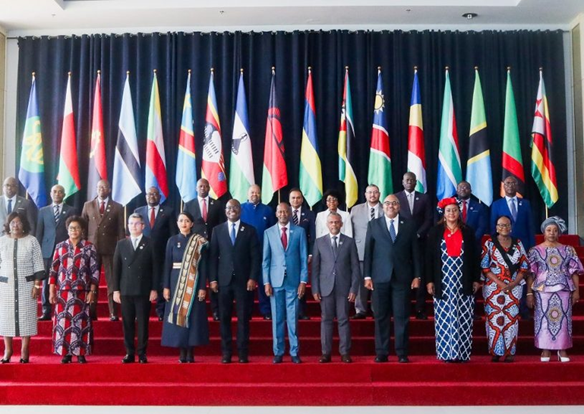
SADC delegates and dignitaries standing before national flags at the summit
Durban is hosting a series of Southern African Development Community (SADC) gatherings. These events are preparing the region for the 46th Summit of Heads of State and Government.
South Africa formally took over the chairmanship of the SADC Council of Ministers on 12 August 2026. The term runs until 12 August 2027. South Africa had served as interim chair since November 2025.
Lamola Outlines Regional Priorities
South Africa’s Minister of International Relations and Cooperation, Ronald Lamola, laid out a bold regional agenda. It focuses on peace, economic transformation, infrastructure development and human capital growth. Lamola made the address as he assumed the Council’s chairmanship. He stressed that regional peace and security remain fundamental to development.
Lamola named industrialisation as the major priority for South Africa’s tenure. This means accelerating agricultural transformation, beneficiating critical minerals, strengthening regional value chains and increasing intra-SADC trade. He noted that Southern Africa holds significant reserves of critical minerals, including cobalt and graphite. However, he urged the region to move beyond exporting raw materials. Local processing and manufacturing must create the value instead.
The Minister also flagged the need to expand and modernise regional infrastructure. This includes energy systems, transport corridors, ports, digital networks and water infrastructure. All of these are essential for boosting trade, industrial growth and job creation across the region.
On youth development and job creation, Lamola stressed a key statistic: nearly 60% of Africa’s population is under 25. SADC countries must invest in education, skills development and economic opportunities. Only then can the region harness this demographic advantage.
What the 46th Summit Will Address
The Summit agenda covers several key areas:
- The state of the SADC region, including global, continental and regional economic trends, plus updates on the region’s socio-economic and political performance. This aligns with the priorities of the SADC Regional Indicative Strategic Development Plan (RISDP) 2020-2030 and Vision 2050.
- Progress on decisions adopted at previous SADC Summits.
- Progress on implementing the 45th SADC Summit. Leaders adopted this under the theme “Advancing Industrialisation, Agricultural Transformation, and Energy Transition for a Resilient SADC” in Antananarivo, Madagascar, in August 2025.
- The operationalisation of the SADC Regional Development Fund. This fund aims to finance and support regional development projects and programmes.
- The state of regional food and nutrition security, plus disaster preparedness and response. This includes measures to strengthen the SADC Humanitarian and Emergency Operations Centre (SHOC).
- The impact of global geopolitical developments on the SADC region.
Can SADC Deliver on Its Agenda?
Southern Africa faces real challenges. Yet this hasn’t stopped its leaders, in both politics and business, from setting ambitious goals. South Africa could sit at the heart of regional trade and economic integration.
The open question: do South Africa and its SADC counterparts have the financial capacity to make this happen? Job creation, economic integration and free trade all hinge on infrastructure investment.
Leadership Under Scrutiny
The conduct of certain regional leaders raises doubts. In some SADC nations, authoritarianism has taken precedence over transparency and accountability. Zimbabwe under President Emmerson Mnangagwa is one example. Eswatini under King Mswati III is another.
Lamola may raise issues like education, skills development and economic opportunities. However, unless President Cyril Ramaphosa takes a tougher stance against authoritarian tendencies within SADC, the bloc’s image suffers. South Africa’s future is deeply intertwined with its neighbours. Their governance choices reflect on Pretoria by association.
The goals SADC has set are relevant to the region’s challenges. But the room tells its own story. Mnangagwa and Mswati sit alongside other leaders. Zambian President Hakainde Hichilema is one. Tanzania’s first female president, Samia Suluhu Hassan, is another. Botswana’s President Duma Boko and Namibia’s first female president, Netumbo Nandi-Ndaitwa, complete the picture. That mix makes the proposed agenda feel far from assured.
Building Stronger Institutions
SADC wants deeper integration with the African Union as a regional common market. Doing so needs strong institutions and leadership. It does not need strong leaders who cling to power indefinitely. Real leadership empowers citizens to vote for who they want in office. It lets national institutions flourish.
SADC initiatives such as the RISDP 2020-2030 and Vision 2050 speak of sovereign equality among member states. They speak of solidarity, peace and security. They aim to transform the region into a competitive, middle-to-high-income industrialised bloc.
This all sounds promising if civil society is empowered. Member states have made some progress in improving economic livelihoods. Regional institutions still need strengthening.
Industry, agriculture and energy have also seen infrastructure progress. How far this goes depends on SADC’s collective resilience. It also depends on how well the region educates citizens on economic and civic matters.
Financing sits at the heart of this progress. The SADC Regional Development Fund will need support. That support must come from the SADC Secretariat, the Parliamentary Forum, the Council of Ministers and SADC leadership more broadly.
Food security will remain a top priority. This means developing agriculture and combating disasters caused by climate change or environmental upheaval. The SADC Humanitarian and Emergency Operations Centre (SHOC) will play a critical role in saving lives.
Global shocks threaten the region. The war against Iran, escalating oil prices and US tariffs are all risks. Economic sustainability, if it takes centre stage, can help absorb them.
How the Summit unfolds will help determine South Africa’s role among its neighbours..