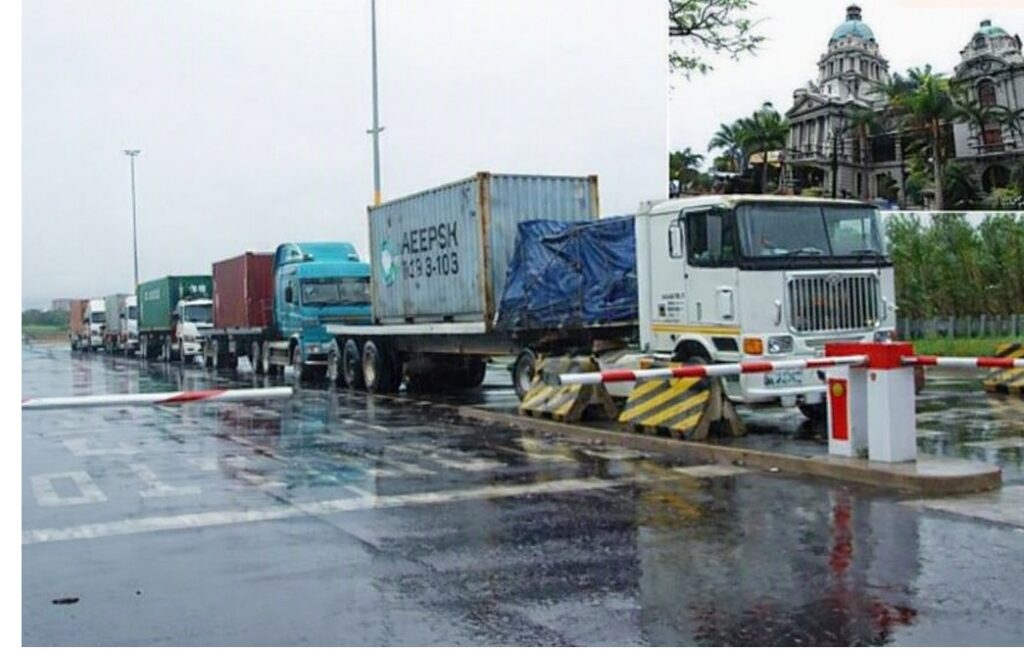
Durban’s Bluff area, which has long been experiencing traffic congestion could breathe a sigh of relief and even fresh air as eThekwini Municipality moved forward with introducing the Integrated Freight and Logistics Strategy (IFLS) to ease traffic congestion on its roads. Addressing a council meeting in July, Ward 66 Councillor Zoë Solomon said this strategy could ease truck congestion in the Bluff, Bayhead, and Durban South areas.
How the IFLS Was Developed:
The eThekwini Transport Authority (ETA) prepared the IFLS and its 2026 action plan, together with the key strategic programs proposed for implementation. The ETA updated the 2013 strategy to compliment the municipality’s Comprehensive integrated Transport Plan (CITP) by providing a coordinated strategic framework for a freight and logistics plan.
The IFLS review followed five key workstreams:
1. Assessment of the current freight and logistics environment, including status quo analysis and future freight demand forecasts.
2. Review and development of the IFLS framework to ensure alignment with current transport, economic and spatial planning priorities.
3. Review of the IFLS project priorities and development of an implementation plan to guide the phased delivery of strategic interventions.
4. Development of implementation mechanisms and project packaging to facilitate the rollout and funding of priority projects.
5. Comprehensive stakeholder engagement to ensure collaboration with key partners, including government entities, industry stakeholders, and freight operators, throughout the review process.
The five Key Workstreams:
City Hall is focused on relieving heavy traffic and congestion on the roads on the outskirts of the city, to improve passage on the roads and lessen the amount of air pollution caused by car, truck or other vehicle’s engines.
- The municipality plans to keep records on how much freight (cargo) trucks transport on the road as well as how much it costs to transport that freight and how much it will weigh in terms of its quantity.
- Among the major goals is to keep the IFLS aligned with current municipal policies, so there is no conflict of interest between local administration (eThekwini municipality) and to ensure trucks and other vehicles do not carry freight beyond the necessary capacity.
- The IFLS project’s main purpose in guiding and developing project priorities is to prevent freight truck accidents on the road, and therefore to prevent such risks as people dying or becoming injured, due to an accident.
- Another purpose of recording the amount of freight loaded on to a truck is to ensure the costs of packaging in the freight does not exceed the necessary requirements. In the world of today, developers have created new and other technology to track and record anything, including truck storage.
- The engagement between the municipality and local Freight companies is to build partnerships and cooperation to create an efficient infrastructure in terms of transport, trade, industry, and investment. Durban Metro remains a key port that tracks the amount of freight (merchandise) loaded onto a truck, so as to ensure that business investment grows to ensure industry grows as production is accelerated.
The Bluff has born the burden of Durban Port-related freight for decades, especially in regard to accidents. Councillor Solomon at City Hall went on to say; “We support a thriving port because it is vital to our economy. But economic growth should never come at the expense of safety, health and quality of life of the communities that live alongside it. Our residents should not continue paying the price for planning decisions made decades ago. This strategy gives us an opportunity to begin correcting that imbalance,” She (Solomon) said.
The purpose of discouraging traffic congestion is to prevent road accidents and ensure the safety of locals. Another issue to prevent traffic from slowing down on the roads, inconveniencing the movement of Bluff Residents’ vehicles. This will lead to better investment in the bluff.