South Africa’s Water Crisis: Why Taps Are Running Dry
Broken pipes, ageing infrastructure, water losses and struggling municipalities are leaving South African families without reliable access to water. As calls grow for the crisis to be declared a national disaster, residents are asking a simple question: how much longer must they live from bucket to bucket?
Before Bina Moodley can complete the most basic household tasks, she first needs to know whether water will come out of the tap.
Moodley lives in Pietermaritzburg’s northern suburbs, where residents say repeated outages have disrupted their lives for months. Elderly residents are being forced to carry buckets, while families rush to collect water whenever the supply briefly returns.
“It is not easy for us as elderly residents to carry around buckets of water,” Moodley told The Witness.
Residents of Bayat Road, Rupar Road and Sukhi Road say water can sometimes return for only an hour before the taps run dry again. The municipality has attributed some of the recent disruptions to burst pipes following increased pressure as the system was recharged after planned shutdowns and repairs.
That single hour can determine whether a household has enough water for drinking, cooking, washing and sanitation.
For Muslim families, interruptions can also complicate wudhu and the daily rhythm of prayer.
This is the human reality of South Africa’s water crisis. It is not only about infrastructure, budgets and government plans. It is about people structuring their lives around a tap that may or may not work.
South Africa is losing huge volumes of water
The South African Human Rights Commission has called for the country’s water crisis to be declared a national disaster.
The commission says the crisis is widespread and has identified ageing infrastructure, inadequate funding for maintenance, skills shortages, poor planning, weak coordination, vandalism and water losses among the factors contributing to failures in water services.
The figures are alarming.
Parliament has reported that South Africa’s national average level of non-revenue water stands at 47.3%. The figure means that almost half of water supplied by water services authorities generates no revenue. Non-revenue water includes physical losses from leaks, as well as authorised water that is not billed and commercial losses linked to issues such as illegal connections and weak billing systems.
That distinction matters.
It does not mean that 47.3% of South Africa’s water is literally pouring out of broken pipes. It means a significant share of water entering municipal systems is not generating revenue that can support the sustainability of those services.
And where revenue is lost, maintenance becomes harder.
Johannesburg shows the scale of the problem
Johannesburg provides one of the clearest examples of how infrastructure failure can affect millions of people.
Reuters reported in August that the city is losing approximately 655 million litres of water every day, with ageing and damaged infrastructure responsible for a significant portion of those losses. Johannesburg Water has acknowledged that parts of its network are more than 50 years old.
In Hillbrow, some residents have reportedly endured unreliable water supplies for years.
One 17-year-old resident, Thandani Masangu, was reported to have spent three hours pushing empty containers through the neighbourhood in search of water.
The statistic is staggering.
The human cost is even greater.
A water crisis is measured not only in millions of litres lost, but also in hours spent searching, containers carried and ordinary household routines disrupted.
Pietermaritzburg residents are living the crisis
Pietermaritzburg residents do not need Johannesburg’s numbers to understand the seriousness of the problem.
In March, a valve failure at the Seymour Reservoir forced the facility to be drained for repairs. The resulting outage affected the central business district and spread to areas including Greater Edendale, Imbali, Westgate, Bisley and parts of the northern suburbs.
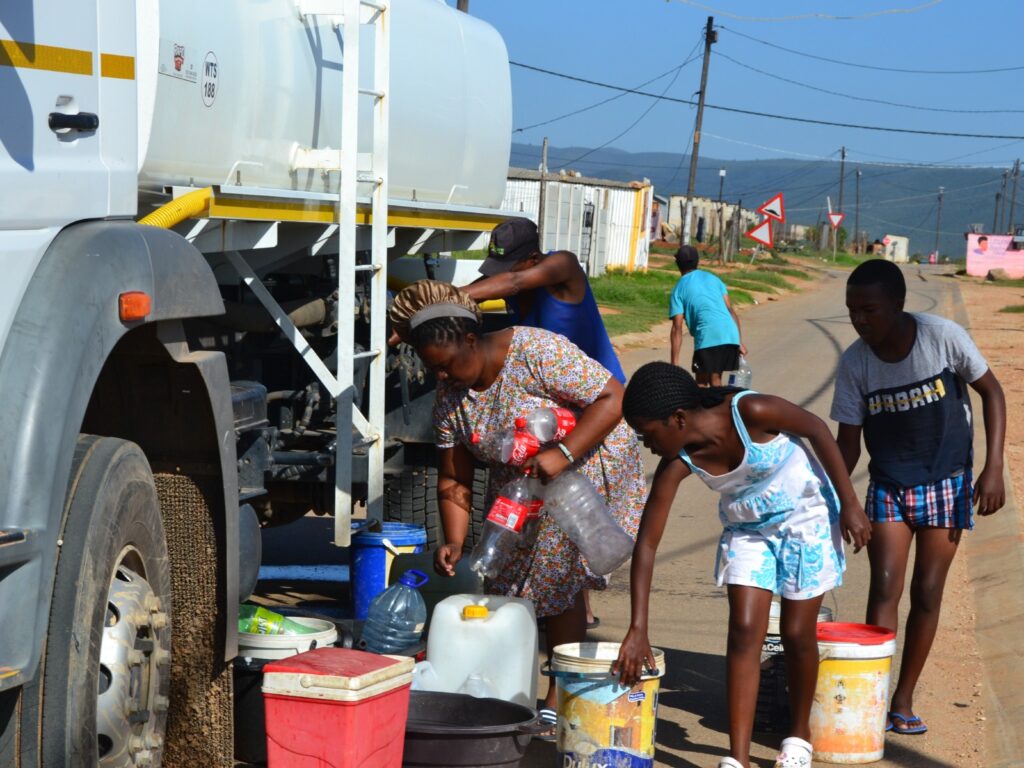
Msunduzi Municipality considered extending water tanker operating hours because the available vehicles could not meet demand. Councillors warned that tanker contracts required careful oversight to prevent abuse and corruption.
By May, Msunduzi was still dealing with continual water outages across several communities. The municipality said it had increased the number of hired tankers from six to 12 to supplement six internally operated tankers.
Tankers can provide emergency relief.
But they cannot become the permanent solution to failing infrastructure.
If communities need tankers every time a pipe breaks or a reservoir fails, the deeper question is whether enough is being done to prevent the next failure.
When emergency water becomes the new normal
Emergency water provision is necessary when households are left without a basic service.
But prolonged reliance on tankers creates another problem.
It can turn a temporary intervention into a permanent operating model.
Msunduzi councillors have already raised concerns about the potential for weak oversight of tanker contracts. The warnings do not mean every tanker contract is corrupt. They do, however, highlight the need for transparency when large amounts of public money are spent on emergency services.
The South African Human Rights Commission has made a similar point at national level.
While supporting urgent intervention, the commission has warned that any emergency response must include strong financial oversight to prevent corruption, malfeasance and misuse of public funds.
The sustainable answer remains infrastructure that works.
The wealthy can buy their way out
South Africa’s water crisis is also exposing a growing inequality.
Wealthier households can increasingly install boreholes, storage tanks, filtration systems and other backup infrastructure.
Reuters reported that one Johannesburg resident spent approximately R100,000 on a borehole, tanks and filtration after repeated municipal disruptions.
Poorer households do not have the same options.
They wait for tankers.
They collect water from neighbours.
They carry containers home.
They plan their days around the possibility that water might return.
South Africa has seen a similar pattern during electricity shortages. Households with sufficient resources could install solar systems, batteries and generators, while poorer families remained dependent on the public electricity network.
Water risks following the same trajectory.
A reliable public water supply should not become a privilege that households must purchase privately.
Would a national disaster declaration help?
The South African Human Rights Commission believes declaring the water crisis a national disaster could help mobilise emergency funding and improve coordination between different spheres of government.
The commission has argued that the scale of the crisis requires a broad and coordinated response. It has also stressed that emergency measures must be accompanied by strict financial oversight.
The question, however, is whether a disaster declaration would address the underlying causes.
South Africa’s water problems are not the result of a single broken pipe or one failing reservoir.
They are connected to infrastructure backlogs, maintenance, municipal finances, technical skills, governance and accountability.
The Department of Water and Sanitation estimates the municipal water and sanitation infrastructure backlog at around R400 billion for the municipalities covered by its assessment. Government has been directing approximately R24 billion a year through national grants towards municipal water and sanitation infrastructure.
The gap is enormous.
And every year that maintenance is delayed, the infrastructure becomes more expensive to repair.
Government has a plan. Now residents need results.
President Cyril Ramaphosa released the National Water Action Plan on 23 July 2026.
The plan sets out short-, medium- and long-term interventions aimed at addressing the root causes of South Africa’s water supply problems. These include increased infrastructure investment, private-sector participation, legal and regulatory reform, stronger action against corruption and criminality, and measures to protect water revenue for the maintenance of water infrastructure.
The plan also seeks to improve accountability and coordination between national, provincial and local government.
These interventions are necessary.
But South Africans have heard plans before.
The success of the National Water Action Plan will not ultimately be measured by the number of documents published, committees established or speeches delivered.
It will be measured in homes, schools, hospitals and businesses where water flows reliably.
Water is a right and an amanah
South Africa’s Constitution recognises access to sufficient water as a right.
The country’s water crisis therefore raises questions that go beyond infrastructure and municipal budgets. It raises questions about dignity, equality, accountability and stewardship.
Water is also an amanah, a trust.
It must be managed responsibly, protected from waste and corruption, and delivered fairly to the communities that depend upon it.
When elderly residents must carry buckets, teenagers spend hours searching for water and families wait for tankers, the crisis is no longer approaching.
It has arrived.
South Africa does not need another promise that the taps will eventually run.
It needs pipes repaired.
It needs skilled workers.
It needs competent municipal management.
It needs water budgets protected.
It needs transparent procurement.
And it needs consequences when those entrusted with essential infrastructure fail to do their jobs.
Until then, every dry tap tells the same story:
South Africa has water, but too many people are still being failed by the systems meant to deliver it.