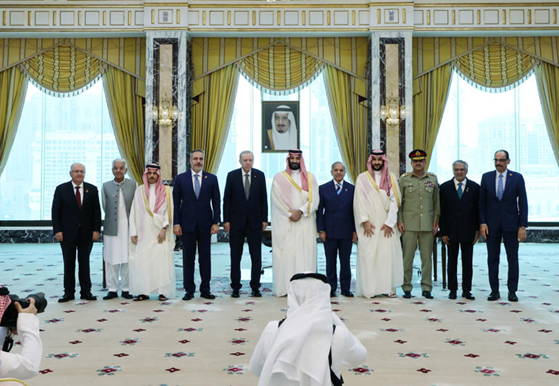
The leaders of Saudi Arabia, Türkiye and Pakistan met in the Islamic holy city of Mecca, in the Hejaz region of Saudi Arabia, to sign a joint defence pact on Monday, 7 August 2026. The signing came as tensions continue to escalate over the war waged by the United States and Israel against Iran.
The trilateral agreement, called the Mecca Joint Deterrence Agreement, was signed by Turkish President Recep Tayyip Erdogan, Saudi Crown Prince and Prime Minister Mohammed bin Salman, and Pakistani Prime Minister Shehbaz Sharif. The pact is intended to provide collective deterrence against acts of aggression, stipulating that an armed attack against any of the three nations would be regarded as an attack on all, the partners said jointly.
Egypt, under President Abdel Fatah El-Sisi, took part in the discussions but was not included as a signatory. Cairo’s participation as a formal member of the group was delayed.
A Pact Years in the Making
The defence agreement between Ankara, Riyadh and Islamabad has been in the making for some time. Negotiations began soon after the 7 October 2023 Hamas attack on Israel and the subsequent Israeli offensive in Gaza, described by some as a genocide, and gained pace amid the ongoing US and Israeli war on Iran.
While Türkiye and Pakistan have not been directly affected by tensions in the region so far, Saudi Arabia, which hosts US military assets and infrastructure, has come under attack from Iran and its allies, including the Houthis in Yemen. Tehran has also attacked other Gulf nations and Jordan, both of which host US military assets.
The three nations have been particularly concerned about the impact of Iran’s war and Israel’s growing influence, and attacks, on the region. Israel has occupied roughly one-fifth of Lebanon as it targets strongholds of the Lebanese armed group Hezbollah, which is backed by Iran. Meanwhile, Iran-backed groups in Iraq have been accused of carrying out drone attacks in Saudi Arabia, and have themselves come under fire from US and Israeli strikes.
Saudi Arabia Seeks New Security Arrangements
Saudi Arabia is under scrutiny over its close diplomatic and military ties to the United States. Crown Prince Mohammed bin Salman, known as MBS, has a close relationship with President Donald Trump and is now seeking a new security arrangement. The Mecca Joint Deterrence Agreement represents a first step toward that new arrangement.
Each of the three founding nations brings something distinct to the pact. Saudi Arabia carries significant financial influence as the world’s leading oil exporter. Türkiye holds the second-largest military force in NATO. Pakistan is the only Muslim-majority nation with nuclear weapons.
The Iranian attacks that followed the start of the US-led war have pushed the Kingdom to deepen strategic ties with regional powers that have a stake in Middle East security. Israel’s incursions into Lebanon and its offensive in Gaza, which some have characterised as a genocide, have underscored the country’s expansionist ambitions, and MBS and Erdogan are watching with wary eyes.
Pakistan, for its part, has a longstanding rivalry with India and does not want to risk a destabilising conflict on its western front with Iran. All three countries, Pakistan, Türkiye and Saudi Arabia, must balance their relationships with the US and Iran against their own domestic concerns.
Trump Weighs In
President Trump commented on the agreement in a post on his Truth Social platform on Sunday. He said he was “very happy” that Saudi Arabia, Türkiye and Pakistan had “recently, and finally” signed the agreement.
Trump also linked the pact to broader changes in regional security. “It shows how the Middle East is coming together, and how countries will finally be able to defend themselves in a more meaningful way,” he said.
A Shifting Regional Order
Washington’s political establishment is reportedly planning to withdraw troops and resources from the Middle East and other parts of West Asia. This could create an opportunity for regional powers such as Türkiye to help fill the resulting power vacuum. Other nations, including Iraq and Syria, could find themselves caught between Iran and the trilateral alliance, depending on how they balance their own security policies.
However, the war Trump started with Iran is continuing. Despite the president’s comments, it appears the United States does not intend to conclude its exit from the region just yet.
The defence arrangement may expand, depending on what decisions Riyadh, Ankara and Islamabad take in the future. Whether the alliance’s foundations prove sustainable will likely hinge on how far the Saudi regime succeeds in modernising its military.