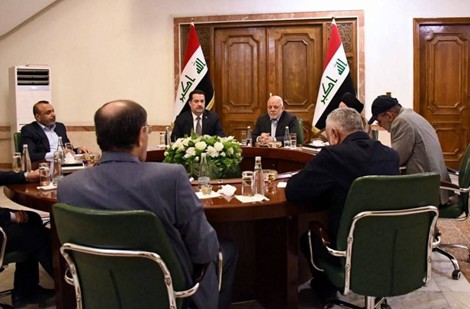

Iraqi News.com reported that leaders of Iraq’s governing Shia coalition, the Coordination Framework held a high-level meeting on Tuesday (July 15, 2025) to discuss the latest strategic power moves by the influential Muqtada al-Sadr, which has sparked anxieties of a potential new alliance between Al-Sadr and incumbent Prime Minister Mohammed Shia Al-Sudani that could recast the political setup ahead of the upcoming parliamentary elections.
The meeting, held at the office of former Prime Minister and Al-Nasr Coalition leader Haider al-Abadi, focused on the repercussions of Al-Sadr’s recent statements. An Informed source within the Framework alliance told a local news agency that the coalition is grappling with how to respond to this “new equation”. Despite maintaining his personal boycott of the November 11, 2025 elections and recently disavowing dozens of his own followers for running against his decision, Al-Sadr on Monday hinted at a new strategy. He signaled his readiness to support an “alternative bloc” that publicly commits to his comprehensive reform program. The key tenets of Al-Sadr’s program include ensuring Iraq’s independence, confining all weapons to the hands of the state, strengthening the army and police, dissolving militias, and formally organizing the Popular Mobilization Forces (PMF) within a new legal security framework.

According to the source, these reformist conditions, particularly regarding state control of arms and the PMF, conflict with the policies of several key parties within the Coordination Framework. More alarmingly for some, they align with the perceived leanings of their own prime minister.
The Iraqi Political system has an unusual informal arrangement since 2005. The largely ceremonial president has to be a Sunni Muslim Kurd, the executive Prime Minister has to be a Shia Muslim Arab and the Speaker of the Council of Representatives a Sunni Muslim Arab. The Iraqi political system is a parliamentary form of government where the political parties that can form a majority coalition determine who the prime minister and cabinet will be. If Al-Sadr a former hardliner turned pragmatist forms a new governing coalition with Al-Sudani and carries through his far-reaching reforms, Iraq and the Middle East in terms of the status quo could be re-defined forever. Baghdad under Al-Sadr could shift further into the Iranian sphere of influence becoming hostile to the US. Baghdad on the strengthening of its military and the integration of the PMF could forge closer ties with Washington rivals Moscow and Beijing.
The Framework Coordination is more interested in business as usual with a weak military and police force. They do not want to rein in the militias which are a law on to themselves. The cracks in the façade of the current political establishment’s practices are beginning to show. There was a drone strike on the same day as the Framework’s Baghdad meeting. The attack occurred on a US company owned oil field in Iraqi Kurdistan, the latest in a string of attacks targeting the region’s energy facilities. Operations at the oil field were suspended.

The Kurdistan Regional Government said the Sarsang oil field in Duhok province was hit, denouncing the strike “an act of terrorism against the Kurdistan Region’s vital economic infrastructure.” The attack followed similar drone strikes a day earlier on an airport hosting U.S. troops and on an oil field in neighboring Arbil province. HKN Energy, the U.S. firm operating the Sarsang site, said the blast occurred at about 7 a.m. at one of its production facilities. “Operations at the affected facility have been suspended until the site is secured,” it said in a statement. A fire broke out but caused no casualties. HKN said emergency teams later contained the blaze. In the past few weeks, Iraq — particularly the Kurdistan region — has seen a spate of unclaimed drone and rocket attacks.
Long plagued by conflict, Iraq frequently experiences such attacks, often linked to regional proxy struggles between Iran and the United States and its ally Israel.

These attacks in Iraqi Kurdistan comes on the heels of the Israeli air strikes in Iran. The fact that drones are targeting vital economic sites and even an air port hosting US troops shows that all is not well in northern Iraq. There are sinister militant forces at play that seek to undermine the stability and territorial integrity of Iraq as a whole. This is a major motive for Al-Sadr’s reforms as regard to security, so why do the political elite of Baghdad oppose his reforms? They seem to believe they benefit from Iraq’s instability. Not even the Americans are seemingly safe. However, Al Sadr may have a point as regards Iraq’s security issues. But it is the ordinary voter on the street who must determine the nation’s future.
With elections in November Iraq must now determine its own destiny at the ballot box. It is time for Iraq to reassert its own sovereignty in its national affairs and diplomatic relations. This means whoever takes the prime minister’s office in Baghdad, cannot allow regional and international powers to dictate their agendas to the people of Iraq. Business as usual cannot continue.
Article written by:
Yacoob Cassim
Journalist at Radio Al Ansaar