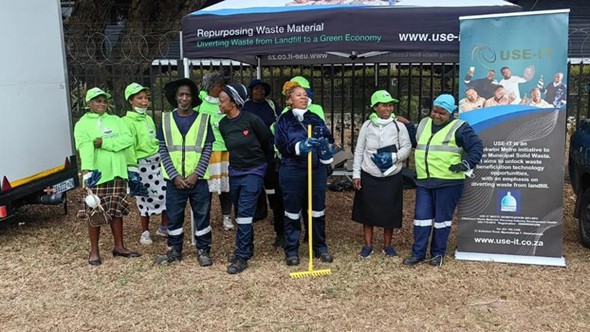

The eThekwini Waste Materials Recovery Industry Development Centre (USE-IT) programme has been allocated R750,000 in additional funding. The Economic Development and Planning Committee for the eThekwini Municipal Council stated in its report that USE-IT is one of the few initiatives within the eThekwini region that specifically supports the development and growth of the waste economic sector.
The committee stated that USE-IT has just finished a successful capacity building initiative where more than thirty people from Hammarsdale, Dassenhoek and KwaNdengezi were trained through a partnership with Human Sciences Research Council using recycled glass material to make a special type of interlocking block material. According to the committee, the additional request on the current partnership is in line with the stimulation and growth of priority sectors contributing towards the realisation of the plan 2 goal of the Integrated Development Plan (IDP), which is to develop the economic wealth of the Durban region for the material well-being of all its citizens.

One of the main purposes of USE-IT is to create jobs, which in turn generate income. In this case jobs where goods that can be valuable are sold by the producers for income. This is an example of wealth creation. It showcases the talent of local engineers in terms of manufacture. At least thirty people were trained in the means of self-employment and conserving the beauty of eThekwini region. More will join as the project/business initiative grows. Durban and various other metros as well as other municipalities across the country need projects such as these. These business initiatives create jobs, sustain livelihoods and grow local economies. They encourage investment and give hope.
Meanwhile the Durban International Conference Centre (ICC) played host for the 16th SITA Gov Tech Conference. Thousands of dignitaries, innovators and leaders in communication, technology and innovation were in attendance with the goal to forge a new path and solutions to new-age digital communications.

This year’s theme, “One Data, One Citizen, One Citizen Service Journey – Digital Transformation,” aims to place the spotlight on the importance of data-driven service delivery. The conference also spotlights homegrown talent, showcasing innovations from South African start-ups and youth-led tech initiatives, with opportunities for funding and collaboration with global tech companies. “Many countries in the developing world are struggling to address their national priorities due to problems such as the slow, uneven and discordant adoption of new technologies, which often leads to disjointed or weakened capacity for data collection, storage, processing and applications,” said Minister of Science, Technology and Innovation, Professor Blade Nzimande.
“As the Department of Science, Technology and Innovation, we are responsible for the implementation of our country’s Decadal Plan for Science, Technology and Innovation (for the period 2022 to 2032).”
He concluded, “There is no doubt that access to data is a key enabler for digital transformation and the digital economy, and it is therefore critical for us as government to ensure equitable access to data so as to foster digital and economic inclusion.”

eThekwini region and Durban Metro are among South Africa’s hubs for engineering, science, technology and business. Every year and on more than one occasion conferences such as this one is held to tackle the often-daunting issue of infrastructure. South Africa can be a pivotal centre of revolutionizing industries and digital innovation, if the private sector, civil society and the government are on the same page. Transparency and accountability in government and business ethical practices is the key. The sclerotic delays in adopting the new technologies of the Fourth Industrial Revolution (4IR) can be attributed to a lack of infrastructure support. Only providing electricity along a decentralized power grid like how the government in South Africa is doing now following the break up of Eskom and allowing the provinces to have autonomy over their own electricity can pave the way to digital access.
eThekwini is the gateway to KwaZulu-Natal and can be a local economic power house for creating jobs. It depends on having the right kind of leadership in both government and business as well as knowing how to delegate power to the right people could lead to serious economic growth. Skills training through education also has a central role. It all depends on how opportunities are used and by whom.
Article written by:
Yacoob Cassim
Journalist at Radio Al Ansaar